As a person who qualifies for senior discounts on public transit, I’m not entirely sanguine about titling a work that features “senior dance artists” (program note) Beautiful Decay. Choreographer Nicolo Fonte drew that title from another artwork, Mark Golebiowski’s photographs of flowers at various degrees of wilt, to the point of bloom-death. That qualm aside, I found it more than remarkable to watch Hellmut Fricke Gottschild and Brenda Dixon Gottschild, both enormously influential on my own life and dance,[i] hold the stage as centers of calm, strength, and wisdom amid the play and struggle of BalletX’s ten young virtuosi.
This work announces its attention to time: the “senior” and youthful dancers are on stage separately and together, the music is Antonio Vivaldi’s The Four Seasons, and the set design creates passages that stream the dancers across the field of action. In the first half of the two-act work, that passage is always from stage left to right. Time flows in one direction only, as the young dancers whirl, kick, roll, and fling themselves and one another across the stage, and the older artists walk or prance in stately dignity on that same trajectory.
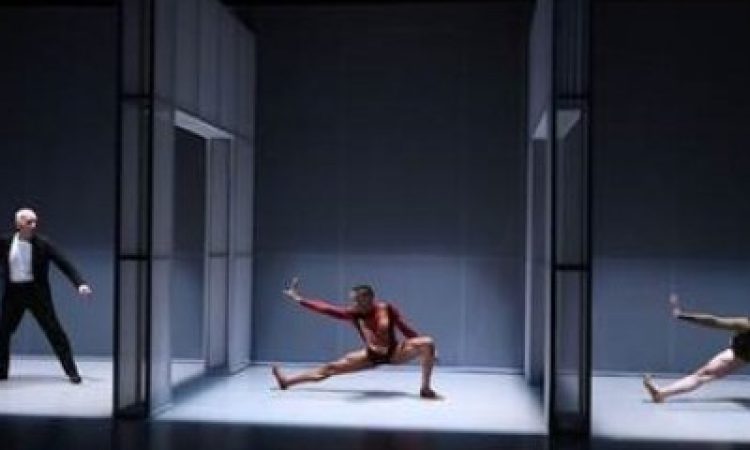
But there are also moments of breathtaking stillness, as in the quiet opening, with Brenda, dressed in flowing blue, upstage behind a scrim, stretching her arms wide and high, arching her chest upward, gazing piercingly through the space. Downstage center, Gary W. Jeter II, in gold, faces quietly toward her, then his complex, twitchy movements and active leg gestures create a pulsing counterpoint to her poise. They are separated not only by the scrim, which soon lifts, but also by the space’s neat division into four “rooms,” marked by white columns and lintels, white light pouring time’s passage into one, or two, or more of the areas as the dancing proceeds. (Set by Mimi Lien, lighting Drew Billiau, costumes Martha Chamberlain.)
Later, Hellmut, in black suit and white shirt, is in the stage left “room,” his quiet presence luring Zachary Kapeluck to join him, like a shadow absorbing and enlarging the bends, gestures, and reaches of the older dancer. The youngsters, in colorful costumes that expose their muscularity, are typically busy with one another, reveling in their physicality—legs zooming, lifts soaring, jumps splitting, falls and rebounds in every configuration. And then, in the midst of the play, an elder enters again—maybe downstage, maybe in the midst of a room—and the youngsters notice. May I touch? May I lean, may I learn, may I hold? All are gentle at such moments, tenderly so. And at times, that gentleness, that silence or stillness, infuses the younger dancers’ encounters, drawing them to awareness of their own moments of quiet.
Fonte acknowledges the Baroque music, with elements of arm circling, oppositions, and complex footwork alluding to the formal movement patterns that crossed the ballrooms and stages of Vivaldi’s time. BalletX’s crew show their fullest extensions, supple torsos, and multiple whirls in the phrases Fonte offers them. Still, whenever one of the Gottschilds enters the stage, my eye goes only to them. They breathe, they pause, they reach and embrace all space. At times, I feel that Brenda is directing the entire production from her core, creating a center of gravity that organizes the youthful frenzy into a just-manageable momentum.
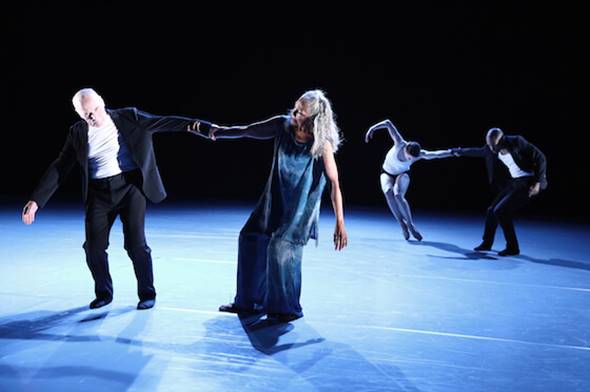
The second act, after intermission, opens up the space, widening and deepening the stage, and leaving only one “room” in place, at stage left. The music, too, opens up to the contemporary, with riffs on Four Seasons by Max Richter and Olafur Arnalds, although its quality decays, at times, to soupy sentimentality and techno thumping. The young dancers seem to mature over the course of the act, as they change to costumes of more somber colors, then strip down almost to underwear—black briefs and white tanks, revealing a version of vulnerability for them that I felt all along with the elders. The dancers young and old intermingle more, freeing their pathways and configurations beyond the inevitability of the first act’s horizontal passage. And then, face to face with one another, they settle into gentle paired hugs or hand-holding. The quiet ending, with blackout, is followed by a roaring ovation from the audience, some moved to tears by now. I too feel a deep sense of gratitude to all these dancers for their glow, their vulnerability, and their wisdom.
Beautiful Decay, BalletX, Wilma Theater, Nov. 29–Dec. 10, https://www.balletx.org/repertory/beautiful-decay/
[i] The Gottschilds were both my teachers during my graduate studies at Temple University. For this reason, I will refer to them here, as we did back in our school days, by first name. The “seniors” were danced on some nights of this BalletX run by Brigitta Herrmann and Manfred Fischbeck, the initial creators of these roles for the 2013 BalletX premiere of the work.