It’s the first snow of 2017, and Philadelphians trudge through it to get to the Iron Factory. Tonight, we are here to watch SHARE, a semi-annual multi-disciplinary performance featuring Philly-based and NY NJ visiting artists. I have just finished catching up with two of these artists, whom I haven’t seen in five years, chuckling that this snowy night of dance feels like an echo of our collegiate experiences. As the lights go down, the shadows of outside buildings blur behind gentle sparkles of falling snow. I feel cozy here.
The show opens with knees up. Ashley Yehoda and Lillian Joergensen walk in, wearing striped shirts and baggy black pants, and face upstage. First action: strip. They wear nude bras, boy briefs, and kneepads. Second action: turn. We see that their briefs are stuffed in the front. Bras and bulges: are they both? Or neither? Does it matter? Rolling, tossing, and swiping the air, they vigorously accumulate a phrase. I’m grateful for their kneepads and excited by their movements. Reaching into their briefs, they pull out the stuffing: white tank tops! The audience chuckles as they put them on. One dancer lays face up; the other is face down. Their heads connect at a single point, chin against forehead. From here, they lift their hips and scoot across the space, a strange and uncoordinated inchworm.
Next, Kate Seethaler and Stephanie Turner dance weather, an improvised duet. Seethaler rocks, balancing between one and two legs, and Turner shifts her torso forward and back. One appears grounded, the other airy. They engage in the soft focus that often comes with kinesthetic listening and improvisation. Occasionally, their qualities are infectious, and they catch each other’s shapes, each other’s energies. Mostly, they stay independent: a juxtaposition of bodies.
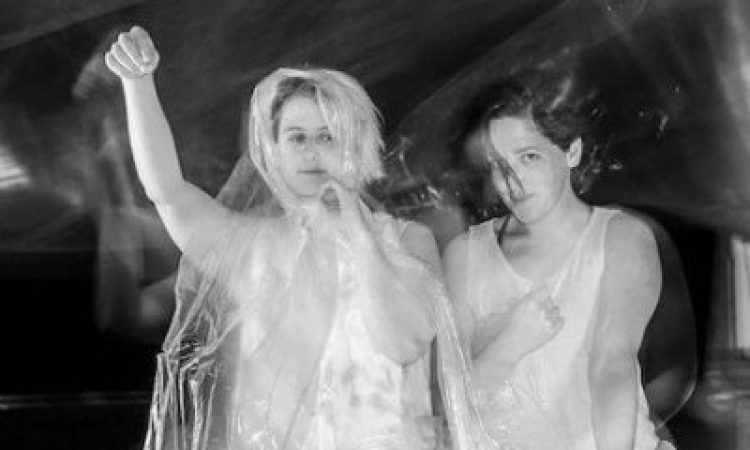
Darcy Lyons, choreographer of Heaviness/Lightness, investigates momentum, body weight, and bubbles. Performed by Sean Thomas Boyt and Andy Thierauf, Lyons’ choreography sits over this duo’s relationship like an Instagram filter: they’re themselves, but a slightly different color. A light-up Newton’s Cradle flashes as Thierauf and Boyt take turns setting the balls in motion. Later, another Newton’s Cradle sets the rhythm for Thierauf’s percussive interjections. Boyt explores muscled control, clunky plops, and swinging momentum as he drops his weight towards the floor. It is heaviness. In another moment, Thierauf lays atop Boyt like a pancake stack. They chuckle in this moment. So do I. A machine starts spinning bubbles into the space. They roll over on their backs, heads together, resting on each other’s chests, the residue of the laughter still in the air. It is lightness; it is play.
Chris Davis’s interactive theater work Juan-Winfield Escutia-Scott, or the Mexican American War, a Butcher’s Play shifts the thus-far cozy snowy energy into an engaging action-packed history lesson. Davis, wearing a captain’s hat, shouts at the audience members to hold objects, a basketball he claims is a cannonball, flashlights, a radio, and binoculars: “Watch my back.” He gives me a picnic cooler and says, “Don’t open that. EVER.” As he guides us through an “attack” on Mexico City, bouncing the basketball from person to person, he is “Winfield Scott,” waving an American Flag. Once at the middle of the space, he describes the castle where this attack took place. He becomes “Juan Escutia,” the little boy that sacrificed himself for the cause, jumping from this castle, wrapped in a Mexican flag, crying “Viva Mexico.” How are we, engaged audience members, implicated in this history? I did what he said. I didn’t open the cooler.
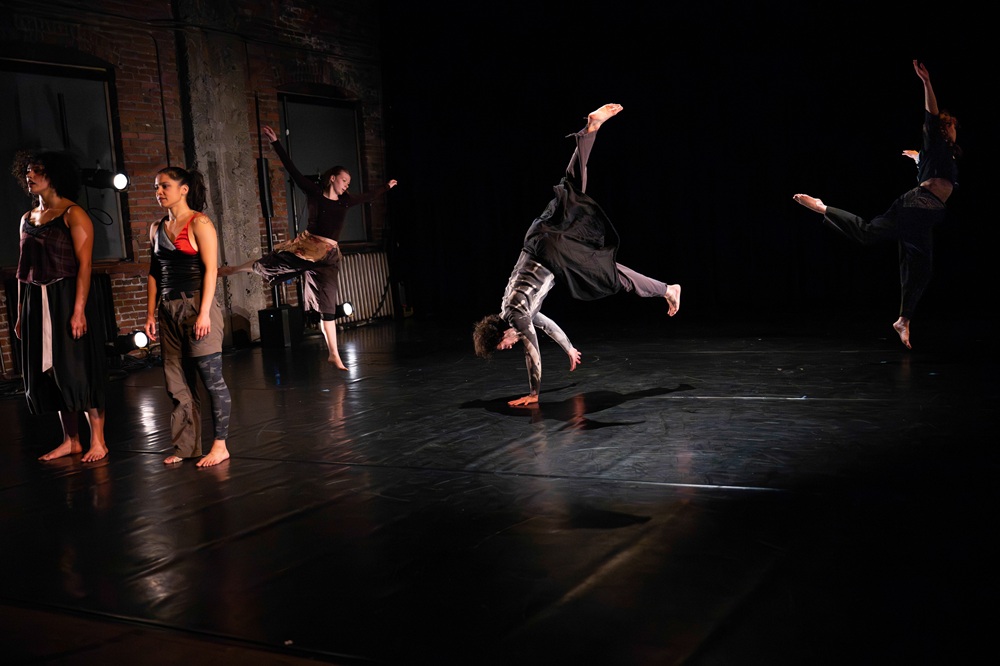
Allie Linn and Julee Mahon spiral softly through The In-Between. As they reach, wipe, and press their arms, I think about surfaces. Their reaches generate the vertical plane; their swiping hands generate the horizontal. They bend forward, hands straight and parallel, and I imagine they’re holding small boxes. Their unison movements create these planes and disrupt them as they move in-between.
Wearing sequined white blouses uncomfortably tucked into tan tights, Molly Ross and Nola Sporn Smith step side, together, and hop. In It’s better from behind, they repeat this sequence. Their feet slap, swish, and thump, establishing a rhythmic triple-meter, only changing their facings, their loose gestures precisely directed. After singing a breathy rendition of “Mama Mia,” they are now on all fours. In one startling pulse of effort, they jump from this position and land on their hands and knees with a massive thump. I feel the reverberation settle in my body, nervous that they’ll do that again. And they do. Soon, they lean their backs against each other, wrapped neck-to-neck, heads spilling towards the other’s chest. It’s a necessary moment of comfort.
I want to snuggle there. It seems cozy.
SHARE, Ashley Yehoda and Lillian Joergensen, Kate Seethaler and Stephanie Turner, Darcy Lyons, Chris Davis, Allie Linn, Molly Ross and Nola Sporn Smith, The Iron Factory, December 9