After a long fourteen years, Mark Morris returns to Philadelphia at the Annenberg Center with four robust and captivating dances from the early and mid 90’s set to the live music of the classic modern 20th C. American composers, Lou Harrison, Henry Cowell, and George Gershwin. Morris’ idiosyncratic vocabulary, compositional vitality, and embodied musicality brought an enthusiastic response from a house that included many local artists and museum curators.
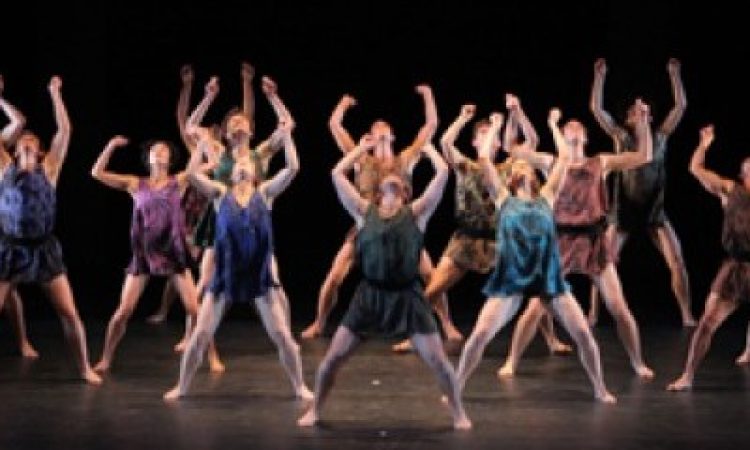
Pacific (1995) arrives like a westerly wind from the northwest birthplaces of both Morris (Seattle) and Harrison (Portland), at times breezy and light, at other times turbulent and stormy. The animated high leaps and spins of the dancers—bare chested men in diaphanous long blue skirts and women in white long skirts with green hues (costumes Martin Pakledinaz)—seem to emanate from unseen energies of sky and sea. Their bodies and flowing costumes are like visual currents of air and water. When Harrison’s music, Trio for violin, cello and piano, gains in speed and conflict, the dancers replace their large sweeping movements with sharp, forward thrusts of the upper torso, and ritual-like gestures of arms bent at elbows, forearms curving up to the sky. Their skyward gazes and outstretched arms complete the homage to a remembered space and time.
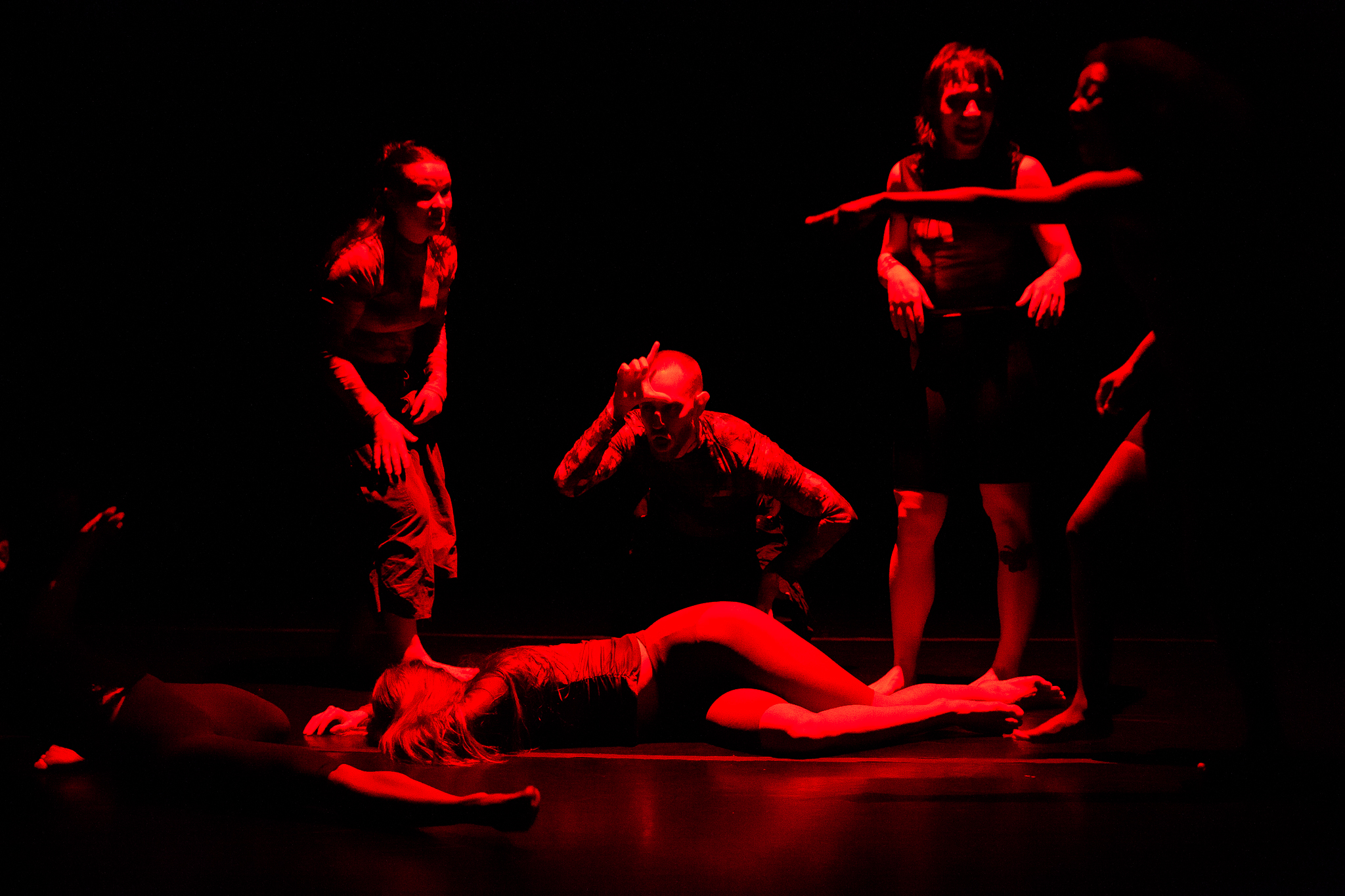
Mosaic and United (1993), set to two of Cowell’s stirring string quartets, is a rich and mysterious smorgasbord of the choreographer’s movement and gesture, encompassing an “everything Mark Morris dance.” The dancers’ freeze actions alternate with fluttering limbs as they stand or lie supine on the floor. Sprinkled throughout the work is a signature gesture: hands clasping the neck with elbows pointed forward. Dancers extend their arms straight out with vertical palms—are they stopping, pushing, surrendering, or supplicating? A crazy quilt of tantalizing snippets pays homage to sailor hornpipes, Russian folk dance, high step Scottish jigs, and goose stepping, reflecting Morris’ endless transcultural curiosity and whimsy—all set to Cowell’s music that evokes Bartok and at times embraces the atonal.
Three Preludes (1992) is accompanied by Gershwin’s rhapsodic, bluesy solo piano work of the same name. This Morris work is a valentine to the jazz spiked American icons who sang or danced on Broadway stages or Hollywood screens.* In a gender shift, the sterling and winsome Laurel Lynch performs the solo, originally created for Mikhail Baryshnikov, and also danced by Morris himself. She wears the same Isaac Mizrahi costume the guys had worn: black V-neck top over white T-shirt; black, belted pants accessorized with showbiz panache—white gloves and shoes with spats. Lynch gracefully swings into the rhythms, casually but with precision. She flashes Al Jolson flourishes of extended hands, palms spread, and mimes a cartoon character deflating into limpness. As Lynch vamps with hand on hip, I wonder whether there was a different impact when Mikail and Mark wore that look.
The great work of the evening is the closing, Grand Duo (1993), where fourteen dancers propel through four sections in ecstatic and frenzied movement barely harnessed to the cascading sounds of Harrison’s Grand Duo for Violin and Piano. The dancers begin with their bodies rooted to the ground in second position, one hand slowly extending overhead to pierce a ray of Michael Chybowsi’s otherwise unseen horizontal lighting, mysterious and unfathomable. In the “Stampede” section the galloping leaps and jumps that criss-cross the stage seem to transform the dancers into Centaurs. Softer, quieter dance passages follow in tune to Harrison’s music where pointed fingers lead strange outstretched arms crossing into X’s, and elsewhere point upwards to a sky, either nurturing or foreboding. The concluding polka section has the charm of an ecstatic folk dance and horror of a Rite of Spring ritual: legs kicking violently, fists pummeling the space, hands percussively slapping thighs. With cyclonic momentum the dancers run, circling, then suddenly form two rushing concentric circles, and shortly resolve back to one.
This exhilarating ride with Morris begs for more returns to Philadelphia. My appreciation goes to the new executive and artistic director at the Annenberg, Christopher A. Gruits, for ending Morris’ exile from the city. As fine as was the program of two company performances, the four curated films, and a Philadelphia Dance for PD (Parkinson’s Disease) Symposium, I question the focus and content of this inaugural artist-in-residence program. I would have preferred one where Morris also engages with local artists and has some relation to the creation of new work.
*Morris, as Annenberg’s artist-in-residence, has chosen four Hollywood musical films from the 30s to 50s that Annenberg is screening in February.
Mark Morris Dance Group and MMDG Music Ensemble, presented by the Annenberg Center for the Performing Arts, Feb. 9 & 10. Remaining films in the accompanying American Musical Film Series are Love Me Tonight (1932), Feb. 17, 7pm; The 5,000 Fingers of Dr. T (1953), Feb. 21, 7pm; and Hallelujah, I’m a Bum (1933), Feb. 28, 7pm. www.AnnenbergCenter.org .