NextMove Dance audiences gave Les Ballets Jazz de Montreal (BJM) standing ovations last weekend at the Prince Theater. The show included three works: Casualties of Memory and O Balcao de Amor, both choreographed by Itzik Galili, and Dance Me, co-choreographed by Andonin Foniadakis, Annabelle Lopez Ochoa, and Ihsan Rustem. Together, they featured virtuosic movement, some comedy, and mostly abstracted relationships represented in a haze of sinewy slicing, slithering, and sliding.
Galili’s first piece is Casualties of Memory, which premiered in Boston earlier this month. The program boasts that the opening image “explodes traditional societal notions of Western patriarchy” and that, “a blend of ethnic and contemporary dance movement, full of curvilinear and visceral power, emphasizes gender equality.” Wow. That’s a lot of buzzwords.
In this opening, a column of light along center stage highlights only the backs of a male and female dancer so their faces are in shadow. Spaced evenly on the floor to either side of the column are ten circular, dim lights that point toward the audience. In the shadows, the rest of the dancers are seated behind these lights; as the duet progresses, they pick up the bulbs and shine them underneath their faces. In the column, the female stands in front of the male, often supported in a balance where she dips and crosses one leg over the other. They move slowly down the column, occasionally switching places, but rarely switching roles. The absence of front lighting makes it so that much of the articulation in this opening duet is lost. I can’t see its detail, but it’s certainly not “exploding” anything, and I get the sense that it actually replicates and reinforces “Western patriarchy’s” aesthetic patterns.
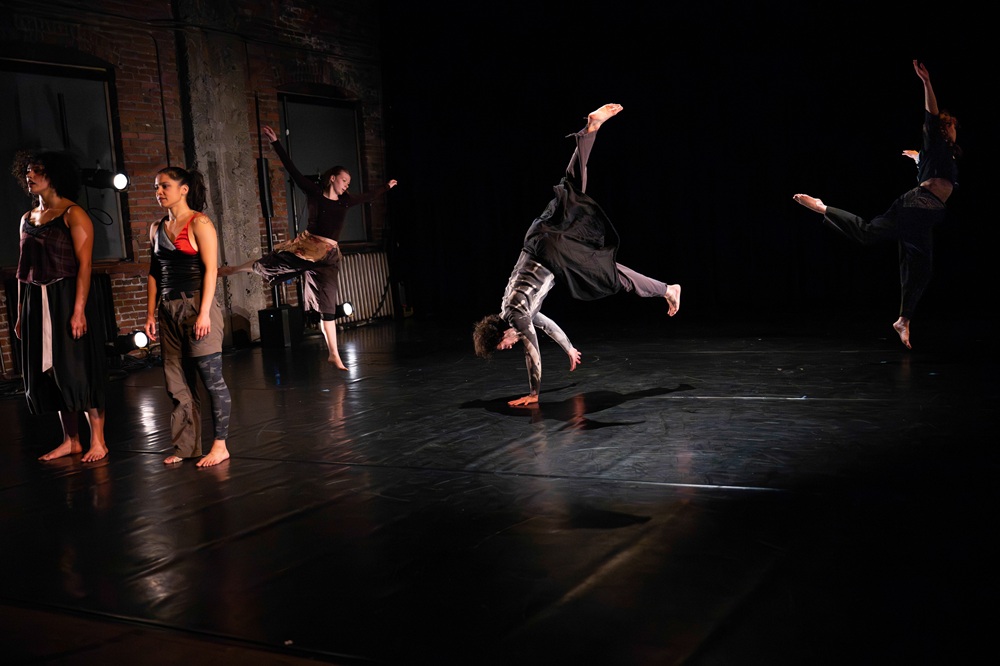
The next section’s rhythmic score contrasts sharply with the opening’s airy music. I can see Galili’s origins with Batsheva in the dancers’ uniform costumes, flesh-colored tanks and underwear. Overhead, the beams on which the lights are hung descend toward the back of the stage, so each lighting change is visible to the audience. As the choreography moves from solo to duet to solo again, the lights also change, flashing pools of light from corner to middle to back. There are so many lighting cues in this work that I imagine the technician flipping cue sheets like a conductor with a musical score. It’s interesting to think of this technician being as agile as these dancers, but occasionally the lights lag, and again I’m distracted by the loss of detail.
As for Galili’s quest for gender equality in this piece, I will say one thing: he does manage to create partnered duets equally and easily performed by same-sex and mixed-sex couples. They wrap around each other, shoot out parallel legs and arms, perform supported cartwheels over a foot, a leg, or a torso. I also see the men and the women performing the same movement material: piercing pointed legs, crotch shots, shimmying shoulders, and reaching arms that slice across the body. Their muscles seem slippery—I can almost see them slip over their bones.
However, Galili does generate “gendered” movement. In a male-male duet, the smaller man interrupts the abstracted movement by sticking his butt out and stuttering quickly on his tiptoes. The larger man stops and stares, tilting his head to look. Someone behind me utters a chuckle. Even in neutral clothing, movement retains its gendered undertones.
The airy music returns, and, in a pool of light, a man slips flawlessly in and out of the floor. The rest of the stage is dark, but I can see the remainder of the cast tiptoeing into the space, holding between their thighs what I think are the original, circular, now un-lit, bulbs. In this moment, I think of genitals—no matter what their sex, all of their genitals are covered with this circular prop. I’m waiting for these bulbs to turn on and “shine a light” on gender equality. Then, the percussive music returns, and—plot twist—this circular “bulb” is actually a drum! The dancers beat in unison onto its surface, appropriately held in place by their inner thighs. This quick reversal—from commentary on equality to a functional instrument that supports unison and rhythm—is potent for me, a strong stopping point.
But it doesn’t end. The rhythmic score continues; they dance the same movements and repeat images; the technician flips pages and pages; and now, I no longer care whether or not it’s gendered. I’m just bored.
Les Ballets Jazz de Montreal, NextMove Dance, Prince Theater, Feb 15-18, 2018