How often do just two dancers fully capture the attention of a theater for fifty-five minutes? How often does a dance pointedly, humorously, and concisely approach topics of interracial relationships, nationality, and language? Honji Wang and Sébastien Ramirez’s Monchichi does just this, taking the audience on an intimate, dynamic journey that unravels the complicated realities of loving and living in the gray spaces where identities clash and coalesce.
Music pulses a synthesized heartbeat that courses through the theater. The lights slowly reveal the silhouette of a tree and a lone female figure seated center stage, her back to the audience. The beat triggers small physical shifts: Wang ripples her fingers, undulates her spine. This soft opening quickly becomes a series of fluid, animalistic gestures punctuated with syncopated flicks and twitches ricocheting through her body.
Ramirez sits in the shadows waiting, then rises to pace, taps at the scrim, and plucks at the tree, conjuring a sense of anticipation with each movement. The duo assess one another, circle and pass, touch and retreat. Unexpectedly Ramirez pounces toward Wang, lands on her neck as she hinges backwards, and they begin their aggressive yet graceful mating dance.
The mood of the dance shifts as the music fades and the lights brighten. Ramirez exits and flings a pair of silver high heels to Wang. She plays with the shoes, toying with them before placing them on her feet. Struggling to stand, she teeters, trips, turns her toes inward, but her stumbles gradually become a source of exploration. Weight falling into her hands, Wang’s legs swivel, twist, and loft off the ground.
One effective tool Wang and Ramirez employ is to foreground elements of performance that the audience knows happen but rarely see: quick changes, personal conversations between performers, and alterations to hair and makeup. Bantering in a combination of German, English, French, Spanish, and Korean while changing their clothing, they tell one another’s stories and interrupt each other with corrections, creating a sense of vulnerability and comfort between themselves and the audience.
German by nationality but ethnically Korean, Wang addresses the frustrations of identity as she spits a series of stereotypical words and sounds associated with Asian identity including “ni hao, chopstick, chop suey.” She ends the monologue by cutting herself off screaming “I am not Chinese!” The moment is both humorous and biting, a quality the dancers keep recreating as they reveal more details of their respective pasts.
These conversational scenes lead to more contemplative and nuanced phrase work. Ramirez performs an entire solo of fidgeting gestures that tumble into bursts of hip-hop, pausing in a single arm balance, headstand, or other precarious position. I relish the quiet moment which follows when the two briefly lay still facing upstage, just listening to the ground.
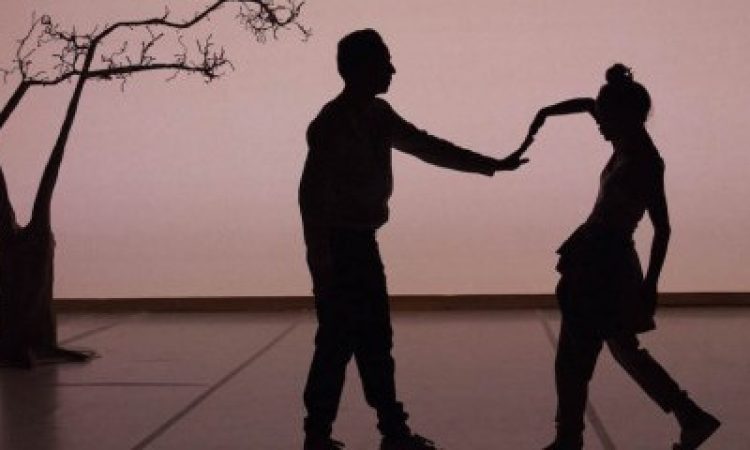
As the dance comes to a close, the lights fade and the dancers become moving silhouettes. In contrast to the beginning of the piece when Wang sat alone, the two now share center stage facing one another. With fingers touching, their arms create endless waves, like a current of electricity, drawing their bodies closer until, connected, they stand still, embracing.
Read Julius Ferraro’s interview with Wang and Ramirez here.
Monchichi, Company Wang Ramirez, Prince Theater, Mar. 15-18, http://princetheater.org/events/company-wang-ramirez.