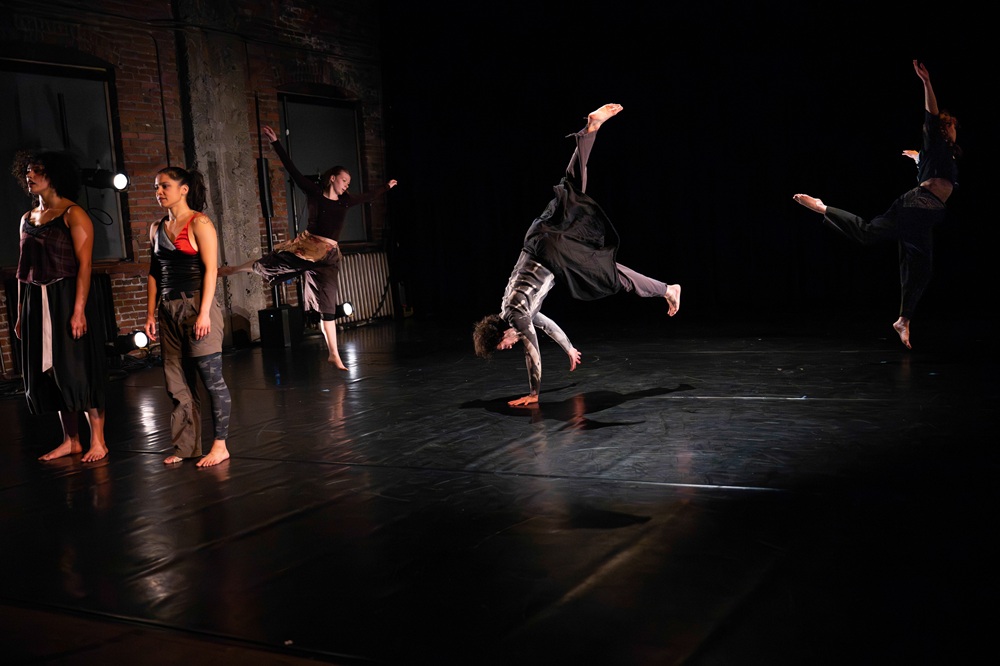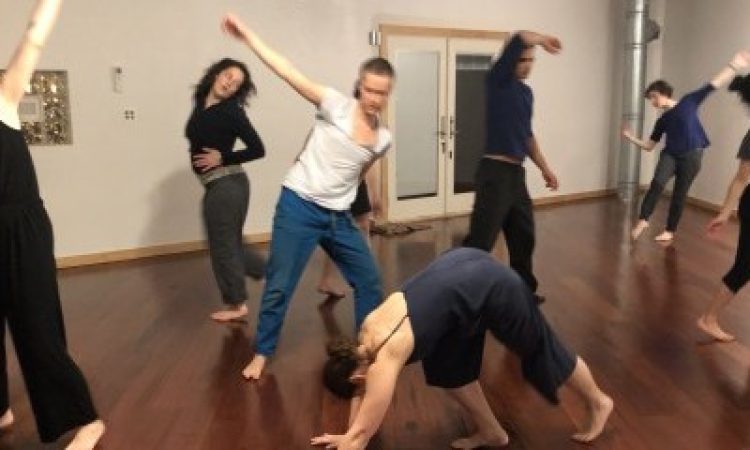
Shake. Vibrate. Gyrate. En masse, fourteen dancers rattle in a scattered formation as a droning synth drops a slow, even pulse. The program states that Nicole Bindler’s* Blood, Sea is an “improvised ensemble dance drawing inspiration from our evolution from ocean to land, our ontogenetic journey from the amniotic sea of womb to adulthood, and polarities within our lives and bodies.” She also discloses to me, in a phone conversation prior to the show, that the piece begins with set material before diving into full improvisation. As the work opens with this colossal quivering—and it is colossal in both space and time—the connections between content and movement arise quickly.
The comma in the title carries a lot of weight; I will not witness a sea of blood (nor its dark connotations), but rather blood and sea as independent but intertwining entities. Although both words conjure fluidity, in this opening I am struck by the jerky quality of the dancers’ movements. In Bindler’s world, the aqueous is not tethered to the aesthetic qualities of smooth, slow, continuous, or sequential. The shaking is ceaseless, which allows my musings to multiply, especially around the embryonic, evolutionary, and blood-based language Bindler’s program has equipped me with. Are they cells? Molecules? Pre-evolutionary life forms limping from the ocean, gasping for air? Each face is locked in an intensely personal focus, which on some reads as strain or grief. These facial expressions might suggest an emotional underbelly within, but as a whole, the display feels subhuman. Over time, the bounces and jerks move some of the dancers—I want to call them “units”—through the space, vaguely clumping them. Is it order forming? Or is this pattern borne by disorder?
The lobby lights turn off, followed by the house lights. Who knew they were even on? Breath and sweat rise to the surface of my awareness—the pulsation continues. The night’s live music is composed by Julius Masri, who tends to stick to the downstage corner and cause soundscapes to flow from electronic instruments I am unfamiliar with. In this particular moment, he plays a lone note that surfaces and creates ripples. The sound moves closer to silence, the bodies closer to a straight line.
And then stillness. Stillness. Stillness.
After eons of vibration, my eyes rest on the simple line of dancers as it gently folds and unfolds. It resembles Trisha Brown’s Scallops, but in this context, I think of the replicating chromosome. They sway together, like kelp undulating in the light. The motor behind their movement is serene. Gradually, one mover separates; another pulls away. The previous order disassembles, and images float to the surface. Some dancers investigate minute movements with their shoulders. One walks ahead with her left arm outstretched, her right hand firmly placed over her eyes. Other dancers join her dignified march.
I can tell now that we are in the throes of complete, large-scale improvisation.
And so, the stakes shift. The chronological order of events is no longer as important as my noticing motifs as they appear and disappear into the physical landscape. I hear one dancer, Janna Meiring, release a note, and with her, voice is introduced; it resonates into flesh as dancers sing into their partners’ chests, hands, shoulders. The space becomes sparse as performers choose to drift to the sides of the stage and watch. It is a performed jam, not yet known but closely watched. As a dancer erupts into laughter; this world enters the social realm and invites new notions of excess, cacophony, and joy. A gaggle of dancers, now human, approach a bottle of wine and deck of cards, which have been hiding in the upstage corner all along. They settle into the familiar theatrical scenario of drinking wine and playing cards. The strange organisms have evolved into people after all. Elsewhere onstage, there are solos and contact improvisation duets with their usual juicy flow and weighted flings. The slow march, with one arm over the eyes and one outstretched, reappears. Strong columns of red and blue light separate the stage into two visual halves. Blood? Sea?
To knowingly watch an open improvisation in a performance setting asks a lot of an audience; it gives you the hard task of making meaning where someone has not previously assured you that there is any. Throughout the improvisation, I find my interest slowly receding, my mind overwhelmed by the unfinished thoughts which arise, compositionally, from the open structure. Occasionally I resist detachment by plunging my focus into one of the individual dancers, all of whom are compelling, as they carve out their space within the world: sounding, solo-ing, rolling, resting. The negotiation between fourteen bodies with their own agendas and entryways into the material is both beautiful and easy to flow away from.
*Nicole Bindler is a writer for thINKingDANCE.net.
Blood, Sea, The Performance Garage, Nicole Bindler, May 5, http://www.performancegarage.org/nicolebindler-bloodsea