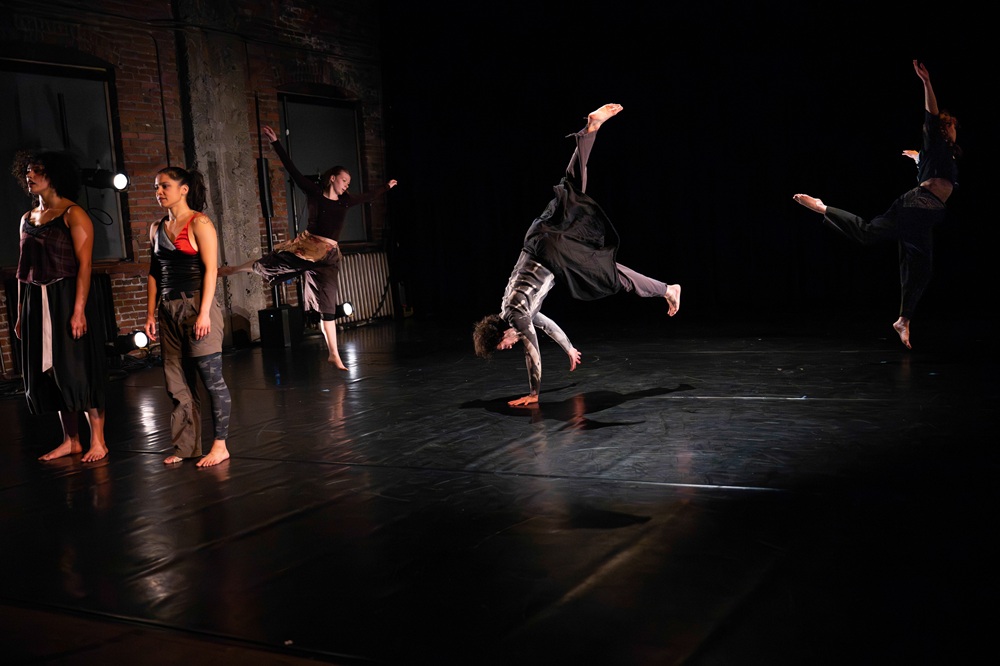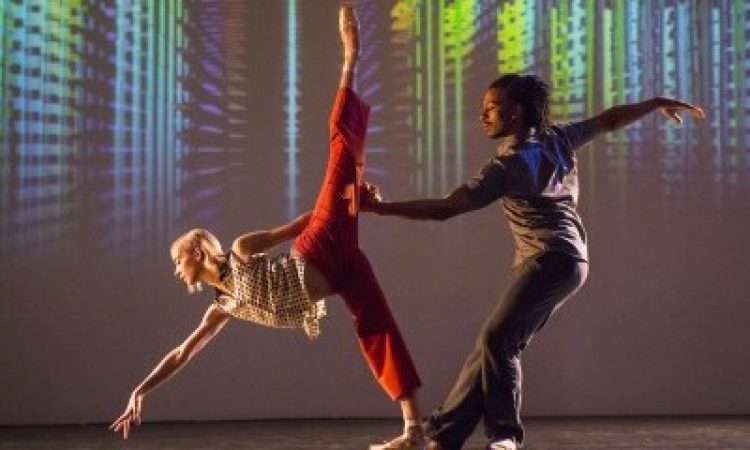
A small square area for me in my chair. A grid for the dancers, moving past each other unseeing. A second grid of sharp diagonal lines projected on the stage. In this tightly-coiled machine, the “anti-story,” “post-human ballet,” of Nora Gibson’s HUMAN I yearned for something to break.
Gibson’s modular choreography takes simple ballet movements—chaîné turns, passés, and jetés—and meticulously combines and re-combines them using post-modern techniques, creating a complex visual rhythm. In HUMAN, however, this rhythm never changes; the dance, visuals, and Mikronesia’s ambient electronic score shift at the same constant rates. In this wash of movement, moments of performance stood out: Sean Thomas Boyt’s airiness, Brian Cordova’s steadiness (the axes of his turns so clear to the eye), and Marria Cosentino-Chapin’s unique urgency. The dancers carry out solos, trios, and partnered duets with impeccable timing given the lack of musical cues.
I was drawn to watch Cosentino-Chapin, the lines of her arabesques fully extended but quick to change, each quarter turn motivated by something unspoken but present. I delighted in seeing her affected by the movement, while the other dancers remained impassive and looked past one other, even when partnering. They looked past the audience, stuck in their grid even when the choreography brought them into the space between audience and stage, inches away from us. I was left wondering whether the “otherness” the piece was investigating was my own; I felt so outside of it all.
Earlier in the week, at an open rehearsal, I was intrigued but overwhelmed by the material. I looked forward to seeing whether the technical elements—including video projections designed by Gibson—would bring out the themes of AI and otherness (according to the online PR) that felt buried. The video prelude was the most successful; clusters of computer-generated bubbles floating in dark space, reminding me of cells dividing. From then, the projections played like a series of screensavers for Windows 95: jerky transitions and neon rainbows. These designs seemed incongruous with the subdued street clothes of the dancers and often visually clashed with the stage lighting. Or anti-lighting? Early on, Cosentino-Chapin dutifully danced a solo almost entirely in darkness while two bright spots inexplicably illuminated empty stage space. No lighting designer was named in the program.
Moments washed by quickly, leaving me no time to be affected by them. A trio of dancers lying long on the ground, arms slowly port-de-bras-ing in unison struck me as the most sci-fi image of the piece, as if these bodies were positioned atop exam tables, replicating human movement. I pieced together that dancer Hallie Lahm might have been the “AI being” alluded to: the opening tableaux of Lahm lying on the floor while the others clustered around her and a scene of her putting on clothes while the others watched. However, Lahm was not set apart in any way from the others, either by movement vocabulary, physical proximity, or performance quality. Gibson’s intention to create an “anti-story” left me in an uncanny valley between narrative and abstraction, uneasy and unsure whether to look for narrative or see pure movement.
I thought of the company’s mission statement, which poses the question “What is ballet in the 21st century?” There are many aspects of ballet that could be examined today: its whiteness, heterosexuality and gender dynamics, class implications, etc. HUMAN glances past gender dynamics in its costumes and choreography. Boyt wears a dress in the piece, but the women are the ones in pointe shoes and the big duet is still Cordova’s for lifting and Lahm’s to be lifted.
Gibson takes this question about 21st century ballet back to form. In HUMAN, she rhetorically answers that contemporary ballet uses traditional vocabulary through post-modern choreographic practices, taking the focus off of super-human virtuosity and back to movement, shape, and space. While I appreciated this perspective, I left feeling that the answer HUMAN provided was just too opaque.
HUMAN, Nora Gibson Contemporary Ballet, Performance Garage, April 20-22, http://www.performancegarage.org/dancevisions-noragibson