The history of most women is hidden either by silence,
or by flourishes and ornaments that amount to silence.
– Virginia Woolf (quoted in the program)
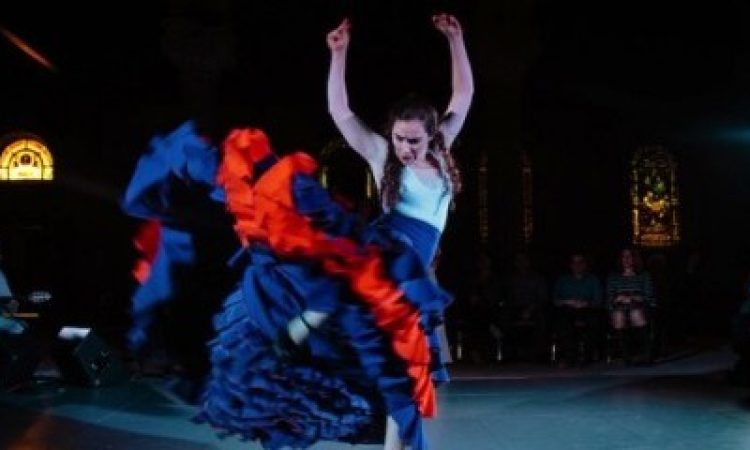
Pasión y Arte’s My Voice, Our Voice|Mi Voz, Nuestra Voz highlights the “flourishes and ornaments” of women but prioritizes their subjectivity and the volume of their voices. Combining vignettes of traditional flamenco, original music performed by live musicians, and an experimental fusion of postmodern dance and flamenco, the evening weaves together a variety of ways that women speak their own stories.
The audience sits in chairs lined up around a square portable dance floor laid out in the center of the Philadelphia Episcopal Cathedral. Sarah Candela and Jeanne d’Arc Casas enter the space, wearing traditional flamenco heels, black shirts, and floral skirts (costumes designed by Patricia Dominguez). Candela sits on a chair, d’Arc Casas stands behind her. They stamp their feet and clap their hands (palmas) occasionally snapping their fingers (pitos) above their heads. Without the typical accompaniment of the guitar (toque) and song (canta) their rhythm reverberates sharply through the church’s archways. Choreographer Elba Hevia y Vaca starts the evening with a firm focus on women, onstage, alone. The silences between their footfalls hold tension and meaning: their strength is in their volume.
Live musicians perform an original flamenco composition by Andreas Arnold, featuring percussive rhythms from the cajón and a surprising addition of cello. I feel nostalgia as I listen to the hopeful music resonate in the cathedral. The musicians go quiet and a single dancer, Candela, enters alone. She unfurls her fingers, claps her hands, plants rhythms into the floor, and begins to sing. Without a microphone, her voice is overpowered by her feet. It’s as if she is still becoming, not yet mature, innocent. The quietness of her voice is only heightened when singer Barbara Martinez, whose voice is hooked up to a microphone, enters the space. Martinez’s voice is rich and deep; she is the embodiment of wisdom and maturity.
Hevia y Vaca and Annie Wilson each wear a fringed embroidered shawl (mantón) over their heads as they tiptoe barefoot into the space. No music accompanies them in this moment, and it feels as though flamenco has left the room. They seem like wandering ghosts. Sparse improvised music plays in response to the movements of the mantón: Wilson lifts the fabric and shakes it, and the drum rolls in response.
With the performers’ faces hidden, the shawl becomes the dancer; the performers, wearing all black, seem to have no identity. I question this reversal of female agency. The women who perform the traditional flamenco are clearly the subjects of their own story; the fabric they wear is an extension of them. In this section, the fabric dances the women, and they become mere objects as the mantón becomes the storyteller. This is evident as Wilson wraps both mantónes around one hand, creating a strange sock puppet. The hand creature pokes towards each musician and the instrument responds in kind. The audience receives this moment warmly, but to me it feels out of place. If the goal is to give voice to this silent “ornament,” then it succeeds. However, I don’t see this as empowering to the women underneath the fabric. It makes me uneasy.
Flamenco has always moved me in ways I haven’t experienced watching other dance forms. Perhaps it is the song, the intricate rhythms, the tense spiraling of the dancers’ bodies, the deep expression of struggle and release. The women of flamenco perform emotion and depth; their power radiates from their centers and pierces audiences who respond with “olé” and “eso.” As Hevia y Vaca mixes flamenco with postmodern dance, I miss the duende; I miss the strength of the feminine voice that is so present in the traditional sections. While I understand her use of postmodern dance to give the traditional costumes a new kind of narrative, the movement itself “amounts to silence” when placed next to power and angst of flamenco.
At the end of the show, the whole cast sings and claps in a circle as each takes turns improvising at the circle’s center. When it’s Wilson’s turn, still barefoot, she rolls to the ground, slices her arms, and spirals up, improvising fluidly without percussive gestures. Her dance is quiet and breaks the mold, but her style is equally welcome. This moment feels honest and cohesive, contrasting flamenco while maintaining its boundaries a way that makes me feel grounded as an audience member. I want to dance in that circle.
My Voice, Our Voice | Mi Voz, Nuestra Voz, Pasión y Arte, Intercultural Journeys, Philadelphia Episcopal Cathedral, May 18-19 http://www.interculturaljourneys.org/pasionyarte/