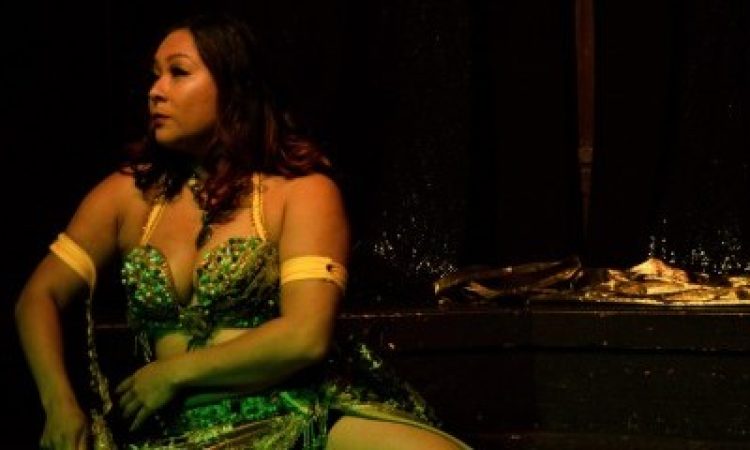
We began with the ground rules to burlesque, starting with ‘don’t touch the performers.’ You may have guessed, this was not your run-of-the-mill dance show. This was a sporting event where, in the midst of the experience, it was crucial to cheer and throw dollar bills when you appreciated a gesticulation or removal of clothing. The evening was composed of short routines the length of one pop song. Styles flipped between burlesque, belly dance, and drag, each less about perfection than about showcasing the charisma of performers outside the straight, white male frame.
“Bitch!”
“You better work.”
“Scandalous hoes!”
These were all empowering phrases shouted at the performers. The MC for the night, the charming and quite tall (or is that the heels?), Icon Ebony Fierce even lightheartedly informed us that if a performer falls on stage we should throw dollar bills at them. “That medical bill is gonna hurt.” This was perhaps a cheap laugh, yet properly placed me in the playfulness of the evening.
These performers were here to entertain and at times mock, yet they occasionally reached deeper, radical moments transcending this familiar frame of “mere entertainment.” Many bits included stripteases to entice the audience to throw their bills at the stage. The movement vocabulary was often straightforward, aligning the performers’ sensuality with the orchestration of the song they chose. A tempting smile coinciding with the drop of a heavy beat and a hip shake matching a climactic music burst—these were instances that ignited the audience. Dalyla Mizani Baker, with her hair whipping vigorously to the beat of Missy Elliot’s “I’m Better,” was remarkable, her athleticism flaunting both sharpness and wildness was full of glee. Even our host celebrated it afterward: “That wig isn’t going anywhere.”
There were also moments beyond my comprehension. A song that ended in a repetition of “Poopity scoop” appeared to be more an inside joke than inclusive. Is this meant for me? Is it enough that this moment is something the performer is visibly proud of and excited about? Being a witness is valuable. So much of being a solo artist is studying one’s self and unraveling that on the stage. I acknowledge that a performative striptease is no easy task. I would be utterly afraid to complete one myself. It’s in the ownership and sincere embodiment offered from the performers: coyly taking off a glove, dropping a pair of pants, or completing an evocative belly roll—acts that are in themselves compelling feats. So maybe it isn’t meant for me, and that’s okay. The audience was particularly enlivened by the naughty seductions in which articles of clothing were removed and then followed by drop splits (which several performers completed)!
Empowerment of the human body, with a multiplicity of genders and racial identities represented, was at the heart of Jaeda’s Dance Card. A select number were drag reversals: including the creative performance by Ms. Red, a female bodied performer transforming from masculine suit to pasties with Panic! At the Disco’s “Death of A Bachelor” filling in the narrative for her striptease. The highlight of the night came from our MC herself, Icon Ebony Fierce performing a fiery lipsync, which included a fine editing of Jesse Williams’ BET Award acceptance speech. Fierce’s performance drew in those who were listening, bringing the audience’s attention to the words. The speech (and this dance) honored activists, teachers, and black women, among others, calling out systemic racism. Hearing this recording, originally made in June 2016, now stirred lots of feelings for me in relation to our current political moment: “Damn, things are still shitty”; but also, “I’m with you.” It was in moments like this when the meaningful undertones of the evening came out. We, the audience, were the sounding board and Jaeda’s Dance Card allowed the performers to shout their feelings to us. And we were called to push beyond the entertainment value of the evening, to truly echo the sentiment.
It’s distinctive to have space to openly experiment with one’s self and being/staying woke. I feel privileged to live in a progressive city like Philadelphia, with access to this multitude of experimental artists exploring their bodies, and to participate in this radical space/community.
Jaeda’s Dance Card, Jaeda, Tabu Lounge and Sports Bar, July 10.