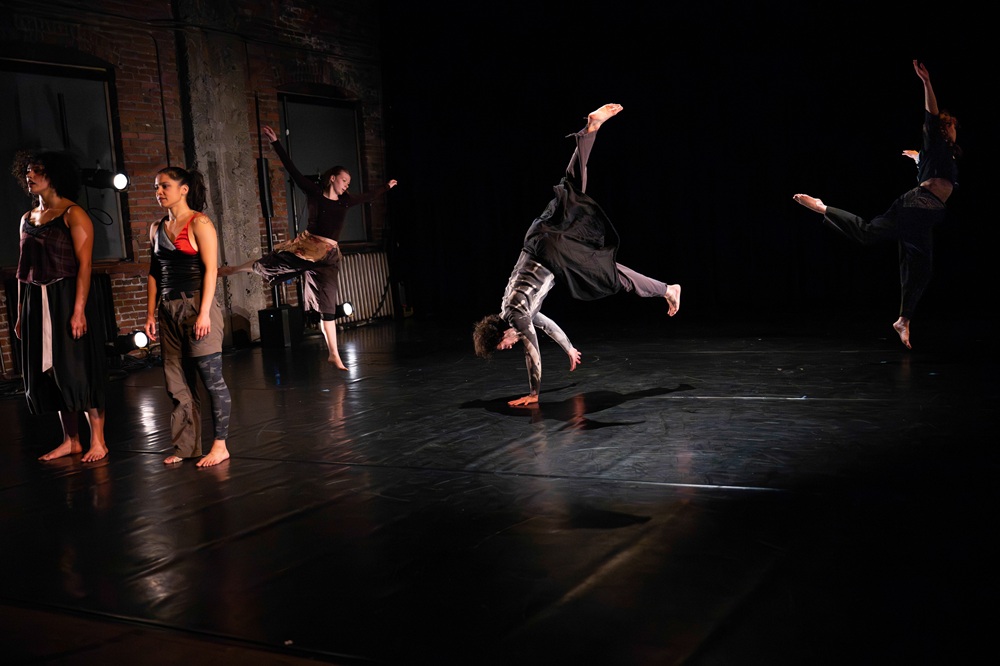
We were set and costumed in an unmistakable reference to the 1950s with “doo-wop” inspired tunes composed and played live by Rosie Langabeer, Tara Middleton, and Gregg Mervine. Together, these multi-instrumentalists scored a then and now, pleasantly guiding multiple narratives with a skipping vinyl record or cricket sounds producing a residue and glue to the stories. Choreographer Penny Sanders carefully created multiple narratives at once with a team of ten dancers. This seemed novel after seeing multiple static pictures, frozen dancers behind the dancers in focus, in the first two pieces. This was Rock-A-Bye, the last of the three short world premieres in the BalletX Summer Series. Thankfully this dance had some guiding threads because the two sets before it were vague and disjointed.
Cricket chirp,
Cricket chirp.
The first piece, helmed by choreographer Andrew McNicol, relied too heavily on the emotion of Mozart’s powerful Requiem (once transformative for its time), rather than provoking a questioning for itself. It was a jumble of dance sequences where only in each segment’s end did a basic narrative begin. One duet emphasized pretty weight sharing rather than any oppositional conflict. However, it rendered itself a fight when it finished with one dancer broken on the floor as the other triumphed away. Luckily nothing lasted too long.
The needle skips over a vinyl record.
The record skips again.
The musicians watch this repetition continue.
The record skips.
The record skips.
A dancer meanders on and picks up the needle.
The second piece was erratic, leaving me unable to concentrate on the dancers’ technical precision. The eight dancers’ primary partner in Situated was a chair. Choreographer Matthew Neenan created a motley party, reminiscent of a drama club summer camp. I was distracted by the cartoonish caricatures of children, which led to mimed drinking, smoking, and a laughable moment of playing spin the bottle. They seemed to be forming a set of compatriots as they occasionally spoke in various foreign languages. However, they were difficult to hear and I was sitting in the second row! Are we not supposed to be able to hear them? Are they actually speaking gibberish? This community of voices seemed less viable than the care that was taken in forming lines, circles, and piles of chairs. But why should I care about a chair? Are the chairs supposed to represent something? I was seeking a link, but Situated did not locate me in the journey of the dancers or chairs.
Cricket chirp,
Cricket chirp,
Cricket chirp.
So let’s go back to the doo-wops. In Rock-A-Bye, duets and trios, heterosexual and same-sex, intimately shared themes of motherhood, friendship, and loss. Caili Quan gracefully danced the role of Fate. She balanced the labor of voyeur to the world of the dancers and catalyst within the assembled relationships. In trios, she initiated connection, guiding pairs into intimate meetings. As relations heightened, she intercepted them, pounding on a dancer’s chest initiating a birth or a divide.
In one pairing, Chloe Perkes, divided from her partner, found solace at a vintage kitchen table. Perkes pushed her palm into the table as if to ask it a question. She shifted to pressing her whole forearm seeking direction. Fate did not answer. A handful of common objects were used as theatrics to direct audience attention. A dancer spread-eagle is dragged across the stage via a shag rug; Fate angles a floor lamp and clicks it on, directing light. These object dances were well executed, but did not feel as profound as others I have seen: Headlong Dance Theater’s More or Susan Rethorst’s 208 East Broadway. In Rock-A-Bye, the objects primarily became tools with which the dancers realigned themselves rather than dance partners. In particular, standing on the rug was where meetings or endings occurred. These encounters shared unions and hope, but were often thwarted by Fate. And in the final coda where one couple was briefly reunited, they curiously landed on the rug, meeting Fate. What if we face fate? They left this question floating in ambiguity. This ambiguity was enticing even with the other rickety pieces.
“Rock-a-bye.
Rock-a-bye.”
Requiem, Situated, and Rock-A-Bye: BalletX Summer Series, BalletX, Wilma Theater, July 11 – 22, balletx.org.