For the last several summers, the magical music festival in Mt. Gretna has embraced a dance show each season. This year’s offering was New York-based Ballet Hispánico, “the nation’s premier Latino dance organization,” according to a program note. While the tree-covered gingerbread town of Mt. Gretna, nestled in the hills of central Pennsylvania, might seem far from Ballet Hispánico’s sources, the rapport between the Gretna Playhouse stage and the festival audience was instantaneous and enthusiastic. Why?
For one thing, these dancers are fantastic. They can do anything, and they do a lot of it in the course of the show—multiple spins, suspended leaps, head-high leg extensions, splits and acrobatics of all kinds. But the dancers’ generous address, reaching and looking toward one another and to the audience, was more winning than tricks or skills. They seemed genuinely to care about each other, and to love us—and we loved them right back, following their every move with eager attention and awarding their feats with mid-dance applause.
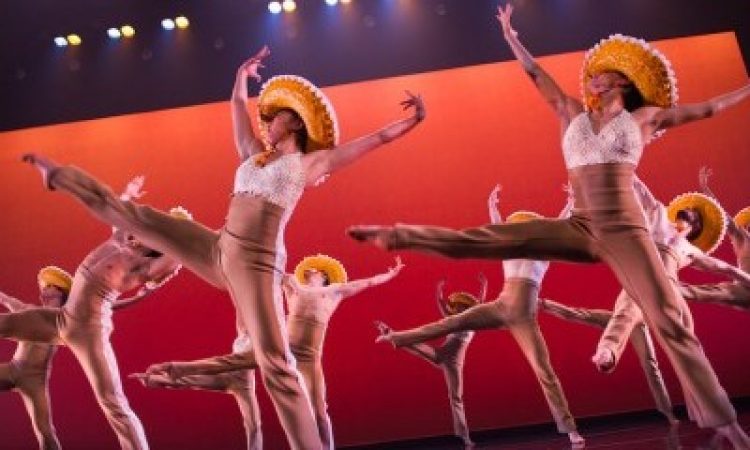
Each of the three dances presented on the program featured a different flavor of Latino dance. In the opening work, Con Brazos Abiertos, choreographer Michelle Manzanales grapples with her Mexican-American childhood. Featuring symbols of Mexicanness—wide, colorful sombreros; long, swirling white skirts; and lots of lace trimming—the company dancers create a community of movement. Lead dancer Dandara Veiga’s powerful portrayal of isolation and struggle, her stillness bursting into angry pummeling in the midst of the group, said it all, but Manzanales didn’t quite trust the choreography. She, perhaps with artistic collaborator Ray Doñes, created a “soundscape” with contributions (according to the program) by nine different artists, along with voice-overs telling us how to feel. In fact, the staging and dramatic portrayals said it all and the manipulative sound environment said too much.
Annabelle Lopez Ochoa, with Belgian and Columbian roots, choreographed Línea Recta to a rich guitar score by Eric Vaarzon Morel. Exploring “the conspicuous absence of physical contact between dancers” in flamenco, Lopez Ochoa here essentializes some elements of the iconic southern Spanish form—ruffled dresses, proud contrapposto stances, splayed fingers, and writhing wrists—while eliminating (entirely, or almost) others. The shoes that help communicate flamenco’s rhythms make no appearance here as the dancers perform barefoot throughout, so the complexity of the form’s footwork loses its raison d’etre and is little used in the work. The dancers’ acrobatic skills lead to complex lifts, carries, and weight-bearing, which introduce the physical contact that the choreographer sought to explore, but also carry us far from flamenco’s sources and power. The almost-but-not-quite touching between performers of traditional flamenco, in its paseos and approaches that flow into tantalizing retreats, creates a hot and escalating communication among the performers that we lose in the acrobatic displays of this work. Perhaps more choreographic acknowledgment of elements like the footwork and the forbidden territory of touch, before breaking away from them, would have helped the audience to follow Lopez Ochoa’s exploration. Nonetheless, the stunning red costumes and the powerful lighting by Michael Mazzola, along with the dancers’ jaw-dropping performances, made the dance well worth watching.
The program closed with Artistic Director Eduardo Vilaro’s Danzón, drawing on the formality of Haitian-Cuban contradance and moving to the celebration of a people in joyous motion. The Latin-inspired jazz of Paquito D’Rivera and Dizzy Gillespie’s classic “A Night in Tunisia,” arranged by M. Summer and D. Balakrishnan, helped to float this work right into our hearts, inspiring the roaring ovation that closed the Ballet Hispánico show. Smiles of shared appreciation lit up performers and audience.
Just one note: given that Mt. Gretna’s audience is musically astute and used to listening closely, the volumes at which the music (all recorded) played were ear-splitting. I noted several spectators stuffing plugs or tissues into their ears. Spare us these sound levels in future, please, and trust our willingness not only to hear, but to listen.
Ballet Hispánico, Gretna Music, August 11.