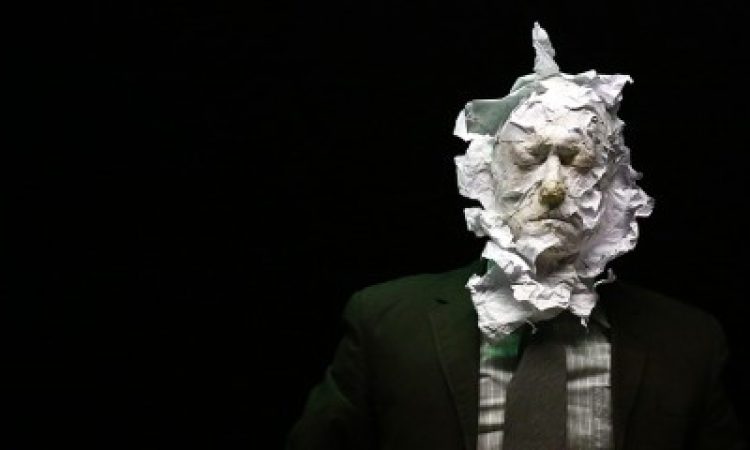
Sitting in the audience for “The Accountant,” we are greeted with a recognizable image: the unremarkable office desk under a fluorescent light, with stacks of white paper awaiting the scrutiny of some poor schmuck. We know the drill: this is going to be a play about the dehumanizing nature of white collar work, and the evils that boredom wreaks on a person’s consciousness. We’re reminded of various iterations of this “office horror” genre (Terry Gilliam’s Brazil comes to mind), and thus, we settle in for an hour of existential dread.
However, in the hands of Trey Lyford and company, the monotonous world of the office is not solely a place of Kafkaesque toil, but also of magic, and poetry, and discovery. Through the eyes of our protagonist, we are led into a dreamscape of an office, perhaps the type of dream that a seasoned business-person might have after decades of work. In this dream, paper becomes the primordial clay from which memories erupt, sometimes unwelcome, sometimes with excitement. Paper is paper, and also a banana, or an orange, or a massive snowstorm. Like a good dream, it is nonsensical, but also perfectly reasonable.
The magic of this show is subtle, making it all the more savored: we watch in awe as a lowly desk lamp takes on a life of its own, bowing its head in empathy for our woeful hero (thanks to master work by designer, Eric Novak.) We hang on to every word spoken by a disembodied employee on the phone, as he describes his own world in luscious detail: “…green of grape, red of apple…” And we crave those colorful fruits along with the protagonist, trapped in an island of greys and putrid greens. With indispensable live music by composer Cole Kaman-Green, haunting lighting by Robin Stamey, and a gloriously understated performance by Mr. Lyford, the landscape of the show is mesmerizing.
I do hold one complaint with “The Accountant,” and that is its length. The show loses momentum once we start to see old tricks repeated. The joyful discovery from earlier in the performance is lost as we begin to recognize patterns. The show could be served by some key editing.
But, despite its lengthiness, “The Accountant” stands as a show worth its salt. I would have never guessed that a piece this magical could be set in one of the grimmest places on Earth.
The Accountant, Trey Lyford, Christ Church Neighborhood House, September 6-9