In a quest to reach new audiences for performing arts in Philadelphia, Theatre Philadelphia and thINKingDANCE are joining forces and exploring how dance writing and discourse can provide new perspectives on theatre. Beginning May 2018, tD writers have been lending their varied backgrounds, interests, and approaches to criticism to professional works of theatre in Philadelphia. Let us know what you think in the comments!
A suit. A tank top. A windbreaker. Shorts. The costumes (designed by LeVonne Lindsay) gently define four distinctive, black men. These men (Isa, Grif, Daz, and Tiny) athletically run, roll, slide, and balance themselves on a steep ramp, which amplifies their precarious world. An awe-inducing, all white quarter-pipe deck intimidatingly angles away from the audience. Within this architectural feat is a small, dated printer sporadically spitting out a single line of text as the audience shuffles in. This is limbo and Kill Move Paradise.
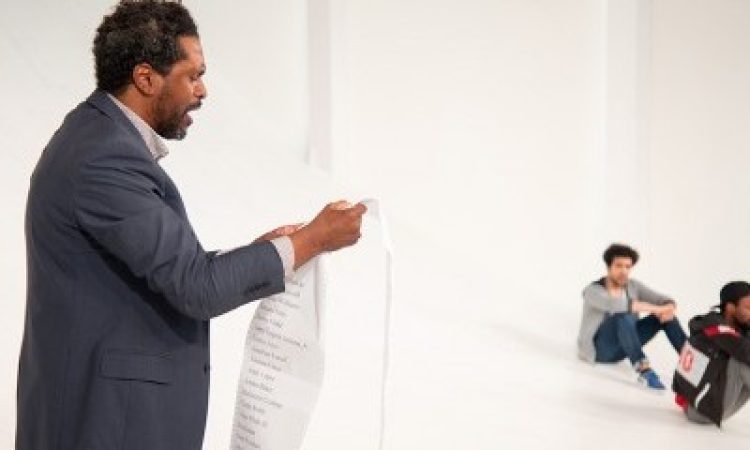
During the show, the printer continues to spit out lines of text until it gets read by Isa. Amadou Diallo and Patrick Dorismond are among the first names he speaks—the earliest names I ever associated to deaths by police brutality. That was 2002, but it didn’t stop there. The horrific, long list of names of unarmed POC (People of Color) who have been killed by police in the United States over decades is read from the printer paper. It goes on for several minutes. Trayvon Martin, Eric Garner, Sandra Bland…all deaths— among many others— where the police officers involved were not indicted.
The words ‘police’ and ‘brutality’ are never spoken in the play. The liveness of violence and systemic racism against POC in America, right now, vibrates on this stage. At times, each performer sees and speaks directly to the audience acknowledging our complacency—we can only listen to their tragic stories and acts of remembering. It reminds me of recently hearing in the news about another black life taken—Harith Augustus— by police. When will this end? The violence continues and within the show is amplified by a cavernous earthquake alongside a rapid light fade.
Kill Move Paradise exercises religious undertones of redemption as four black men struggle with hopelessness. “Transformation takes time,” Isa poignantly states. This is both for themselves and for the audience. They each weigh a dichotomy for and against religious salvation. Daz negates, “Fuck your fucked up salvation cosmology,” acknowledging the complex layers beneath the conversation. Collectively, salvation is in their relationship. Kill Move Paradise is a powerful convening of black men’s voices. A radical act, as so few production companies of the Wilma’s size (or larger) produce shows that highlight the black man’s story. Especially four black men’s stories in the same show!
All four actors (Anthony Martinez-Briggs, Avery Hannon, Brandon Pierce, and Lindsay Smiling) are riveting, balancing the show’s humor and honesty. I am particularly captivated by Pierce gliding through this unfamiliar world with his nimble motions and blunt reactions. His entrance, which includes a laborious climbing and sliding down the ramp, over and over until exhausted, is heart wrenching. Martinez-Briggs’ smile and laugh charm me into leaning in to listen closer. Hannon’s youthful innocence brings collective joy to all four playing cowboy and aliens, morphing into ridiculous, four armed creatures. And Smiling’s difficult role of providing gravity is restrained.
This is a wholehearted, refined progression for the Wilma. The company’s multiple year experimentation in physical and artistic trainings has paid off as this show hits the bull’s eye. Director Blanka Zizka fluidly orients the ambitious, brave world in all aspects. After last year’s Passage, which awkwardly tried to unite the performers’ multiplicity of voices with the audience, this one collectively soars. This can also be attributed to James Ijames’ gorgeous, poetic language. Ijames is a modern August Wilson, writing essential, urgent plays for and about everyday people.
For this story, and our own histories: let’s create a transformation together.
Kill Move Paradise, Wilma Theater, September 4 – 23, www.wilmatheater.org.
Tickets: https://fringearts.com/event/kill-move-paradise-7/
To join the conversation, follow thINKingDANCE and Theatre Philadelphia online and on social media to read, share, and comment.