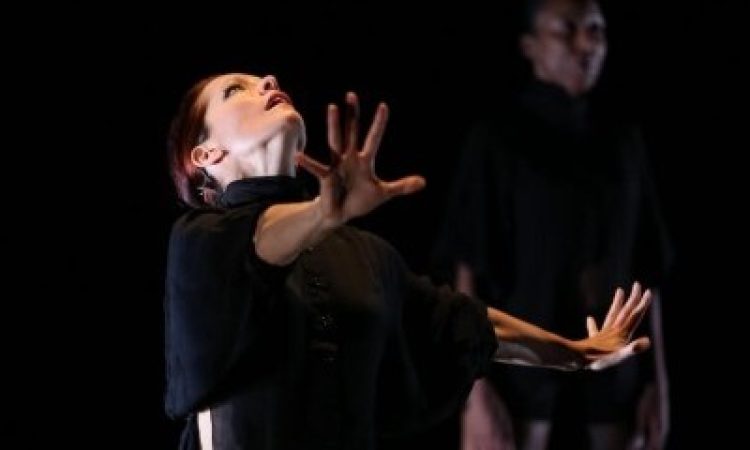
Reach – quiver – look – step – touch…. The power of etched gesture is nowhere clearer than in the work of Anna Sokolow. With austere economy of means, this maverick of early modern dance establishes her language, tells her stories, and unfolds her world in movement. The five Sokolow works shown in reconstructed and reimagined form as part of Dancefusion’s “Moving” are episodic, dramatic, emotional, and immediate. You see them, you feel them, you “get” them, and they end. No frills, no elaboration. Opening with Sokolow’s 1975 Moods, and moving to three early solos—Lament for the Death of a Bullfighter (1941), Ballad in a Popular Style (1936), and Kaddish (1945)—the program ends with the 1971 Unanswered Question, leaving us with Sokolow’s signature vision: don’t expect any answers, there are in fact only questions—none of them easy.
I had never seen some of these works, although I’ve read about them and longed to know how Sokolow would have danced them. Images of Kaddish have fascinated me; I am deeply grateful to Jim May, Samantha Geracht, and Lauren Naslund of the Sokolow Theatre/Dance Ensemble for bringing this work to life as a trio of women, magnifying the impact of the work’s original solo form. Simultaneously, each woman danced her own version of unspeakable grief, registered uniquely through each one’s body, through each one’s left arm—bare but for the wraps of black tefillin that glued my eyes to the thrusts, folds, and clenched fists of each dancer.
The Dancefusion performers contributed three works of their own, all by young choreographers—Jennifer Yackel, Omar-Frederick Pratt, and Camille Halsey. I noted continuity with Sokolow’s work in each new dance’s attention to dramatic gesture and the probing of inner experience for expressive movement. There was also plenty of technique on display—multiple spins, floating leaps, and high leg extensions, particularly in Pratt’s Diaries, with its acrobatic trio for Zaki Marshall, Lamar Rogers, and the choreographer. Well-crafted, heartfelt, and unstintingly performed by their casts, these works hold promise that this generation of modern dance is capable of sensitive, human connection. Sokolow’s lessons in economy of means might serve these young artists well in subsequent endeavors.
It was wonderful to see the Sokolow Ensemble dancers performing the great artist’s work, and also to see Dancefusion’s cast stepping into Kaddish and Unanswered. Dancefusion Assistant Director Janet Pilla Marini, in Lament, was riveting; every look, twitch, and breath told, piercingly, this tragic hero’s story.
Moving, Dancefusion and Sokolow Theatre/Dance Ensemble, Sept. 14 and 15.