Meg Foley’s The undergird asserts that only the body can perceive and hold the experience of death and grief.
We begin by walking past a pile of colorful fabrics and a pile of soft foam pieces, migrating towards the far-left corner, just beyond a wall of white felt fabric folded over the top of metal frames. This is The undergird.
We don’t see the four dancers—Meg Foley, Drew Kaiser, Jungeun Kim, Annie Wilson and designer Natalie Robin—though we can hear shuffling feet across the cement floor. They begin to speak:
“I am pressing the heels of my hands against my eye sockets.”
“I am shifting my weight from left to right.”
This becomes a grounding format they will return to throughout, tracing a long arc into personal stories of death and grief and what lies both beyond and within its confines.
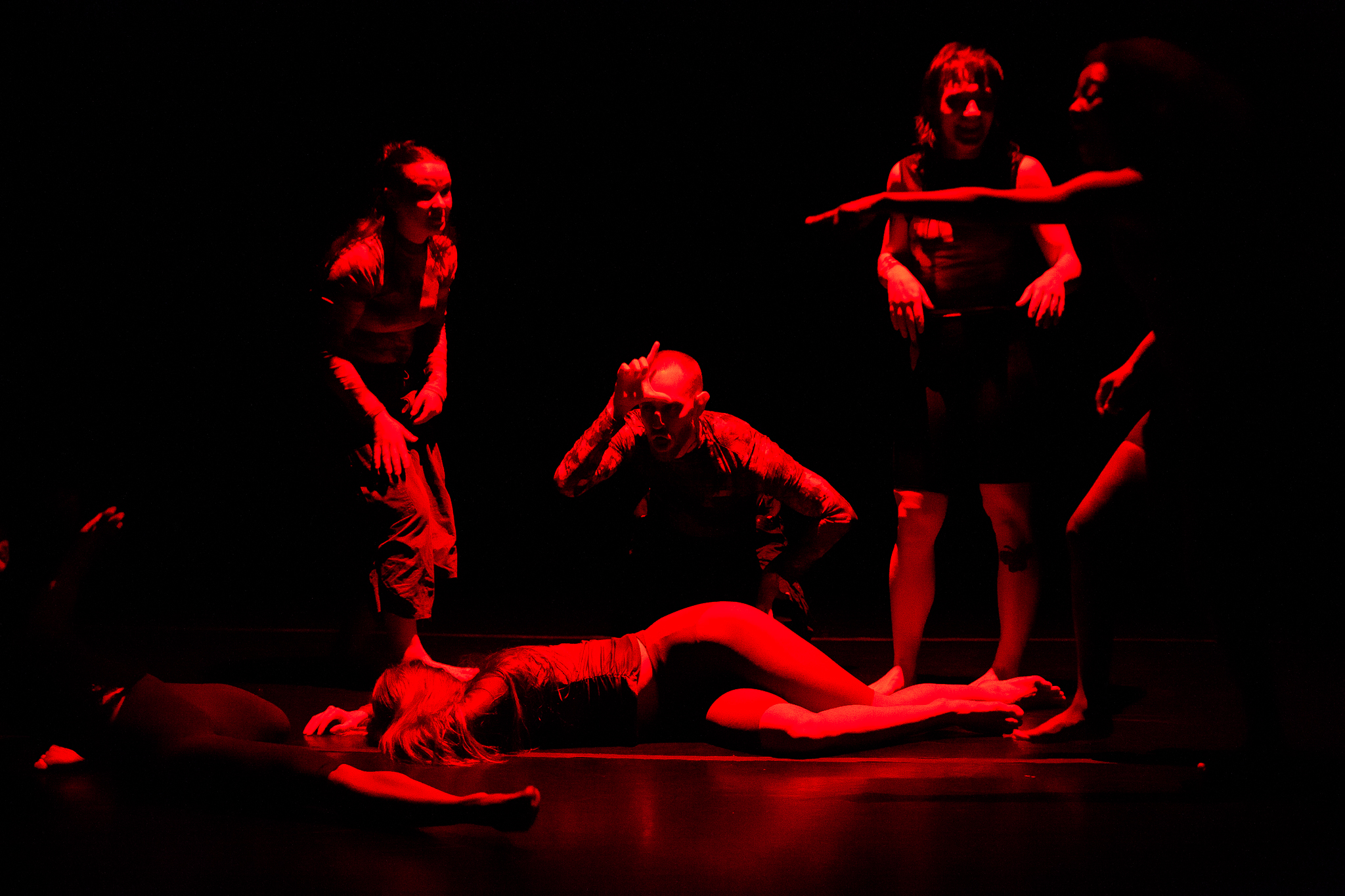
All four enter, delicately eyeing each other as they playfully bounce between stillness and tension. Foley and Kaiser configure in close proximity on the floor, in constrained stillness punctuated by abrupt alternations in shape. Kim and Wilson slowly pick up an edge of the wall fabric and crumple it up above their heads. They repeat along one wall, creating the illusion of a cloud on the horizon, materializing and dematerializing.
Wilson and Foley engage in a mirrored duet, scooping their arms along the diagonal of the space and name seemingly random objects, conjuring a multitude of memory:
“A stuffed animal.”
“Patio furniture.”
“A crockpot of cheese soup.”
Each of the performers has a solo, where components are structurally the same, but inhabited in a personal way. Wilson is squeezed on all sides with foam blocks, until memories of her dead sister erupt out of her. “I am raising my index finger to the sky. She is in my ribs!” Kim reaches her right arm up, extending her fingertips upwards, “I am looking at the house I grew up in.”
The lights shift dramatically highlighting the texture of the walls, and then complete darkness. “The room disappears. The air turns to stars.” I feel as if I am suspended in air, the dust of stars a part of my lungs, along with the saturation of all memory.
The undergird encourages coexisting with what reality is: a mish-mash of collisions and collapsing of time.
The undergird, Meg Foley, Icebox Project Space, Sept. 13-16.