This is a place you want to visit, to dwell in, perhaps. Four floors up, in fidget’s airy, bright, warm, family home, we step into a garden seeded with careful forethought, nurtured lovingly, and yielding the fruits of cultivated taste and whimsy. What happens here?
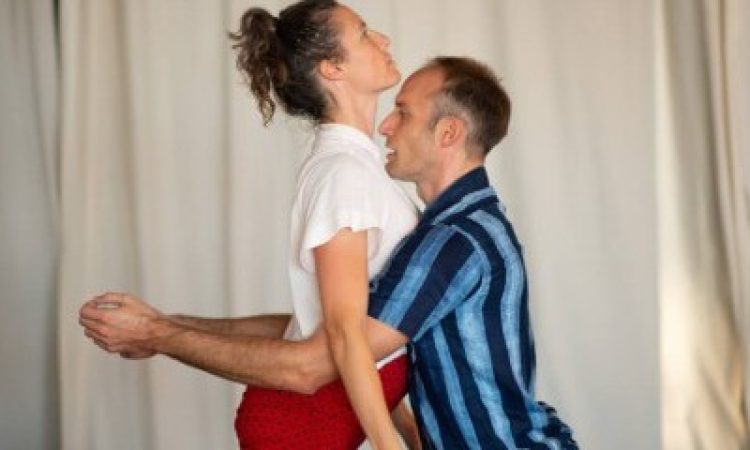
People—Megan Bridge and Beau Hancock,* that is—sit here, breathe here, touch air, touch their bodies, touch one another, walk, stroll, jump, roll, carry, fall, lean, crawl, look, watch, and listen—to music, to words, to their own bodies, to the other’s body. Sometimes alone on the stage, sometimes together, sometimes nearly treading on our feet as we perch on kitchen chairs and couches around them, sometimes retreating to a back wall, to the side, to a corner. Wherever they are—one or the other—I want to be, I want to see. They carry me, as they carry one another.
What do I love most about watching them? I love their quirks—a hip juts out, an impulse shivers through the torso, one’s head nuzzles the other’s sacrum, they get stuck in a corner—and I love their daring. I love it because it catches my breath: they are there for each other, they save one another, they teeter and balance and hold and carry, and they breathe together to make their bizarre lifts and handstands work out in the end. I love it, too, because they know this structure and this music deeply. They can ride the rhythms and swishes of the sound, and meet the meanings of the rambling text (or counter them) as they converse with the music, with one another, and with us, the audience.
The Backyard is Bridge and Hancock’s “palimpsest” (as they note) of the improvisational work, PA RT, created and performed by Steve Paxton and Lisa Nelson in the late 1970s, and toured by this legendary duo until 2002. The music, Robert Ashley’s Private Parts, and the structure of alternating solos and duets remain from that earlier incarnation of the piece. The current performers worked with the dance’s originators, and with other guides and commentators, to make this still-improvisational work their dance. And it is.
I’d love to watch it over and over, to experience the freedom of its continuous unfolding within the discipline of its structure. As I ride my long train home, the dance’s poetry nourishes me.
* Megan Bridge and Beau Hancock were formerly writers for thINKingDANCE; Bridge still serves as a tD editor.
The Backyard at thefidget space, Sept. 14-16