With roots dating back to the 2nd century BCE, Bharatanatyam began as an artistic yoga enacted at Hindu temples. This traditional dance form was born in Tamil Nadu, Chennai, in South India. It battled the scourge of imperialism when British rulers deemed the practice inferior and immoral. Bharatanatyam now lives between the worlds of spiritual practice and performance art. Viji Rao, artistic director of Three Aksha, balances these two worlds through her vision and choreography. Rao presented Saha (Together) at the “Poet-tree en Motion: 2018 Performance Series” at The Rotunda on June 20.
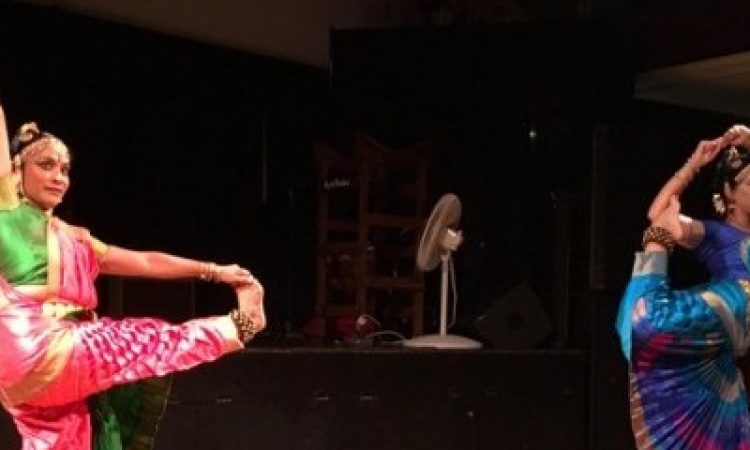
As a Hindu Indian-American, I hunger for connections to my roots. As the piece begins, I am taken back to memories of childhood, watching such performances on VHS tapes sent by my nani to my mother before Indian media was easily accessible in the States. I feel a lump in my throat, thankful to see South Asian artists given a platform. The room fills with the soulful and rousing recorded vocals of the Nattuvanar, alongside sounds of South Indian instruments. The double reed nagaswaram releases stirring stretches and reverberations that follow the pattern of the words. The thavil beats in unison with my breath and heart. The emotive clanging of cymbals builds anticipation and fuses with the energy of the higher powers. The dancers, adorned in shimmering silk sarees, gold jewelry, and gajras (flower garlands), enter the stage in perfect unison. Viji Rao and Mahima George use poised movements to show the transfer of energy, from within the body and soul, moving outward to the audience.
Bharatanatyam tells a story through intricate gestures, facial expressions, and poses. Saha uses these elements with a creative precision. The dancers move with outstretched arms, as they rotate their wrists. Their fingers flow like petals in the wind. Knees bend, with torsos straight as wire. Legs swoop, then hold an exacting position, as the dancers’ bodies tighten and tense to hold the pose. The pleated fabric of the saree works as an extension of the body, creating original silhouettes. Their rigid muscles give way to fluid limbs. The entire body including the face is involved in movement and storytelling. The performers use whimsy through their mischievous smiles and darting eyes. Each part creates the language of Bharatanatyam. Yogic poses and postures tell the stories of the vedas: the Hindu scriptures that infuse this dance form. The dancers pound their feet powerfully against the wooden floors, becoming an instrument in unison with the “chanak chanak” of ghungroos (Indian anklets). The music dissipates and the dancers exit the stage as gracefully as they entered.
Saha leaves me awed and breathless. By contrast, other acts of the evening remind me of why cultural representation and understanding is needed in the U.S. Performers such as “Setu Tribe” and “Plum Dragoness” leave me uneasy about their use of appropriated culture that lacked any deep explanation or historical context. The MC Plum Dragoness enters the stage with bands across her forehead holding up her long dreadlocks, representative of cultures across Africa and Asia. She described the evening as female empowerment, including a night of “authentic” performers. That word stuck with me all night as I saw the misuse of it. Setu Tribe continually used words from another language that they never identified, leaving me wondering why they wouldn’t. Their attire was a mix of Native American style feathers, Indian and African style facial adornments, and Polynesian style tops and skirts. The music included sounds of beating sticks and vocal grunts from the dancers. The mish-mash of cultures left my head spinning. The feminisms being practiced lacked an intersectional lens. While Three Aksha’s piece was authored by a voice that represented the culture depicted, other performers plucked aspects of cultures like a tourist buys souvenirs. Why would these performers not give us any context of the cultures they were using? Why would the MC not honestly state that several performers were borrowing cultures to create something new, instead of making a claim to authenticity? Though I have no false illusions that culture is borrowed and will continue to be, I struggle when appropriators seem ignorant to the triggering outcomes of their “appreciation” and their lack of history, context, and mindfulness. As a first-generation Indian and Hindu, my relatives and I were forced to assimilate and hide our identity. Our history wasn’t just plucked from us, but rather torn. I remind myself that we all have blind spots and put aside my discomfort to focus on the joy of Indian dance.
At the end of the night, I’m left to ruminate on how in a country where cultures are commodified and watered-down by the dominant group, there are artists who are able to break through and empower and educate the viewer. I wonder how those who borrow culture can do so in a way that doesn’t do more harm than good. If cultural appropriation is inescapable, what are the ethics involved in this practice? Ultimately, I’m just happy I have the chance to bring light to a dance company that gave a moving performance.
Saha, Three Aksha, Poet-tree en Motion: 2018 Performance Series, The Rotunda, June 20.