This is a personal response to Yixuan Pan’s workshop How to Clean a Window which took place as part of the Kinematic Workshop on September 1st, 2018 at the Icebox Project Space.
It’s my first time stepping into the Icebox Project Space in North Philly, a space that, despite its massive concrete dimensions, somehow feels soft. I make my way through the pre-workshop flitters—chatting voices and dim lights—to the glossy floor. Mmmmm marley… I can feel my body pouring onto its smoothness like batter on a pan. Since graduating from college a year ago, the surfaces upon which I’ve danced have diversified drastically: I often find myself sprawled out on the floors of classrooms, on tiles, grass, rocks, my roof, wooden floors, in parking lots, or jamming out on the strange linoleum substance that poses as “wood” in my bedroom. I wonder about the accessibility of marley floors, about how difficult it can be to find outside of the academy. I think about how spatial constraints and conditions inevitably inform the aesthetics of any dance form—the difference between dances developed on the street and those which were constructed in the studio. The sprung marley platform under my feet is centerpiece of all of the Kinematic Workshop’s programs, which were offered free to the public throughout the month of August.
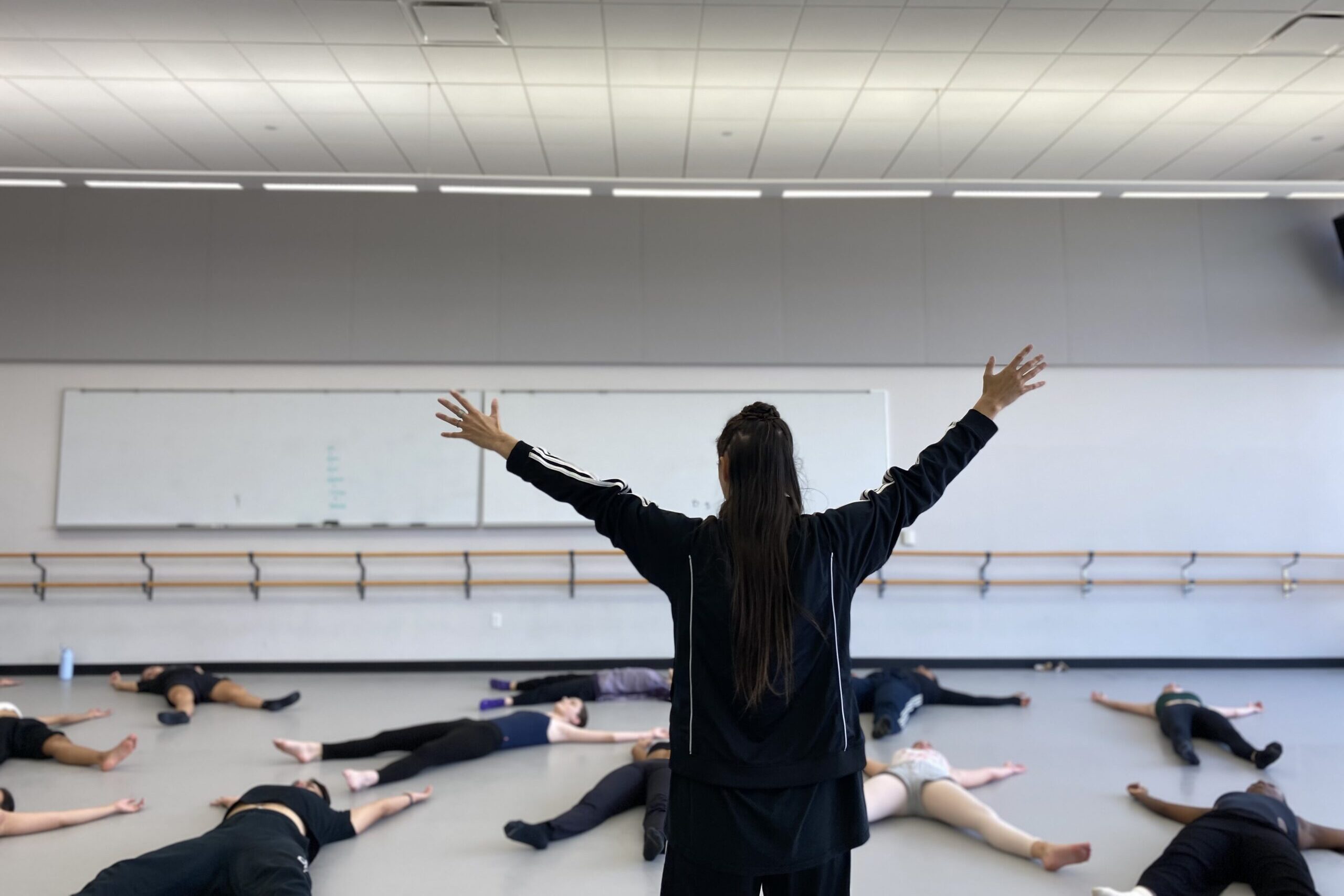
How to Clean a Window is a sensual memoryscape, an ASMR heaven consisting of Yixuan Pan’s voice, lightly echoing through the speakers in the vast room. Speaking into a mic attached to her shirt, she instructs us to gather in a loose circle, face outwardly, and lie down. “Imagine a window,” she says, and begins to release images into the space with her voice, inviting us to consider the shape, size, location, and memory attached to the window in our minds. As she instructs us to “clean” the image we’ve conjured, her poetics strikes me as particular—her language is comprised of both practical instructions (“clean in a circular motion”) and looser statements which necessitate interpretation. This allows me to offer both physical and emotional care to my pane.
What might it look like to draw circles on my window with my head?
My heart?
Trace the window’s dimensions?
Remove its dust particles, but do so without disturbing them?
Pan tells us later that she has an artistic background in glass and that she once spent a lonely winter in Finland staring out a window for hours after the sun set at 2pm. I’m interested in the ideas she proposes—about the window as both an object of separation and a portal to information—but I’m even more intrigued by my own tenderness, indeed a tenderness one can feel for any object at all. By the end, in fact, I develop a real affinity toward my window. I build a fondness going through the motions. I locate it, work to bring it to the forefront of my mind’s eye. I spread my breath upon its surface and watch the condensation fade away. As my window perpetually floats forward in space, asking me to chase after it, I forgive it, accept its mischievousness, learn to love it anyway. I walk out into the dull Saturday afternoon and watch the distinctions blur between notions of care, attention, time, and love.
How to Clean a Window, Kinematic Workshops, IceBox Project Space, September 1