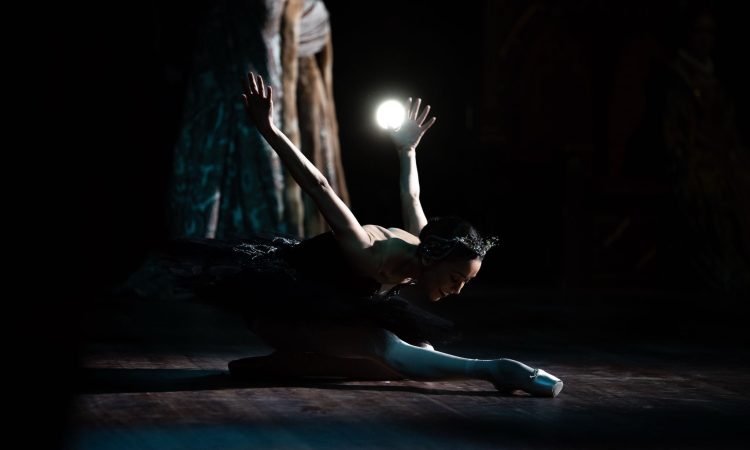
Last month, Philadelphia Ballet Principal Dancer Nayara Lopes, went viral on social media after she recounted a racist whiteface experience at the Finnish National Ballet (FNB). Her widely reposted interview with Dance Magazine, and a companion essay on her personal Substack reignited conversations about race, tradition, and representation in ballet. Following a wave of coverage in Finland, FNB announced the upcoming departure of Artistic Director Javier Torres, two years ahead of the scheduled end of his contract.
I spoke with Lopes about the widespread reactions to her story and the subsequent coverage. The following is an excerpt from our conversation, edited for clarity and continuity:
Rachel Repinz: In your September article with Dance Magazine, and your piece on Substack, you discussed the deeply racist whiteface incident you experienced while dancing with the Finnish National Ballet. What made you decide to speak publicly about this experience?
Nayara Lopes: After the incident, I was shocked by everything that happened, especially in 2026. I considered moving forward and being silent. But as time went on… it felt very important to not just be silent… I was able to heal, I felt like I needed to have a voice. I didn’t want to just publish anything on social media or Instagram. I wanted to do this in a very specific way that was factual in bringing awareness to what actually happened in order to actually create a change.
I needed time to really think through it. I didn’t want to just call out a big organization. I gave time for them to speak up if they wanted to apologize or make a change in policy, but nothing happened. As the time went on, I was more certain that I needed to share my story. Sharing my experiences at a company meeting last spring gave space for the dancers from Finland to speak up. I hoped that sharing my story with Dance Magazine would have a similar impact for other dancers and our field.
RR: Now that we are almost two months out from publication, how are you feeling about the public response?
NL: It went two ways. I didn’t know what to expect because it’s so hard to speak up as a Black dancer. It’s hard to speak up as a dancer [in general] because you’re afraid that it’s going to affect your work, or it’s going to affect your friendships, or how people think [about you]. A lot of dancers are still very traditional, and a lot of directors are still very traditional.
I was surprisingly pleased with the [responses] and the support from friends and from people I never heard from before. I got so many messages [saying] people were experiencing the same things, or they experienced [similar things] in the past, and they spoke up and they got fired.
The responses were very positive overall. [It’s been] 98% positive, but there are about 2% of responses that are like, “listen, it’s just tradition.”
RR: This idea of tradition came up a lot in your Substack essay, particularly how ballet and other dance forms are grappling with this idea of sticking to tradition. What does that mean? How do we carry tradition forward in a way that’s not harmful?
NL: I think that tradition is made to inspire, not to stop us from evolving. It feels like, “okay, tradition,” but what is that tradition? If it’s causing harm, then why do we keep doing it?
So many things have happened in history just because people didn’t question it, because they let it happen. Isn’t it time for us to dig a little deeper?
With tradition, we also tell the history of what’s happening today. If a Black child goes [to a Ballet performance] and wants to see themselves [on stage], they are never going to see themselves there. [If Black dancers are painted white],it sends the wrong message, instead of finding beauty with diversity. I was never objecting to being painted or made up as a character, I was objecting to being painted a different [race]. If you want an angel, I can be a Black angel, or there are gold angels. There are other ways we can talk about makeup, maintaining my race, my beauty.
RR: Javier Torres doubled down on the decision [to use white makeup]. In his words, the makeup was intended to make your skin appear more “pale.” He rejected the idea that the idea was rooted in racism because he is Mexican. I’m curious how you received his response?
NL: When you say “pale,” “less pale,” “white,” “less white,” it’s all offensive. It’s all the same. You’re trying to change my race. You’re trying to change my color. You’re asking a Black dancer to appear white on stage. Just because it’s tradition doesn’t make it right.
I understand that’s a vision, but it’s still harmful, offensive, and outdated. If there’s no willingness to have an open conversation, then that’s not the environment for me to be part of.
I’m not calling him racist. But acts and practices can be racist, even if a person or an institution doesn’t mean to be.
RR: In your Substack article, you write about Torres recommending you focus on contemporary work, despite the fact that your career was grounded in classical Ballet, and recall the persistent conversations about your retirement—conversations that you did not initiate.
NL: So, as we were talking about tradition… originally ballet was built to not include [us]. If you think of a ballerina, of a Swan Lake or Giselle poster, you don’t see a Black person there. So it was already not built for us.
[Torres] told me I was a contemporary dancer, that I should focus on contemporary. But I never danced lead roles in contemporary works for FNB. When I was cast in the contemporary [pieces], he put me in the ensemble. So it felt like an attack.
When a Black dancer is put in that situation, a seasoned Black dancer, and then you go to a meeting, and [leadership] is instigating your retirement when you keep delivering… these microaggressions are degrading and build up.
RR: After taking time off from performing, how does it feel now to return to Philadelphia Ballet for your 10th season, and 5th year as a Principal Dancer?
NL: To be fully honest with you, in the beginning it was tough, not because of the dancers or the directors—they have been so welcoming and sweet to me. It’s just that after an experience like this, it’s so shocking, and it really hits you to the core. It feels like you don’t belong to the art form, no matter how good you are or how much you do. So then, I was just questioning everything.
I was a little bit skeptical of how it would be, but I actually feel like myself after two months back to work.
RR: At the end of your Substack article, you offer a call to action: To hold these conversations in our companies and hold leadership accountable. What does meaningful accountability look like to you, and what would you like to see ballet leadership doing differently?
NL: I think that accountability looks like having these conversations about belonging and equity regularly and proactively, not only when dancers are hurting, or when major incidents like this happen. Also, having an understanding that [change] doesn’t just come from dancers. This comes from the leadership. This is a vision that, if your director or your leadership doesn’t have this vision, one or two dancers are not going to change anything. If an organization and their whole team, their artistic staff, their makeup, their costume[s], their pointe shoes, the people at every single stage of a company, don’t understand that they have to make those adjustments or have those conversations, nothing will change.
It would be really nice if the dancers that are there already, when they speak up, they’re heard and are not questioned: “Why are you saying that? and “You should understand this is tradition”. Because again, we’re humans and we evolve, and so does the form.
RR: What’s next for you? Do you see advocacy continuing to be a part of your work?
NL: I want to continue advocating for Black dancers and meaningful change in our industry. But I want to do that work with companies that are genuinely open to change, where conversations about diversity and inclusion are met with a real willingness to take meaningful action. I know that not every company shares that vision, and I want to focus my efforts where meaningful change is truly possible.
If you want to create advocacy, it has to be from a real place. I want to do the work, but I want to do genuine work. I don’t want to just do work that is going to give me followers on Instagram and make me feel good. I feel real work takes a lot of time and it is very hard to be heard in the right way, but I will try.
I have joy in helping… A lot of people helped me, so I understand the importance of it. I also understand that for something to be done well, it has to be real.
Rachel Repinz in Conversation with Nayara Lopes, Zoom, October 12, 2026.