Fringe artists are literally thinking outside the box, forcing audiences into less traditional performance spaces. Almanac mobilizes the crowd around the garden at MAAS. Museum Workout actually gives you a workout. Caen Amour invites viewers to leave their seats and watch a part of the show otherwise entirely out of sight, hidden behind a wall set in the middle of the stage.
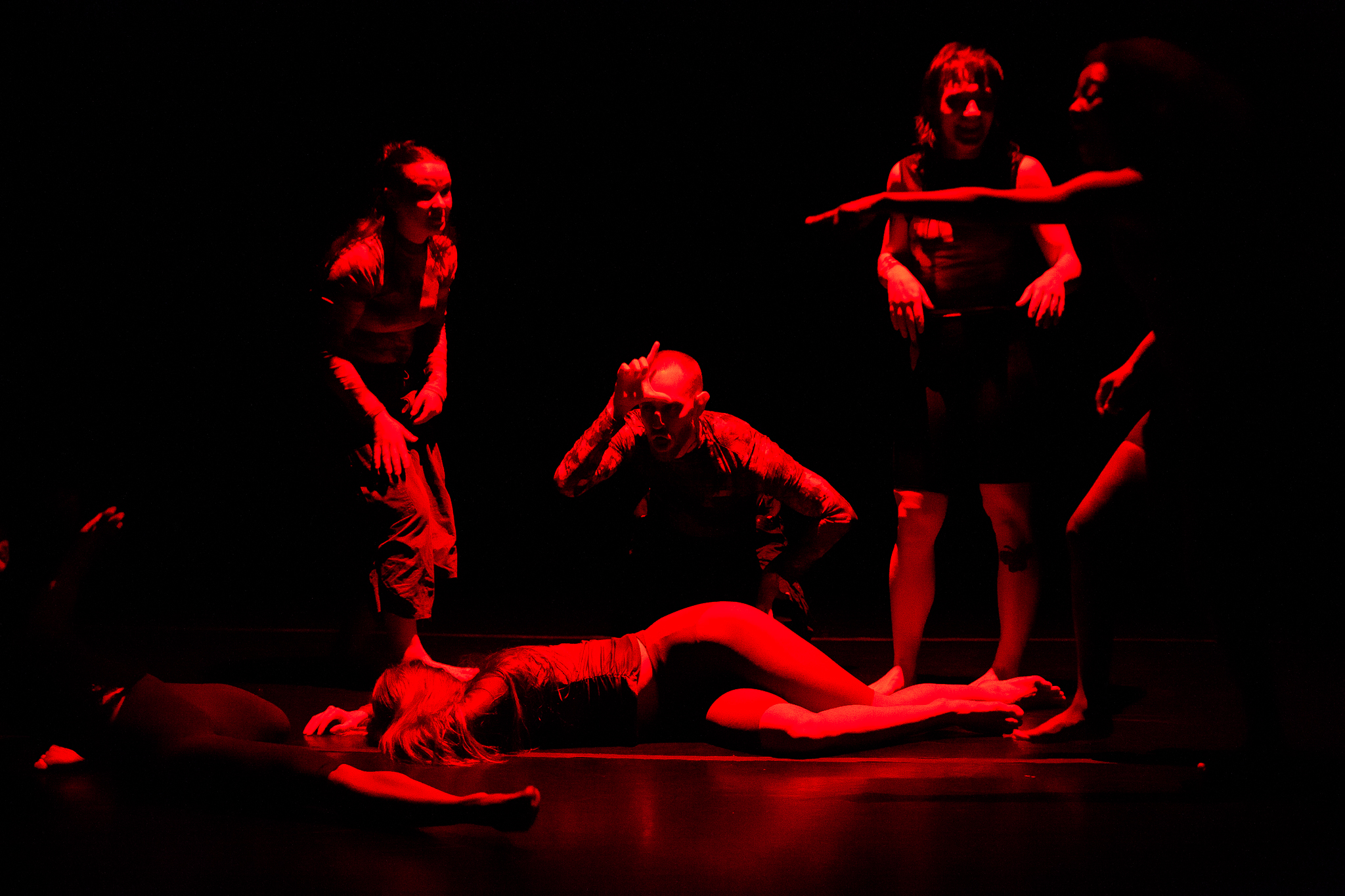
Following suit, Tangle Movement Arts performed In the Forest in an inverted theater in the round, where seven divided spaces lined the perimeter so that the audience could freely peruse the center space. Three areas held equipment for acrobatic demonstrations. In two divisions were spools of yarn and woven displays on looms. In another, a large pile of chairs was haphazardly stacked. The last was a white territory of large bubble-like forms and folded origami structures.
The cast was attentive to sustaining their characters, even out of the limelight. In a show with freedom of range, I chose to focus on easy-to-overlook details, watching characters displaced from the main spectacles. In those moments, I noticed critical minutiae that enlivened more realistic creatures and thus a more believable world.
By following pinpointed characters, I was able to track their stories, including when they crossed boundaries. A whimsical character unwound thread, methodically placing it around a wooden frame. She spoke aloud to herself, growing puzzled in not knowing how to unravel and reorganize it in a satisfactory way. With the guidance of a futuristic, robotic individual who helped her in construction, she was able to make sense of the found materials. Exhausted and quieted with gratification, she crawled inside their creation and slept. Combining their strengths, there was problem solving, understanding, and exchange: artificial intelligence meets a thoughtful, resourceful persona.
Just as I became enthralled by these confrontations, In the Forest ended. Then I wondered: What about the alternate parts of the show? Did I miss a brilliant trick? How did other characters progress through their explorations? What would I have seen if I had chosen to watch one of the constructed environments and the events that ensued, rather than certain creatures?
In this visual playground without directive, I was compelled to make choices that would ultimately create an exclusive experience. But that’s the bright side. On the other hand, I’ll never know what I missed, leading me to accept that the thread I followed is the tapestry I was meant to weave.
Tangle Movement Arts, In the Forest, Sanctuary at the Rotunda, September 12-15.