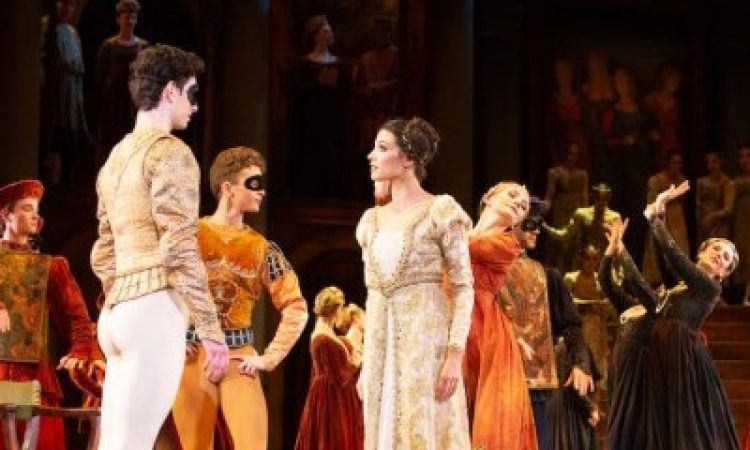
Kenneth MacMillan’s Romeo & Juliet (1965), a company debut for Pennsylvania Ballet, dwells in the darkness of Shakespeare’s drama, offering no relief, no redemption to the audience. The work’s gorgeous colors, choreography, and emotional complexity stop dead after the lead figures’ suicides in the Capulet family crypt, with no burying of family feuds or silencing of swords, as the bard’s play offers in its concluding scene. Rather, in MacMillan’s treatment, the heartbreakingly beautiful young lovers—Lillian Di Piazza and Sterling Baca on opening night—lie dead at the bed-turned-tomb that grimly recalls their one night of married ecstasy.
PAB Artistic Director Angel Corella addressed the audience before the ballet began, expressing his excitement at several milestones—the company’s 55th year, his fifth as artistic director, the 25th anniversary of Beatrice Jona Affron as music director and conductor, and the company premiere of MacMillan’s ballet, which Corella has been building the company up to perform. How did the company fare in this work combining stunning music (Sergei Prokofiev), complex choreography, broad dramatic demands, and exquisite staging (scenery and costumes by Paul Andrews, lighting by Brad Fields and Joseph Naftal, dance staging by Julie Lincoln and Robert Tewsley)? They were wonderful.
I’m not familiar with much MacMillan, although I’ve seen a couple of terrific filmed performances of the famous balcony scene in this ballet. I was delighted at the nuance and variety throughout the choreography, with much play in the use of the body, the height of legs, the allusions to historic social dance, the subtle introduction of characters to the stage. In comparison to full-length ballets like those of the Petipa school (i.e., The Nutcracker, Sleeping Beauty, Swan Lake), R&J gives the men much more to dance, and allows all performers to mine dramatic character, even as individuals within the corps de ballet in group dances. They are all distinct people, composing a richly varied scene and expressing their own reactions to events, whether in the town square or at the Capulets’ ball. The PAB corps was excellent. Some of the dancing is fast and exuberant, as in the village scenes, at other times it’s expansive and space-devouring, as in the bravado of Mercutio (Albert Gordon) and the love encounters between Juliet and Romeo. But MacMillan is also not afraid of stillness—the young lover’s first long look at one another at the party, or Juliet’s deep, quiet searching as she resolves to run off to Friar Lawrence when her parents demand she marry Paris, their choice for her spouse.
Watching the technically proficient Di Piazza over the past few years, I’ve wondered if she had the emotional range to fulfill the highest-level ballerina roles, which typically demand both melting softness and steely strength; in R&J, she proved herself. I believed her as she wrestled with growing from girlhood to womanhood, and even more so as that womanhood deepened in the face of tragic circumstances, which forced on her decisions her protected life had not prepared her to face. She was willowy, charming, naïve, enraptured, playful, surrendering, determined, and always stunning to watch. Sterling Baca, whom Corella has been grooming as a danseur noble, has enough of boyish good looks and awkwardness to pull off Romeo, while his leaps, turns, and supports to his partner are dependable. He too is growing as a dramatic dancer.
The ballet was a coup for PAB. It is long, however, and unfortunately stalls out a bit as it moves toward the conclusion. A long dead spot follows Juliet’s supposed death, induced by Friar Lawrence’s herbal potion: the curtain comes down, the music stops, and I wondered if some mishap had occurred onstage. A few audience members hustled out of the theater, perhaps to beat the rush out of the parking garages. After a few minutes, the music picked up and the curtain rose on the crypt scene, but a dead feeling had already begun to settle over the audience. Missing Shakespeare’s last scene made the tragic ending even heavier. Still, for those who stayed to applaud, the enthusiasm was palpable and the touching warmth that Di Piazza and Baca expressed with their bows was, for me, redemptive.
Romeo & Juliet, Pennsylvania Ballet, Academy of Music, Oct. 11-21.