I walk into a vintage shop in Fishtown and stroll through their collection of affordable wares. This is The Art Dept Collective, a corner row home transformed into a multi-use space and store. I peek around its corners, trying to find the installation Touch. I finally ask the worker and am guided through their kitchen, back outside to a garage behind the building. As they set up the exhibition, I admire the garage, which has also been converted into a storage and artist studio. I am invited in and directed to close the door behind me.
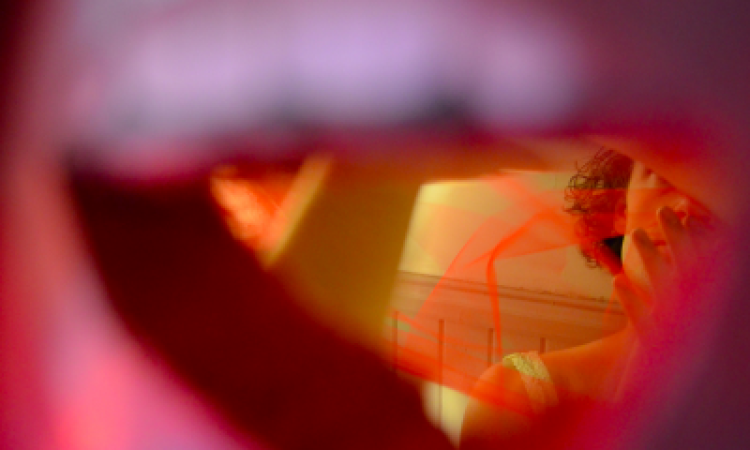
Inside is a square living room fitted with a couch, a coffee table, and a television perched atop the bottom half of a mannequin. One central ruby light bulb illuminates everything in shades of red. Artist Eliza Leighton has warmly fashioned walls covered with plush, shaggy fur that beg to be touched. Numerous glass hands reach out of one corner of the wall. I quickly forget about the two o’clock sun that I just left outside.
The television directs me: “Hey. Hi there, why don’t you sit down?” and “Welcome.” I quickly make myself comfortable on the couch, which could fit two other people. “Hey. Hi there, why don’t you sit down?” It repeats again. And again. Something is off. The screen fills with disjointed images of a different living room, first as itself, then cut in half, and then overlaid with abstract scarlet shapes in motion. I prefer to disengage from this trippy image cycle. The walls have been tempting me. Alone, I stand against one wall to touch the shag. It is comforting.
Before arriving, I had read how the artist frames the piece with a safety-and-content warning: “This installation deals with themes of sexual violence, and may not be suitable for all viewers, specifically children.” These walls are an illusion of comfort, leading me to expect relaxation, when instead I feel disoriented. The television continues to offer its blurry images as its welcome laboriously wears itself out. This is purposeful. It pressures me to reflect on misleading acts: ideas of safe spaces, comfort, and disingenuous welcomes. Leighton has provocatively shaped a room that forces me into conflict. I lounge on the couch, yet I notice my legs firmly planted on the ground. My muscles debate the tension.
Now an atmospheric buzz from the television demands my attention. The voices morph and distort, continuing their feud, but the words have changed. The recording now tells me “You’re welcome, You’re welcome” over and over. It’s like the twins in The Shining: “Come play with us.” I can’t trust this. Have I gotten what I wanted? What was it I came for?
I stare at the lone light and the shades of red in the room. From cherry to maroon, the furry walls shift between shades, depending on how the light hits the hairy threads. How many hands have touched this wall? How long will this go on? Thinking about the safety-and-content warning, I reflect on Christine Blasey Ford’s testimony during the Kavanaugh hearings. Her words about how the assault “haunted [her] episodically as an adult” parallel the repetitions in this room.
This 15-minute installation is a reflection of time on a broader scale. Touch is a recounting of trauma that the body is trying to release, but continues to cycle through. Leighton uses senses rather than words to highlight unsettling spaces; I hope this installation builds a site not just for acknowledgement, but also for healing. The number of people who are sexually assaulted can’t be measured, as any number of assaults aren’t named or reported because of fear of victimization, fear of reprisal, fear of lack of evidence, among other factors. We cannot pretend that these things do not occur. Survivors, it is not your fault. You are not alone.
Touch, Eliza Leighton, The Art Dept Collective, Oct 5–28. https://elizaleighton.cargocollective.com/