Bookshelves hold up a high platform in the center of the stage. Two staircase-like structures extend from it, up to the wings (and the heavens beyond). On the platform: two chairs, a table, a bottle of scotch, and a single lit lamp. The set-up quivers with potential. I’m at the Annenberg Center to see a collaboration between theater-maker Anna Deavere Smith and choreographer Donald Byrd. I am more familiar with Smith’s work and excited to see how her transcript-based documentary-style theater intermingles with dance. The transcript in question, A Rap on Race, is a conversation between white anthropologist Margaret Mead and black writer James Baldwin recorded and published in 1970.
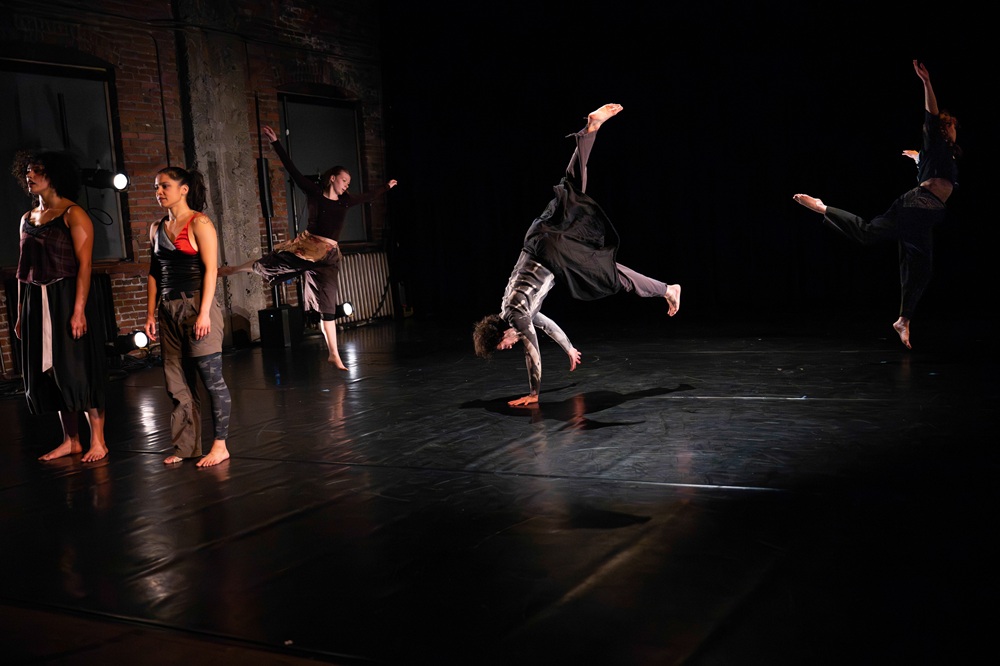
Julie Briskman and Donald Byrd ascend a staircase to the platform. With the house lights still up, the staircase is whisked away and the show begins. Thirteen dancers flood the stage, some in high-cut leotards, black tights, and character shoes and some in black muscle tees and jazz pants. Dancing to a recording of Charles Mingus’s The Black Saint and the Sinner Lady, the evenly-spaced ensemble executes impressive attitudes, battements, sharp turns. Two dancers come together, grasp hands, and counterbalance each other, flicking their legs and angling their arms, sparring. The music cuts and lights come up on the platform.
“I learned about race when I was a child—”
“How did you learn about that?”
The verbal skirmish begins, the two actors reading from thick black binders and swigging water in the breaks. Briskman’s Mead is fierce in her arguments, often outdated enough to garner laughs from the audience, as she expresses her belief that America has the capacity for change, even while she genuinely acknowledges the pain Baldwin has suffered. Byrd captures Baldwin’s charming nihilism (“I’m not romantic”), the flourishes of his speech, his deep listening, and passionate counterarguments. The speakers handle the dense text with nuance, bringing out the humanity and humor in their intellectual rapport.
Lights go down on the speakers and up on the dancers. Cue music. The conversation and dance never overlap; the dances function as interlude, only occasionally connecting to the conversation. Mead muses that touch seems integral to black people’s communication. A touching duet follows, static and strange. The dancers place their hands on each others’ shoulders, one at a time, moving around the other, avoiding eye contact. I miss the intimacy that touch and dance can provide. In his 1971 review of the book version of A Rap on Race, Richard Elman yearned for this, too: “Margaret Mead and James Baldwin both agreed that touch is a necessity in human communications, but there is no record from this transcript that they ever did. Nor do we get any idea of what their feelings toward each other really were from tone of voice, or facial expression, or what they did with their hands and feet.”
Briskman and Byrd play their parts with a kind of intimacy, stemming from the delight of two sharp minds meeting, but they never rise from their chairs. Intellectuals above and corporeal reality below? The choreography, isolated, meticulous, and stylized even when the movements suggest loss of control, lacks the messiness to support this theory; the conversation feels more messy, more real. Smith and Byrd, in an interview featured in the program notes, both mention that the musicality of the Mead/Baldwin conversation drew them to the material. Byrd’s delight in voicing Baldwin’s string of “Well, well, well, well,” interrupting Mead’s argument, showcases this musicality. I struggle to find that delightful musicality in Byrd’s choreography, at odds with the accelerations and call-and-response among the instruments of Mingus’s jazz band. The dancers’ movements stay large and static no matter the swells of music, and their small bursts of footwork erupt seemingly out of nowhere. This approach to rhythm makes for tense viewing, especially as the conversational tension grows. While this might have been Byrd’s intention, it feels flat and arbitrary to me. Nearing the end, I let go of my desire for interaction between music, dance, and words, and just listen to Baldwin’s last speech:
“It is difficult to be born. Difficult to learn to walk, difficult to grow old, difficult to die, difficult to live. Everybody, everywhere, forever, but no one has the right to put on top of that, another burden, another price, which nobody can pay and a burden which really nobody can bear. I know it’s universal, Margaret, but the fact that it’s universal doesn’t mean that I accept it.”
A Rap on Race, Spectrum Dance Theater, Annenberg Center for the Performing Arts, Oct. 12-13.