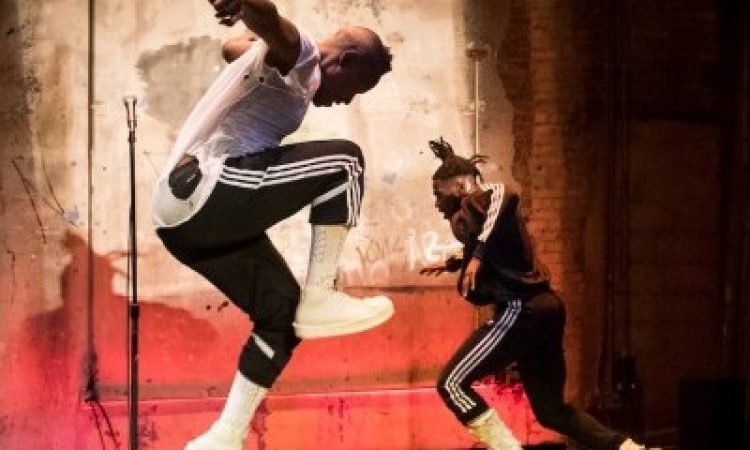
A whirl of pastels and near misses, Shamar Watt weaves through the crowd at breakneck speed. Pink, yellow, orange hoodie. Animal-print high tops. Smooth ebony skin shimmering beneath tight leather bands, gold medallion at jugular notch. Beautiful black body on the run. Hyped up like a street hawker, a hustler, he bounds over the limbs of mostly young bodies encircling UArts’ GershmanY Gym floor. Gesturing, urging us to rally him on, our attention fueling his fervor.
“Welcome to the spaceship,” a voice bellows from above. We follow his gaze up to nora chipaumire and her sound technician on the balcony, the sources of booms and beats in multiple languages. Watt points, struts, poses. “Gucci skin! Gucci teeth! Gucci smile!” His fingers signal as chipaumire counts from one to seven (a bridge in Congolese rumba, we later learn). He stops for a selfie. Speaking their language now. The students lean into the frame from behind as chipaumire howls: “Snap the picture! Snap the picture! Snap the picture!”
In a slow motion walk, like easing through molasses, Watt oozes a leg forward and hovers. Peacocking, he puffs chest to sky, slowly shimmies his hips. (An older white man seated near me thinks nobody sees him take a picture.) Eyes closed, hands caressing the air, Watt churns belly, hips, ribs. Massaging his organs, stirring up some junk. Some shit that is deep. For the ages. “Been working in the fields all day.”
Horns, guitar, and keyboard edge the percussive rattle toward pop. Raising a Starbucks cup to the sky, he drops to the floor and gives us ten, springs into jumping jacks, hops knees to chest, leaps skyward like an ’80s guitarist, legs splitting front and back. Glorious, magnetic, unhinged. Like a methamphetamine-powered rocketship. Bound for worlds brighter than this one.
chipaumire shouts: “*Nigga Soda! A soda for every occasion. A nigga for every occasion. A star for every occasion.”
* * *
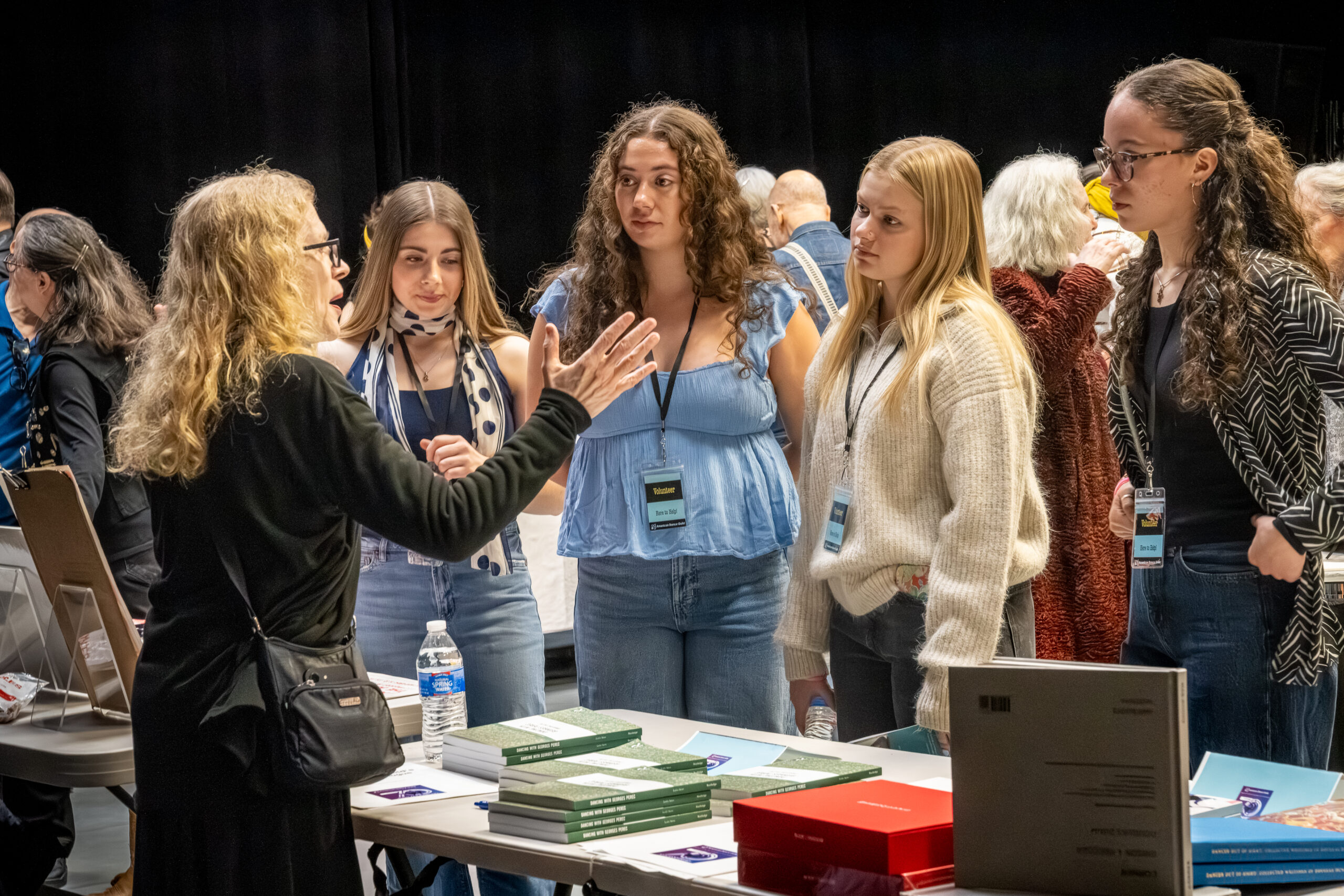
In the talkback, chipaumire, originally from Zimbabwe, discusses the “embedded lecture” within *NIGGA, the third installment in the triptych #PUNK 100%POP *NIGGA (verbalized: hashtag punk, one hundred percent pop star nigga), a “live performance album inspired by [her] formative years in Zimbabwe during the 1970s, ’80s, and ’90s.” Noting that *NIGGA moves back and forth in time, from the constitutive trauma of slavery to the liberation of Afrofuturism, she describes it as “forensic research” into the word nigger, depository of “all our fears and possibilities.”
Calling the voice “another limb” of the body, she roots her interest in sound as both true to the “sonic materiality” of black bodies and opposition to Western, capitalist conceptions of “dance” and dispensable bodies. She frames the black African body as a weapon; existing on the margins, it speaks, thinks, and confronts the empty/object body of capitalism, always the same, always replaceable. In her work, chipaumire and her team are intimately involved from the initial thought to the final production, and thus, indispensable: “The work cannot exist without these humans.”
Linking sound and freedom, she observes that “everyone is born with a voice, but somewhere along the way, we are encouraged to lose it, it becomes offensive. Or we go to an academy for ten years to regain it, and then we’re in debt for three generations.” The irony of this statement within a conservatory-style university dance program, where chipaumire is currently a visiting artist and where undergraduate tuition and board runs $60,000/ year, is noteworthy. Nodding to the importance of teachers, she leaves it to students to reckon with this business model of education: “no teacher can put dance in you, but they can help you free it.”
On the topic of resistance, she encourages fighting oppression from within: “There is no running away somewhere else,” she says, for “the bigger picture is humanity.” To shutter oneself away, whether in a liberal Arcadia or a survivalist enclave, she implies, is ultimately a rejection of our common humanity and the possibility of real change. On avoiding the trappings of capitalism, in the process of fighting the system from within, chipaumire implores her young audience: “Freedom is not on Facebook. Get off of fucking Instagram. True liberation is a process of deep work. Nobody will tell you what your value is, you have to figure it out for yourself.”
* * *
On her website, chipaumire cites Congo’s capital, Kinshasa, and urban African pop as primary influences of *NIGGA. She describes the Congolese as “unabashedly freed” by the horrors of their history—from the brutality of King Leopold II, to the assassination of Patrice Lumumba, to the failure of international aid and human rights organizations. She traces this liberation from innocence, false hope, reliance on anyone or anything outside of the self, to Kinshasa’s modern-day musicians. Independent, YouTube-fueled pop stars who have paved their own path to global recognition, they are a proudly homegrown alternative to the standard fare of globalized airwaves, to the deafening traffic of round-the-clock news.
In a world turned upside down, where legitimacy is in increasingly short supply, chipaumire suggests that liberation begins within.
*NIGGA, nora chipaumire with Shamar Watt, Knowing Dance More Series, University of the Arts, Oct. 17.