Tiny. Tiny is trending. Even in a world where the “great” and the “awesome” appear to stomp all that is lesser and least.
Lena Dunham’s Tiny Furniture became her breakthrough film in 2010. Tiny houses are popping up offering less than 300 square feet to downsizing households. And now tiny dances have snuggled into Philadelphia, alighting onto a four by four raised platform stage at Mascher Space Cooperative.
Created in 2002 by the Portland, OR dancer/choreographer Mike Barber, the concept of Ten Tiny Dances is twofold: to upend an audience’s expectations of what dance is and how it should be presented, and to challenge artists to address the constraints of space and time. Like Barber’s original performance, Mascher’s was also a fundraiser, here to replace the disreputable dance floor in its rented Kensington industrial loft space.
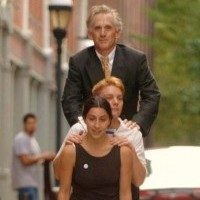
A host of Mascher artists, alum, and friends were up to the task of working on and nearby the newly constructed four foot square stage. A quartet rendered Allemande as a keeping-to-the-square clever square dance with vocal commands, “together, apart,” hand claps to keep the rhythm, and a floating vocal score by Caroline Shaw, Allemande from Partita for Eight Voices. The work, choreographed by Dawn Pratson, also allowed the dancers, Javitta Brockington, Christina Gesualdi, Sogol Shirazi, and Pratson, to escape the confines of the tiny space. Katherine Kiefer Stark’s Actor and The Leading Lady may have offered the most kinetic and dramatic use of the space through weighted and cantilevered partnering between Stark and her leading lady, Marisa Illingworth in a red shirt. The sonorous cello solo from Ajibola Rivers accompanied the unfolding struggle of the leading lady to remain on top.
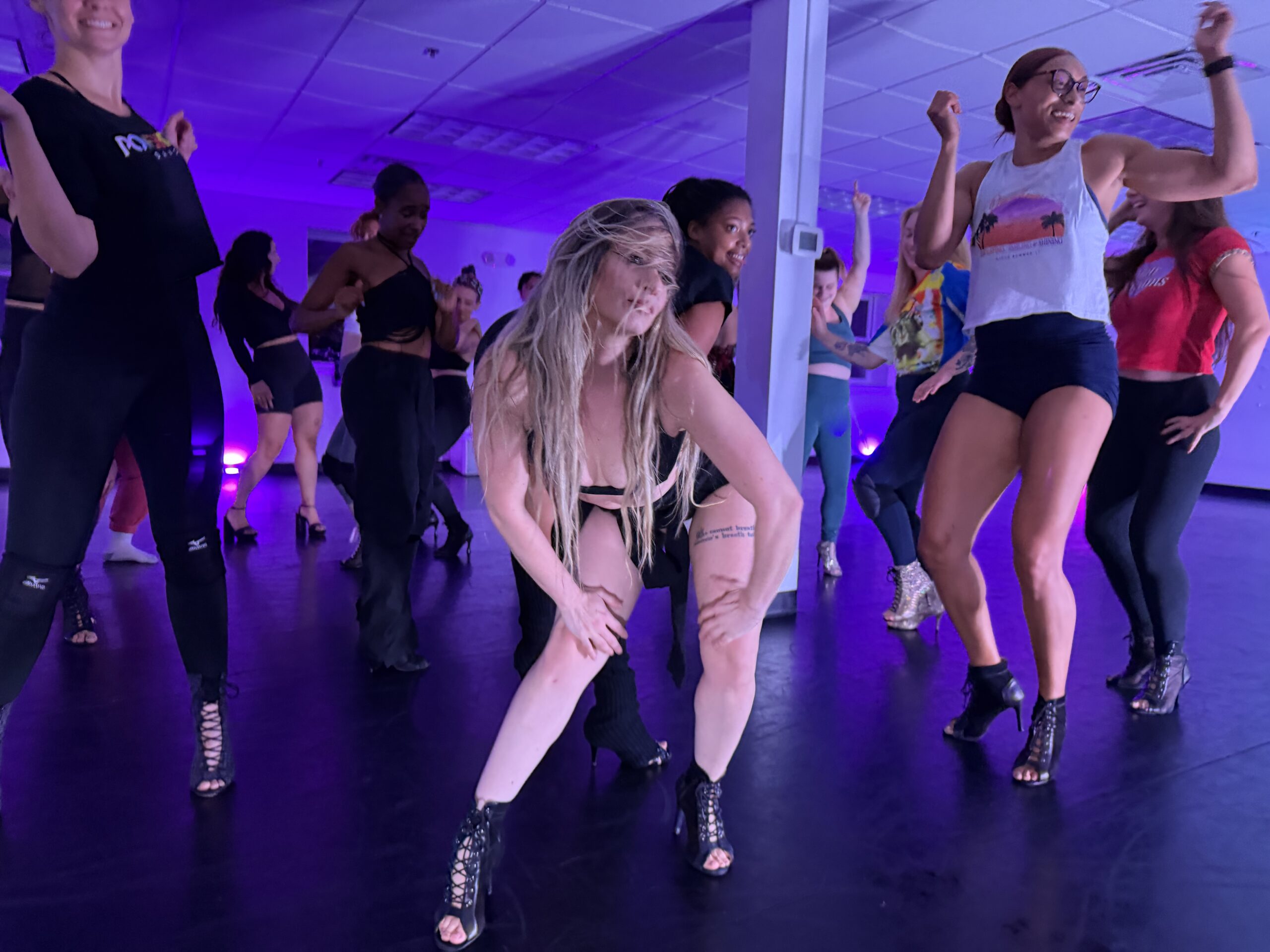
Vervet Dance’s raucously memorable In the Tiny Square, directed by Curt Haworth, featured a small army of rambunctious revelers who attacked the square from four approaches with furtive runs and slides across its surface. Armed with a trombone, tambourines, and assorted noisemakers, they were game for action. Vervet dancers* seemed to achieve their goal with a collective seizure of the formidable low ground in what became a Simone Forti-like Huddle. (The original 1961 Forti Huddle sans trombone and tambourines can be seen live within the Judson Dance Theater: The Work is Never Done exhibition at the Museum of Modern Art in NYC.)
In Melisa Clark’s Ouroboros, Dawn Ann Perez and Clark used the proximity of the space to create an alone-together duet of slow movement and stop action positioning that produced a cool and elegant alienation. In contrast Celine McBride and Mary-Carmen Webb in Paige Phillips smart, mirroring duet, Where do I begin?, bubbled with sisterly affection and nonsense.
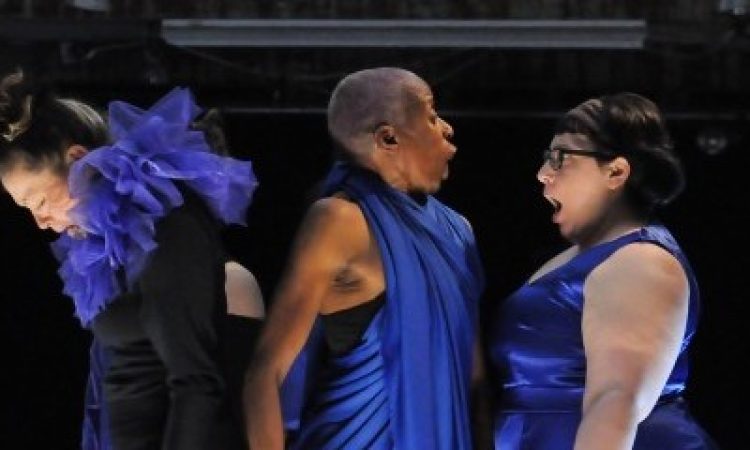
In other works on the program, Ben Grinberg in his To potato alley on its made bravura use of animated pecs and rippled abs while substituting the names of food items to avoid a more serious personal narrative; Sophie Davis and Derek Freeh in Margot Electra Steinberg’s Too Close to Sink brought a dental gloss to the stage with non-stop tooth brushing as they conversed and cavorted with a surprise ending; Kate Seethaler’s wait and see invited the audience to enliven her darkened space with flashlights, sounds and banter; in the more obscure, by title and content, creamanglaise(Ruriden) five dancers in dark blue costumes (Shannon Brooks, Patricia Dominguez, Rhonda Moore, Mira Treatman, and Laura Vriend, choreographed by Annie Wilson) shuffled, grimaced and emoted in directional unison; and Christina Gesualdi offered in Thomas Cole Continued some toned-down or shall I say, tiny irony in the face of Thomas Cole’s grand 19th C. paintings of America’s Manifest Destiny landscapes.
In today’s political environment, to the shouts of “making America great again,” Mascher’s crew has aptly responded with their Ten Tiny Dances.
Ten Tiny Dances, Mascher Space Cooperative, Oct. 26-27.
*Vervet dancers were Erica Corbo, Margot Electra Steinberg, Loren Groenendaal, Curt Haworth, Katherine Kiefer Stark, Eliot Klein, Chloe Marie Newton, Connor Przybyszewski, Andy Thierauf, and Mauri Walton.