An art must forever renew itself. Thus, in a pattern familiar to other dance companies—and, in some ways, to music, drama, and even museums—Pennsylvania Ballet alternates presentations of established masterworks with shorter runs of new, or at least close-to-new, works. After opening the 2018/19 season with Romeo & Juliet, the company’s current program features three contemporary ballets. Following another familiar pattern in ballet presentation, one of these works, Petite Mort, is by a long-established choreographer, Jiří Kylián; one, Evenings, by a hot and happening choreographer, Andrea Miller; and one, The Divide, by a relative newbie, PAB corps de ballet dancer Russell Ducker. Kudos to PAB for bringing out two world premieres—Miller’s and Ducker’s ballets—on one program.
Will any of these dances join the ranks of the “masterworks” over the course of time?
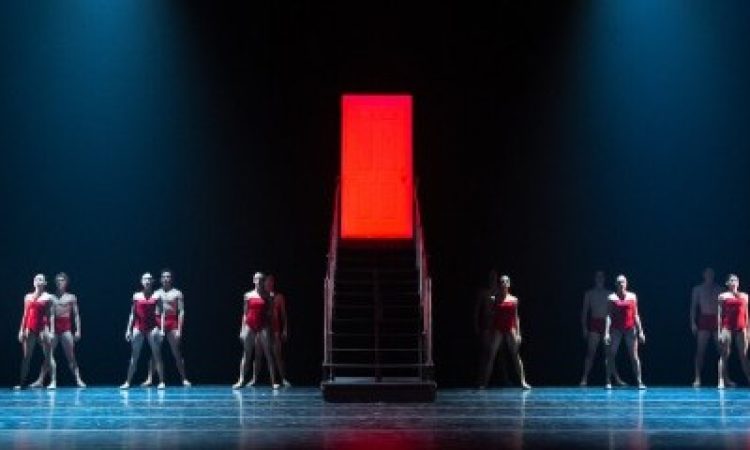
I don’t expect to see Ducker’s ballet again. Despite some striking images, mostly connected to The Divide’s imposing prop, the work seems a pile-up of unrelentingly hectic motion, but toward what end I could not discern. The prop, a large, wheeled black staircase topped by a white door, is in constant motion, powered by the cast of fifteen dancers, who deploy it to move around, climb through and over, cross from side to side, hang from, leap over, push off, hide inside of, and so on … and on. Glenn Branca’s music, the inspiration for the dance, never lets up in volume, tone, or build, which becomes numbing. I gleaned some kind of plot involving a crew in white, led by Ashton Roxander, facing off with a crew in black, led by Zecheng Liang, although eventually most dancers change into red bathing suits (costumes by Martha Chamberlain), enhanced by hot red lighting. Beyond that, I lost clarity, aside from images that kept popping into my mind of Star Wars battleships crawling with combatants wearing various matching sci-fi gear. In The Divide, those combatants periodically break into arabesques and pirouettes.
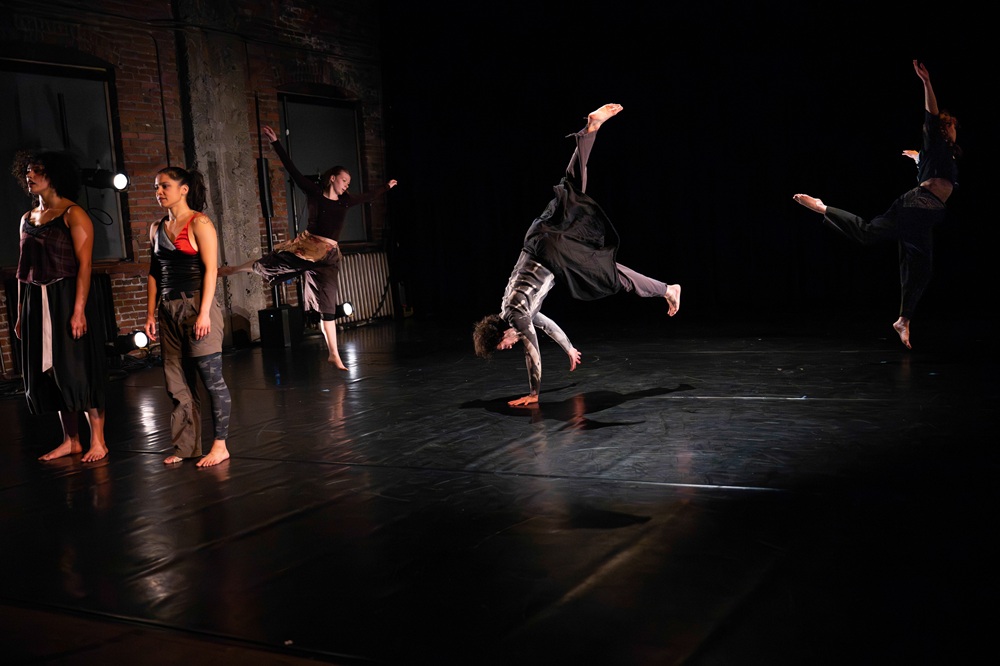
Miller’s ballet too features tormented, struggling figures (only six), although they mostly wrestle alone or in pairs with their inner demons in the dark of Evenings. Exquisite cones of light, designed by Michael Korsch, create the isolation within which each dancer works out his or her peculiar anguish. Moments of stunning vulnerability took my breath away—So Jung Shin, fawnlike, struggling to find her legs, only to fall into the unassuming but protective arms of Ian Hussey; or Jermel Johnson empowering his partner to wrap herself in and through him, but also to push off from his strong legs to stretch yearningly into space. In a solo, the remarkable Albert Gordon teeters upside-down-inside-out until he flops, fishlike, from front to back, figures out how to stand, and finally tears through the billowing space around him. All the dancers (Kathryn Manger and Oksana Maslova round out the cast), reveal their strengths and tender humanity here. Unfortunately, the romantic melancholia of Arvo Pärt’s music pushes the work to the edge of melodrama. I’d love to see the ballet performed in silence.
Nor would I consider the Kylián a shoo-in for masterwork designation, though it is a ballet of tremendous craft. Petite Mort’s opening moments, with six men (Gordon, Liang, Johnson, Hussey, Arian Molina Soca, and Sterling Baca) manipulating swords precisely yet bizarrely—no familiar fencing moves here—brilliantly contrast with the mellifluous Mozart piano concerto that Kylián’s choreography rides. His musical attentiveness can highlight a trill with a hand-flutter or beating leg, or float atop a soaring climax with supported, partnered leaps. His partnering, indeed, unfolds like a primer for the pas de deux, with seemingly endless invention and variety. The puzzle for me is that the ideas Kylián plays with—the swords, for instance, or the stiff dress forms that the women move in and out of at times—seem arbitrary, discontinuous. Still, his facility with movement in space, the rich range of his vocabulary, and the choreography’s musicality make Kylián’s Petite Mort worth seeing, and more than once.
Petite Mort and World Premieres, Pennsylvania Ballet, Merriam Theater, Nov. 8-11