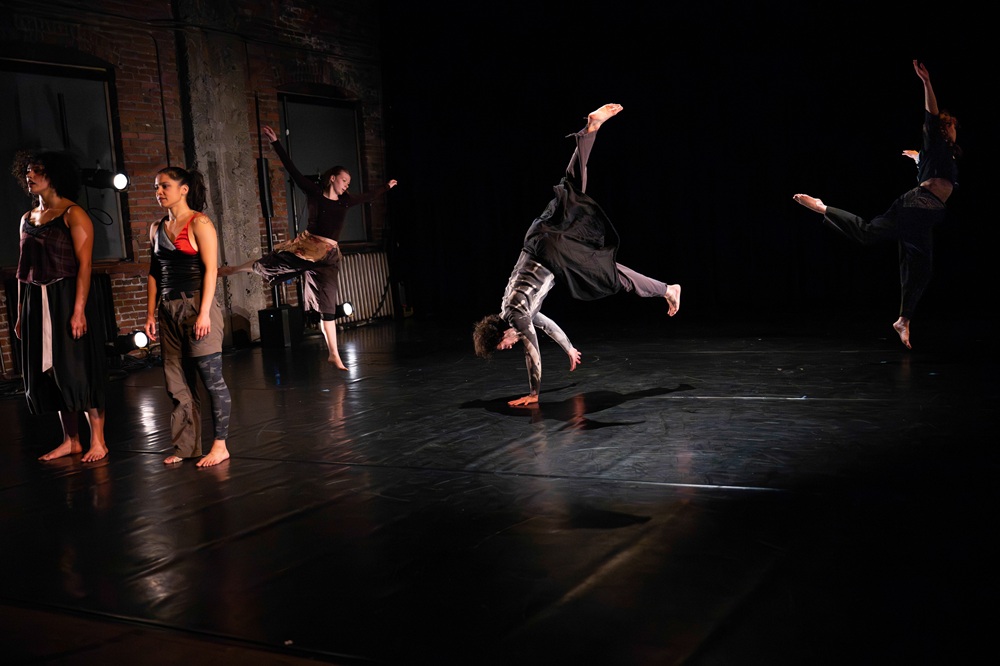
A shirtless, muscular dude. A near-equally ripped woman in jean shorts, long brown hair free-flowing. In Koresh’s Come Together Dance Festival, the opening act—“selected works” by Brian Sanders’ JUNK—the performers move through a series of partnering counterbalances: he steadies her arms as her legs split into a penché, then he lifts her body dramatically in the center spotlight; she uses his head as a balance point, her foot pressed into the back of his neck as she elongates herself upward. In the next excerpt from the company, two women set out a bucket of water and hold a towel to conceal the male performer’s “junk,” before he presses into handstands and straddles, his hands upon the bucket’s edges. I imagine his focus rooted in his own reflection below, though it is invisible to those of us watching. Later in the evening, in Peridance Contemporary Dance Company’s Folie a Deux, two dancers whip and writhe their bodies to a whirling soundscape of strings. In their first moment of contact, his hand reaches for her shoulder. She jerks away from his touch, and again his hand ricochets toward her body.
I couldn’t help but notice how trite the approach to gender felt—or maybe it had just been a while since I’d seen “contemporary dance.”
The festival featured 46 companies over the course of five days, and was advertised as a celebration of “the diversity, creativity, and technical excellence of Philadelphia’s dance community.” Certainly, technical excellence abounded in the ten companies I saw that night. Performative gazes sizzled, legs extended, sweat poured. But watching at least five male-female partnering duets with tired, gendered tropes abounding, I found myself consumed with thoughts about such stereotypical, and in my opinion ultimately harmful, approaches to gender in modern or contemporary dance.
To be clear, not all of the pieces on the bill adhered to heteronormative structures, or left gender unconsidered. A male-female duet by the Megan Flynn Dance Company explored a kind of quirky, wriggling and balletic formalism, while Tribe of Men by PowerMoves Dance Company, featuring an all-male cast of virtuosos in various styles (ballet, breaking, flexing, modern), flaunted masculine power through clearly performative power-moves: headstands, extensions, intricate tutting, and pirouettes. Though Tribe’s program note—“All men are brought together at some point and time”—baffled me, it was clear that these men were openly considering their masculinity and diverse backgrounds through the work.
But in both Roni Koresh’s Wet Stones and an excerpt from Igal Perry’s Dia-MonoLogues, the dancers took turns owning the stage in large unison sections grouped by gender, much like one might expect in the structure of a ballet performance. Here come the men, and off they go. In come the women. Ah, now here are the men again, each finding a woman to partner for the next section. It left me wondering about the strange, amorphous amalgam that is “contemporary dance” in the United States—and about which choices are deliberately choreographic and which are unquestioned (or under-questioned) conventions of forms past, unbreakable.
Come Together Dance Festival, Koresh Dance Company, Suzanne Roberts Theatre, November 14