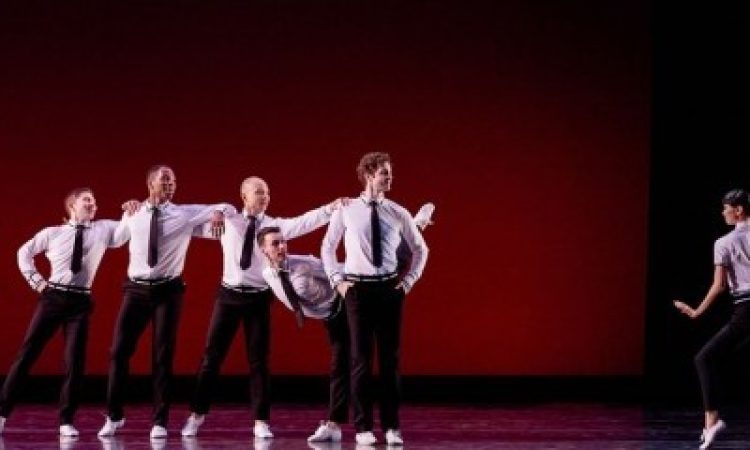
I don’t need traditional gender roles. I don’t need male dancers, by and large, partnering female dancers.* I don’t need voiceovers of Tony Bennett, segmenting the finale of the evening This Thing Called Love, visualized by the male dancers alone. I don’t need dancers slow dancing in male/female pairs, except when a male dancer is otherwise occupied by a solo. I don’t need male and female dancers miming infatuation with each other with weighted glances and sultry winks amidst long penché arabesques and turns in attitude derrière. I don’t need the infatuation at all.
I don’t need Kana Kimura to exit the stage during us/we, a world premiere, and reappear with a huge black tulle skirt pulled over her costume of amalgamated t-shirt pieces (worn by the rest of the cast as well). Members of the ensemble wear scraps of bafflingly political shifts: I see shirts about “the rebellion” and the CNN logo alongside a company shirt for a small dance studio. The dancers intersperse athletic lifts, legs split in grand jetés, with whispers on the potential of humankind when united. In between such sections, Kimura struts around the stage making eyes at the audience. I don’t see what this has to do with anything else. I especially don’t need this in the middle of a piece in which the apparent thematic material is the division of humanity, the sociopolitical atmosphere, and urban environments. Particularly when the majority of the company and the choreographer appear to be white, this is simply tone deaf.
I don’t need to see Jessica Lang Dance because I’ve seen the glossing over of complexity and the harshness of reality in contemporary dance all too often. Despite numerous awards and accolades, including a Bessie Award and commissions from Jacob’s Pillow and The Joyce Theater, I found the work to be pre-digested to the point of blandness and baldly obvious. Nothing I saw was innovative, or fresh, or added any nuance to the human experience beyond “love is when you flirt with the opposite sex and pain is when you writhe on the floor.” I don’t need emotion for the sake of glamour, forsaking any authentic emotional experience.
If you, on the other hand, do need to see Jessica Lang Dance, you had better do it soon. The company announced that it will be folding in April in a press release, noting that, “Ms. Lang will continue her creative work as a choreographer, working with companies around the world.” A New York Times article cited the financial difficulties of managing a small company as a contributing factor, in addition to Lang’s desire to return to creating dance full time, uninhibited by administrative responsibilities. According to a WHYY article, she already has a few choreography gigs lined up.
*Based on the pronouns used in the bios of each artist, it appears that all dancers in the company are either male or female.
Jessica Lang Dance, Zellerbach Theatre at the Annenberg Center, Nov. 30-Dec. 1.