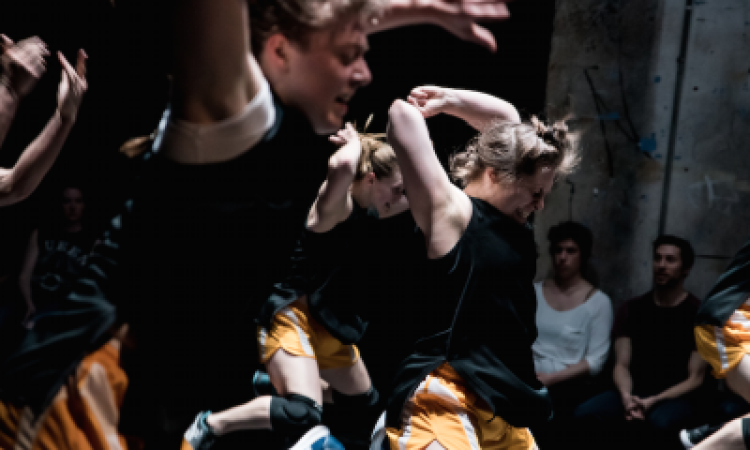
Whip, sweat, stain, groan, moan, hit; shock, surprise, frustration, pain, excruciation, ecstasy. Sitting in what feel like courtside seats in Abby Zbikowski’s abandoned playground, I feel the life of the movement on my skin. The space is awash in exhalations often culturally linked to sex or violence. The animal body. The body as energy.
Before the piece begins, the nine dancers generate molecular heat in the space, warming up, dabbling in phrase material, bouncing, shaking. As the lights dim, I am held in the moment with them, the precious calm before the marathon begins. I feel adrenaline within me as if I, too, am about to perform. Raphael Xavier’s soundscape starts to pour into the room; it mimics the dancers’ vibrations as it builds in intensity. And then, in an instant, the roar gives way to silence.
We are here. The bodies will undertake it all. For the next grueling hour, with minimal intrusion from recorded music, the rhythms of work catapult from these bodies reaching and surpassing the limits of exhaustion.
While the movement remains unrelentingly clear and sharp, in the dancers’ strained facial expressions and exclamations I see and hear the fight happening. It is the struggle against natural momentum, against flow, of swimming upstream. They fight for movement that contains no excess, bodies slicing through space. In solos and labyrinthine group sections, I see the dancers push back against the scream of lactic acid and the body’s need for full gulps of air to deliver solid muscular facts. Sweat flings off of their bodies, which brush millimeters away from us. Rhythms arise from breath, sneaker skids, palms pounding the marley.
There are moves which recall other forms, chops from break dancing, headstands from yoga, footwork from top rock, heel digs from house, kip-ups from capoeira. Characteristics have been adopted and some have been abandoned; it’s a hodgepodge that’s been formalized, its excess and context sloughed off to put the focus on pure power. The performers I am most drawn to throughout the hour maintain a largely inward gaze. Their eyes are not searching for some truth beyond but rather alerting me to the fact that the meaning is here, in the flesh and in the sweat. The anguish and power are happening solidly in a plane we can see, touch, and hear.
In one of the final sections of the piece, the focus seems to be on the repetition of near-misses: an arm swipes out of the way just in time. Another dancer slides past inches away from an armpit and catapults into a somersault. As the dancers reset and run through the pattern again, I notice some of the first smiles of the evening appear on their faces. They lock eyes with one another, grinning, ready to begin again. Throughout the evening the support the dancers show to each other constitutes a necessity, a life force. They call out to each other the way a coach or supporter in the stands might: “You got this, Jen!” “That’s it, Fi!” Having once performed in a student piece of Zbikowski’s at the American Dance Festival in 2015 that ran about a fifth of the length of this one, I can only imagine the emotional support needed to keep going for an entire hour. As audience members, we largely hold back in our vocalization (with some enthusiastic exceptions). Were we seated in an arena, a club, or a basketball gym rather than a black box theater at Bryn Mawr, I wonder if the same would be true.
The piece concludes with a solo by Justin Faircloth. In the wake of the electric energy that’s been generated onstage, he moves through a concluding sequence that’s both full-bodied and slower in pace. By now our ears are well-tuned to the dancers’ grunts and exhalations, and we listen as he releases his breath with each movement. When he’s left us with all he has, he walks off into the darkness.
abandoned playground, Abby Z and the New Utility, Hepburn Teaching Theater at Bryn Mawr College, Dec. 7-8.
(Carolyn Merritt interviewed Abby Zbikowski for tD in May 2017. https://thinkingdance.net/articles/2017/05/10/Extreme-Physicality-An-Interview-with-Abby-Zbikowski)