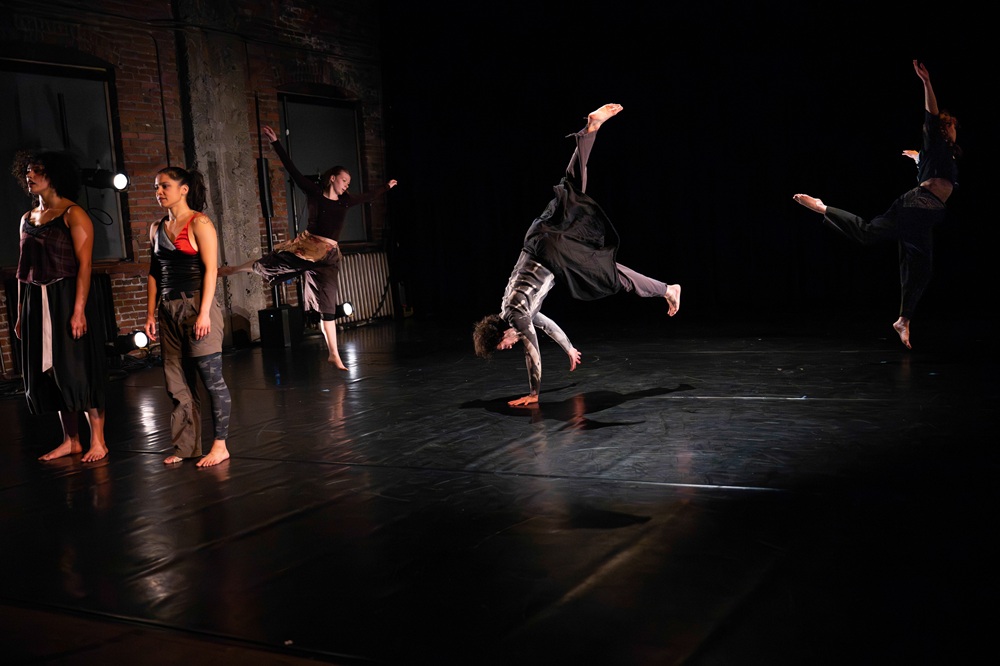
The Mascher Space Cooperative catalyzes punchy, relevant, demanding performance. The recent showing of Polish Dance Artists in Philadelphia, curated by Zornitsa Stoyanova,* brings work from two artists from Poland, Wojciech Grudziński and Aleksandra Borys, and the Philadelphia-based Stoyanova. Each artist, in some way, explores the presence and impact that humans make on, with, and beyond the earth. The Polish artists’ residency was supported by Art Stations Foundation and the GPS/Global Practice Sharing program of Movement Research.
Solo and Untitled by Zornitsa Stoyanova
In darkness, Stoyanova attaches tiny lights to her bare calves and arms. I can see her only through brief shocks of light against her body. As she sways, these lights illuminate the silver landscape of mylar at her feet. Crinkly sound cascades with each determined step, accompanied by space-age tones and voice-recorded text: “The international space station circles the earth, an image of humanity’s achievement.”
Stoyanova recognizes that mylar, this space-age, polyethylene material, has taken on new meaning with its use as emergency blankets for refugee children at the border. She lifts a leg up to a half-bent shape, slowly replacing it with the next leg, to progress across the mylar landscape. She angles her hip to one side, then an arm to a T-shape, breaking fluidity into disjointed robotic gestures. “Reflecting and diverting our attention. Making what’s inside it invisible to our senses,” goes the text recording.
The mylar fills with air, becoming a bubble that reaches her height. She edges along it sideways, her face contorts between pleasure and horror, as the once peaceful sea of sounds gives way to soundbites of shuffling and childrens’ voices overlain with Stoyanova’s text: “The children/The children of others/The ones escaping….”
The mylar bubble grows until it consumes Stoyanova’s body. As she slips out of sight underneath the shining mass, we confront the technology that enables humans to expand beyond limitations, as well as to constrict others’ ability to do the same.
POPULUXE by Wojciech Grudziński
In a short flowered skirt and pale pink tee, Grudziński spills shards of shiny black broken plastic onto the floor. He carefully builds a crystal that juts out from his stomach by stacking one shard at a time. They break and spill again. He lunges down, sprawls his legs out and fans himself with the largest piece.
Populuxe (conflating popular and luxury) emerged in the 1950s as a consumer cultural esthetic that adds futuristic design to everyday objects, especially architecture and furniture: luxury of the future for everybody, now. In a scaled down version of his work, Grudziński creates a Populuxe body which expresses the “vulgar joy of being able to live so well,” his program note proposes.
Grudziński leans forward onto his hands, dropping his head down, knees bent and butt towards the audience, exposing his male package in white briefs—an act repeated throughout. He slaps his thighs together rhythmically. Then with a silent lion’s roar and eyes wide open, he forces his tailbone down, undulating his spine up and backwards, wrenching every muscle. Purposefully strained, yet graceful, he lowers his body close to the floor, mouth still wide open, full with the privilege to consume everything.
Momentum when matter meets antymatter by Aleksandra Borys
Borys typically explores dance in a natural environment. The challenge for this Mascher performance and a prior one at Movement Research lies in translating that experience for the first time within a more traditional, indoor audience setting. She enters in a t-shirt and jeans, carrying a thin, naked branch. She walks midway to the upstage-left corner and wraps her long brown hair around the branch, letting it dangle, then drops her body to the floor. With lightness and precision, she swivels her body around itself, pushing from one arm and sliding in a circle. Her hair hangs over her face in a mess, the branch tangled in it, acting as an extension of her head, a horn. Sometimes the branch directs her next move. It pushes her along the floor, then up along the far wall. Often, her movement is so slow, almost imperceptible.
The only sound is liquid dripping within the Mascher heater, the overlapping shouts outside of people on the street, and long silences with only the occasional creak of an audience chair. Borys remains in the far corner for the duration of the piece, and I focus intently to discern the curl of her fingers. She is in no rush to show us anything.
Borys joins a long lineage of improvisational dance artists whose work has been rooted in the natural environment: Anna Halprin, Eiko and Koma, and Andrea Olsen, among others. While she may not be alone in this exploration, her approach is also authentic, and the translation is pleasing.
Polish Dance Artists in Philadelphia, Mascher Space Cooperative, Dec. 14 and 15.
* Stoyanova has been the Programs Coordinator for Mascher Space Coop, and is also a writer for thINKingDANCE. Janna Meiring was an artist-in-residence at Mascher in 2018.