In a quest to reach new audiences for performing arts in Philadelphia, Theatre Philadelphia and thINKingDANCE are joining forces and exploring how dance writing and discourse can provide new perspectives on theater. Beginning May 2018, tD writers have been lending their varied backgrounds, interests, and approaches to criticism to professional works of theater in Philadelphia. Let us know what you think in the comments!
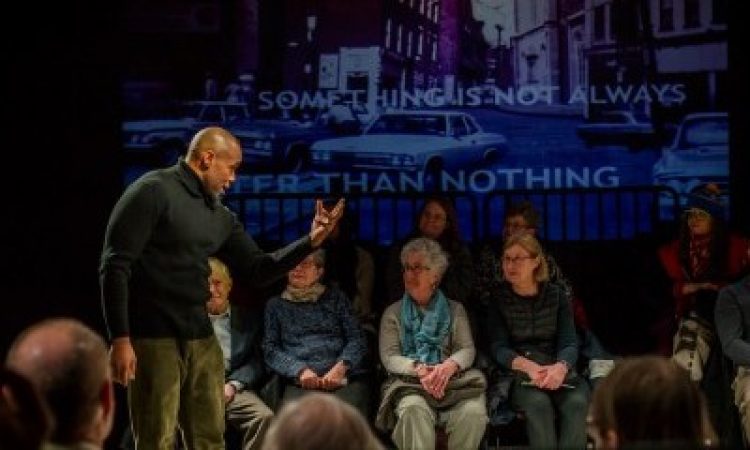
At the top of How I Learned What I Learned, August Wilson‘s autobiographical one-man one-act, I detect the slightest note of nerves in narrator Kesserack’s voice. He quickly finds his groove, sharing anecdotes of Wilson’s life growing up in the Hill District of Pittsburgh. Phrases and names from that life appear on the walls around Kesserack; his genial welcoming of each image feels like a reaction akin to being casually interviewed by an old friend. A few minutes into the play, I’ve bought it; I’m in deep with it. When “Oral Sex” pops up onto a wall, Kesserack/Wilson smirks at the audience with a sly, “We’ll save that one for another time” look. I laugh with as much mirth as anyone else there.
We learn early on that Wilson dropped out of high school at 15 and the stories that follow could be traced as a literal explanation of how he learned what he did: how he continued his own education outside an institutional structure, how he determined to teach himself to write poetry and later theater. Yet, the play functions more as a wash of experiences illustrating how Wilson came to understand the world around him and where he stood in it. The stories that he tells of racism and prejudice, violence and drugs, are often stories of boxes the world placed him in. In contrast, the stories he tells of a young kiss, seeing a crowd of people outside a music venue listening to John Coltrane’s jazz waft into the street, meeting his wife Constanza Romero, are experiences in which he found incredible, almost reverential beauty. The language is a gorgeous mix of the colloquial and the evocative.
Kesserack does the role, originated by Wilson himself in 2003, complete justice. In an interview, director Malika Oyetimein described Wilson as “an everyday man’s prophet,” and that’s exactly how Kesserack portrays him. The combination of the intimate, in-the-round theater and Kesserack’s benevolent delivery of Wilson’s powerful truths permits audience members to engage audibly with the work in a manner that resembles call and response. Folks giggle and guffaw, vigorously nod, let out audible “mmhmms” and “yeahs.” The fourth wall is porous. The space feels comfortable, somewhere between presentation and sermon.
Early in the play, Kesserack wears a simple black t-shirt with the words, “I am supposed to be white” across the front and “I am an accident This did not turn out right” down the back. Costume designer Amanda Wolff achieves a stark contrast between Kesserack’s corduroy pants, peddler’s cap, black knit turtleneck, and the blunt shirt over it. There’s a wryness to this and a certain dry sarcasm as Kesserack meanders about us, gesticulating as he muses on certain folks who claim to be “colorblind” when it comes to race. At a later moment, a confrontation with a friend is personified by a few seconds of irate-sounding jazz. Together with Wolff’s costuming, the lighting/video design and sound design, arranged by Matt Webb and Larry D. Fowler Jr. respectively, subtly further the tale without dictating where the story goes before we actually get there. For example, certain quotes of Wilson’s appear on the walls word-by-word just after they leave Kesserack’s mouth, not beforehand as though they were cues. Elements like this keep the story and its teller at the forefront of experience, with design in a successful supporting role.
How I Learned What I Learned plays through April 14 and coincides with Wilson’s Gem of the Ocean, the first in his ten-part American Century Cycle. As noted in the program, this is the first instance where two productions by the same writer will run simultaneously at the Arden.
To join the conversation, follow thINKingDANCE and Theatre Philadelphia online and on social media to read, share, and comment.
How I Learned What I Learned, August Wilson, Arden Theatre Company, Bob and Selma Horan Studio Theatre Stage at the Arden, March 7 – April 14.