In a quest to reach new audiences for performing arts in Philadelphia, Theatre Philadelphia and thINKingDANCE are joining forces and exploring how dance writing and discourse can provide new perspectives on theater. Since May 2018, tD writers have been lending their varied backgrounds, interests, and approaches to criticism to professional works of theater in Philadelphia. Let us know what you think in the comments!
Part of the curated Fringe Festival, Cartography, created by Kaneza Schaal and Christopher Myers, tells the story of four young people seeking asylum during the refugee crisis that began in 2015.
The pre-show music and house lights fade as a projection of the ocean, no land in sight, illuminates a white wall of stacked boxes. A pool of light reveals Victoria Nassif crouching upstage. She begins to sing, first softly, then more powerfully, filling the space with her voice. She passes the song to Malaika Uwamahoro, then Noor Hamdi, and finally to Janice Amaya, each singing in their character’s native language. The song resolves with a blackout.
Ominous, foreboding music transitions us to a scene of waiting. The actors banter back and forth about the daily complications and frustrations of applying for asylum, waiting at borders, filling out paperwork, and passing the days not knowing the next step of their journey.
Vignettes of the four performers chatting about their status as refugees make up the majority of the show. They rearrange painted cardboard boxes to form minimalist sets, indicating a new location and the passage of time.
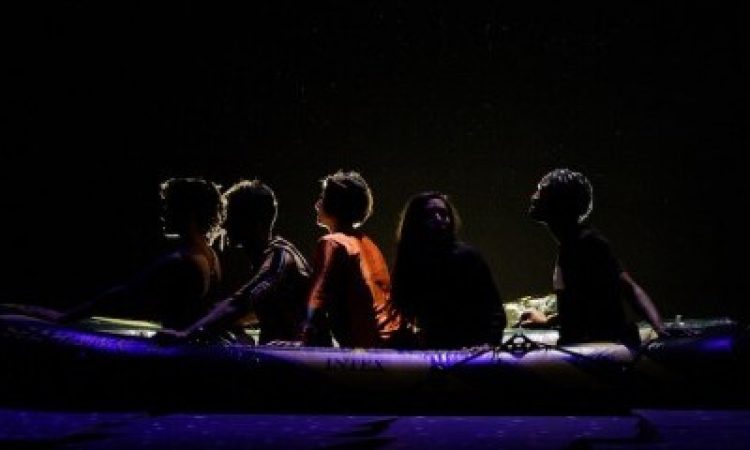
The actors pull out a rubber raft and start inflating it with a hand pump as Nassif tells a vague story about a boy. The other actors interrupt to add details of their own creation to this seemingly fictional story of a boy who migrated in a time before papers, asylum, and border agents.
I find myself wondering why the writers included this dialogue about the unnamed boy. Is it a universal metaphor for migration? A collectively told tale to pass the time while the actors inflate this raft? At this moment I am craving more depth from the characters’ own backgrounds. We hear fragments of their histories, but every time they approach a moment of specificity, another actor interrupts or the scene breaks. I wonder if the characters represent a collage of refugees as opposed to specific people.
Once they inflate the raft, they lift it onto the boxes that now cover the floor forming a raised platform for the raft to settle. Nassif manipulates an aluminum blanket, effectively creating the sound of waves before joining the others to set sail on the cardboard sea. This image conjures the photographs that once flooded the news of desperate migrants sailing, swimming, and floating away from their homelands in hopes of finding refuge.
Uwamahoro steps out from behind the white wall, now reconstructed downstage, and launches into a monologue. Her character’s accent is gone she tells her personal migration story. Each actor follows suit, taking the stage to share their personal stories. Breaking the fourth wall, they address us directly, asking us to take out our phones and go to map.com. We input our own family’s migration pattern.
A map of the world projected on the cardboard wall starts filling with pathways that jump across oceans, continents, and borders as we submit our own data. This visual representation powerfully indicates the reality that most of us descend from, or are, immigrants.
People migrate. Sometimes by choice but often by force, be it war, climate change, oppression, or violence.
Hearing the actors’ personal stories and seeing this map of migration grounded the performance and connected the actors to the audience. I empathize with Amaya as she speaks of tearing down fences. I am drawn to Hamdi as he tells of imagination and invention. The actors’ stories out of character are specific, but I crave this specificity from the characters. The fictional characters just speak of the maps that brought them here. I want to experience their topography, the details of their stories; not just the zoomed-out picture.
Cartography, Kaneza Schaal and Christopher Myers, Christ Church Neighborhood House, Fringe Festival 2019, Sept. 12-15.