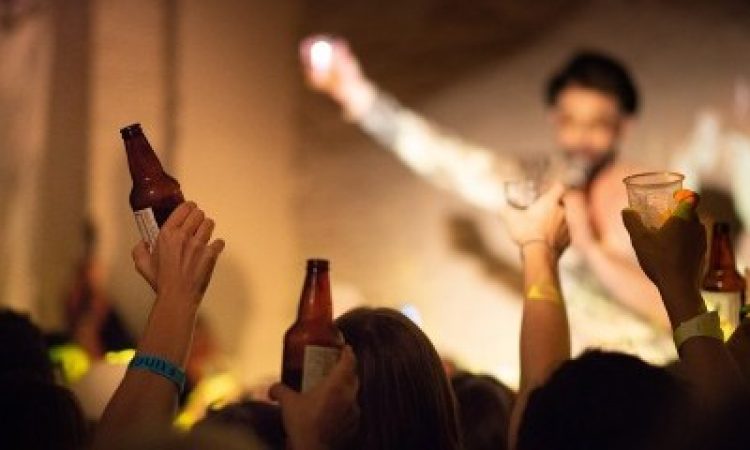
I’m down on South Philly’s Electric Ave., in a queer haven enjoying Late Night Snacks, an after-hours performance featuring different artists every night of the Fringe Festival. Tonight’s bill is hosted by US, otherwise known as Anthony Martinez-Briggs. Before the moon baby (intentional lower case), who serves a traditional cabaret meal of pop covers clad in a fluttering goldfish-esque mini dress, is the incomparable Miguel Gutierrez in his performance of SADONNA—One-part sad, one-part Madonna. Or, one-part Gutierrez, three-parts Slutinos, the sad Latinx boy-band trio of backup singers.
“Do you believe in love? ‘Cause I got something to say about it,” Gutierrez asks. A loop-y beat submerges the room in an ocean of synth. “Satin sheets / are very romantic / but what happens when you’re not in bed?” He sings a delicate love-song rendering of Madonna’s hit to open his set. Then, he speaks of how the SADONNA tour is ending, and as with the death of a friend, he finds himself making peace with it before it happens. A slight tone of parody in his voice elicits some laughs—it’s hyper-fragile, drawn up one octave. The ensuing performance draws us into the space(s) between queerness, death, and life.
As Gutierrez speaks, a familiar melody drips, in perfect harmony, from the lips of the Slutinos—a slow, jazzy rendition of Madonna’s “Holiday.” He proclaims, “I know I’m not the best singer. And I know I’m not the best dancer,” and tells us what his fans no doubt already know, “but I’m not interested in any of that. I’m interested in pushing people’s buttons. In being political.” After covering “Holiday” they move on to “La Isla Bonita,” emphasizing, to my delight, the awkward moments where the song transitions back into English from Spanish.
Though at the beginning Gutierrez claims the show “kinda wanders and has no center,” the final song, a cover of “Vogue,” has immense gravitational pull. Towards its end he stops singing Madonna’s lyrics and begins, instead, to speak the names of legendary houses from New York—the originators of the Vogue culture that she co-opted in her hit single. “House of Xtravaganza. House of La Beija. House of Ninja. House of Mizrahi.” I think of #SayTheirNames and its importance in allowing the often invisible to be seen as artists gain clout by stealing from queer communities of color, from trans women. “They have style! They have grace!” he yells as cheers of affirmation erupt from the audience. “They never stood around! They just move! They do it! And when you struck a pose it’s ‘cause they went through it!”
It ends with the chorus, filled with rage, with mourning, subverted and haunting:
“Vogue!
Vogue.
Vogue.
Vogue.”
Fringe Arts Festival: Late Night Snacks, Miguel Gutierrez’s SADONNA and the moonbaby, 1316 Percy St., 2019 Fringe Festival, Sept. 13.