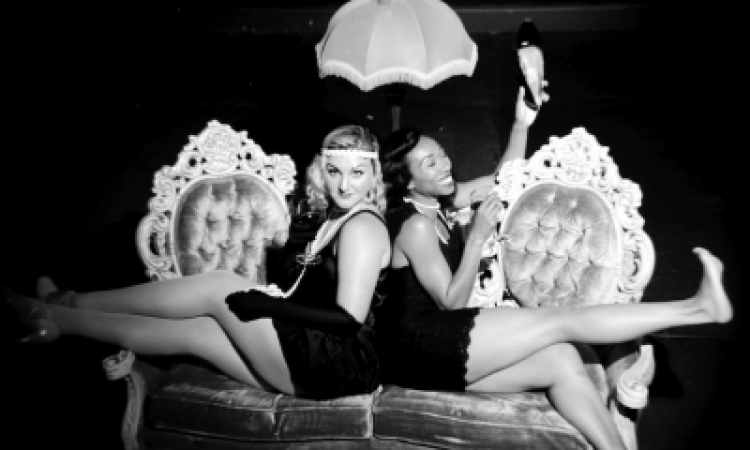
At The Murder & Booze Cabaret, I traveled back to the time of Prohibition. In black slips and long strands of pearls, two female singers (Allison Boyle, Camille E. Young) belted with their voices, showing off impressive ranges. Accompanied onstage by a soulful guitarist (Sam Kwietniak), the three mixed modern pop songs with the jazzy musical style of the 1920s. Songs from Nirvana, Lizzo, and Green Day popped up intermittently throughout the cabaret. They did the Charleston while singing “Who’s that girl that’s rockin’ kicks?” I most enjoyed watching the intensity build; when they surrendered to the notes, my heart both raced and melted.
The show referenced popular theater tropes, like the murdering wife from Chicago who stumbled into a life of music and liquor. Young’s character defended herself against accusations of murder, but was thereafter cornered into confession through interrogation. We learned that people were selling merchandise during her trial and she was the first woman to be sentenced to death by electrical chair. The bright side: “At least she got press.”
Ultimately, the murderess blamed her wrongdoings on gin. There was a lot to “blame on the alcohol,” as the Jamie Foxx song goes. In a slow rendition of “Toxic,” Young distanced herself from a glass on the stage. She crawled towards, rolled around, and lifted it to eye level, pouting disapprovingly, as if scolding it for causing her downfall.
As the show continued, other stories surfaced. Young and Boyle declared that “Babe [Ruth] had a soft spot for prostitutes,” then sultrily sang “Womanizer.” One songstress stood on the furniture and said, “Any woman who doesn’t want to fuck can leave now.” She extended a baseball bat upward from her groin and sang “Hit Me Baby.”
Murder & Booze was poorly billed as a cabaret. The show reached towards a cohesive plot within the context of a cabaret but fell short, fumbling an attempt at history lessons on topics like Prohibition and feminism. The show as a whole felt slightly misguided. Yet, I saw value in attending a show to merely sit back, sip a drink, and be entertained. With one of my favorite friends next to me, listening to well-trained artists in a relaxed environment, it was the perfect way to end my Fringe season.
The Murder & Booze Cabaret, Love Drunk Life, Arden Theatre Hamilton Family Arts Center, 2019 Fringe Festival, September 6-8, 19-22.