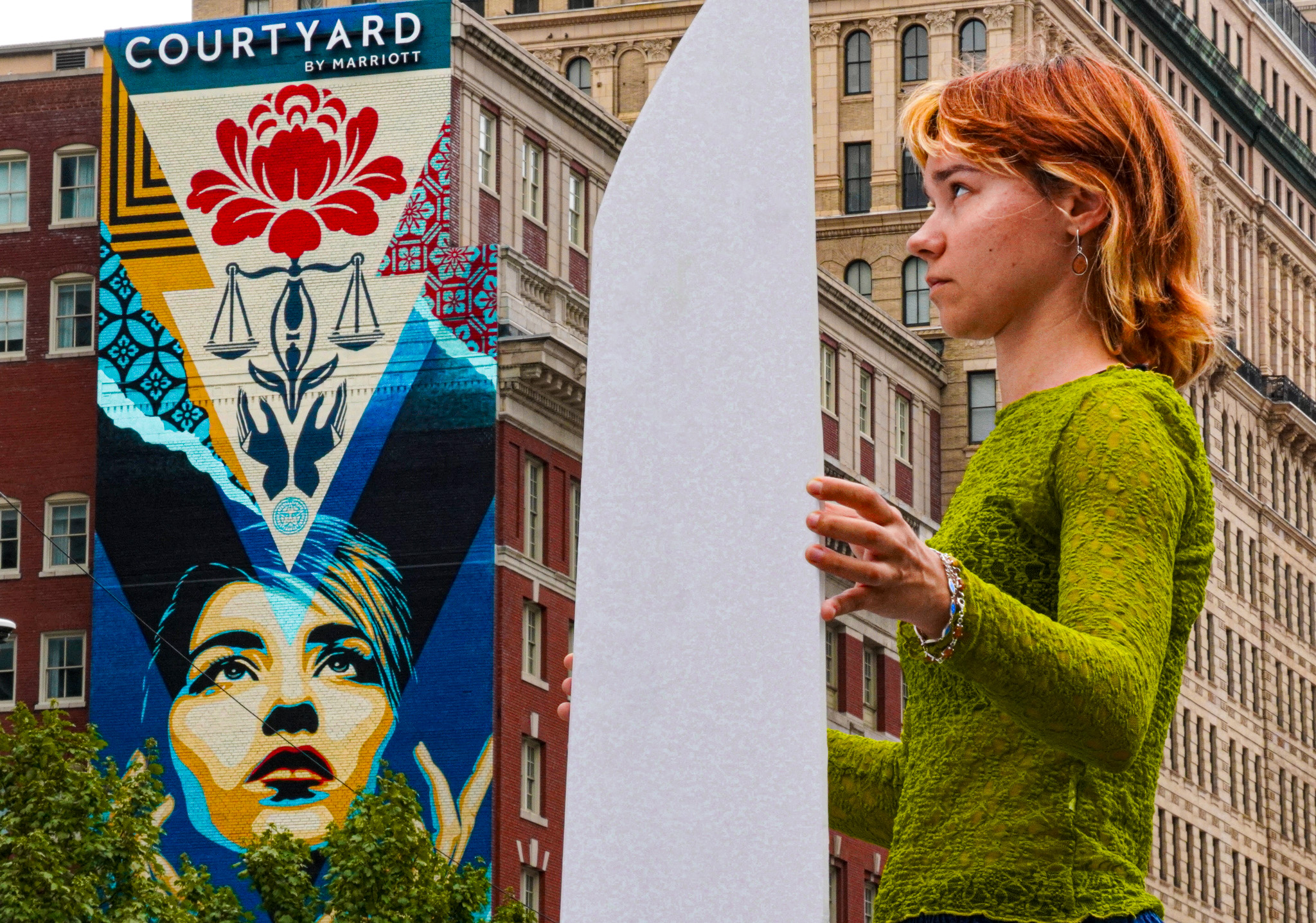
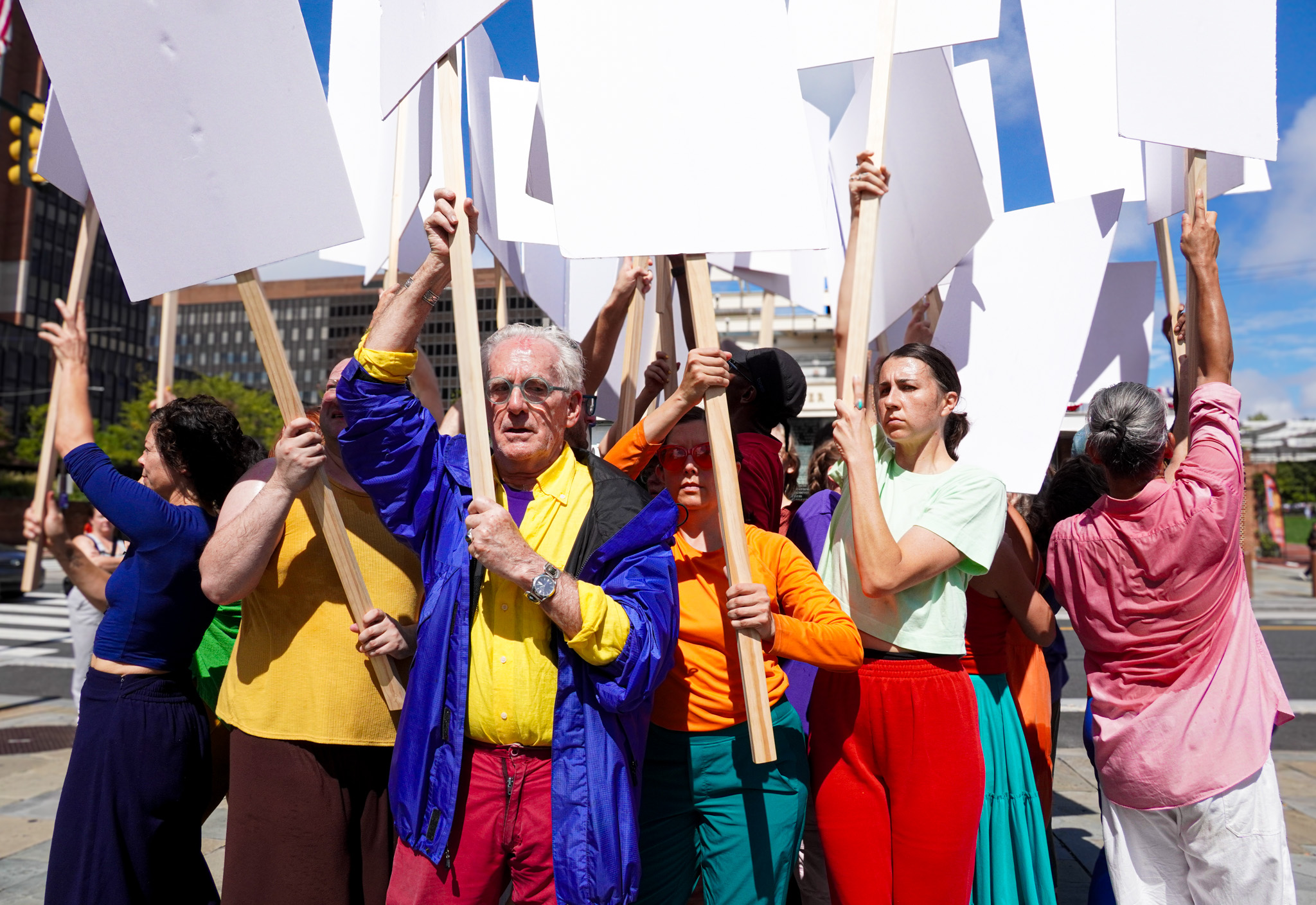
“The awkwardness of it is what gives it life,” a recorded voice speaks. Dancers shift position, posing with hands placed on each other in deliberately casual postures, their eyes looking off into the distance at something captivating but unseen. These moments of living statuary anchor Leah Stein Dance Company’s Close to Home, inspired by the paintings of Philadelphia local Edith Neff. Unfamiliar as I am with Neff’s paintings, the performance captures an ambiguity around staged realism, playing with casual and deliberate, spontaneous and formal, watching and being watched.
Gabrielle Revlock shifts like a teen girl looking in a mirror until laughter erupts from the speaker, pulling her into explosive movement. Michele Tantoco and Maddie Hopfield* press the other into different shapes, resulting in an awkward, playful molding dance.
Recorded and live speech, snippets of interviews about Philadelphia and Neff’s paintings, thread through the performance. The live speech, often a string of single words punctuating rhythmic movements, occasionally feels too oblique for me to connect with. The recorded speech provides juxtaposition and layering, as in Tantoco’s solo.
She starts in the corner, caressing the floor with her feet, letting the slithery movement travel up her body and take her swimming across the floor. Recorded voices speak about their experiences with segregated pools in Philadelphia, a nod to Neff’s Swimming Pool at Hunting Park. Tantoco’s swimming uses the whole space—her feet slide across someone’s discarded program; she rebounds off the wall between two audience members.
Stein uses the small space creatively. It never feels crowded, even with an ensemble of eleven. Eventually, we are invited to look out the windows. The performers are down there, weaving through the South Philly streets, playing and interacting with their environment. They pause in the middle of movements, transformed into momentary paintings, which we view through window frames. Two Mummers in fancy dress join, playing sweet accordion music that sails through the windows.
Later, we move outside to watch them. I’m filled with a sense of contemplation and nostalgia, a similar feeling to considering a beautiful painting. I am aware, as are Neff’s paintings, of the complexity inherent in these feelings: how Philadelphia is changing, how issues of race and politics are present in these quaint scenes. In Close to Home, these issues coexist with the beauty of human beings, living sculptures, at work, at play, at life.
Close to Home, Leah Stein Dance Company, The Art Room Studio, 2019 Fringe Festival September 21-29.
*Performers Maddie Hopfield, Graciella Maiolatesi, Jonathan Stein, and LSDC Administrative Manager Mira Treatman are writers for thINKingDANCE.