Has anyone ever been scared to walk home, alone, at night?
A dancer asks this question in Megan Mizanty’s work Laura, part of the Dance Alumni Showcase at Temple University. Mizanty responds to the question through the lives of women: violence (both experienced and as a constant potential) and the strength of friendships are seamlessly interwoven through movement, text, and sound.
Laura begins with a body, face down on the ground in a pool of light. Sienna Martz created the soft sculpture installations that frame either side of the stage in Conwell Dance Theater. A line of police tape runs across the middle of the stage connecting the two sculptures. The dance takes place in front of the police tape. The sculptures are red objects protruding up from the ground like coral or stalagmites. They initially appeared to me as the backside of torso-less legs but by the end of Laura, they were penises growing ever larger, encroaching on the space.
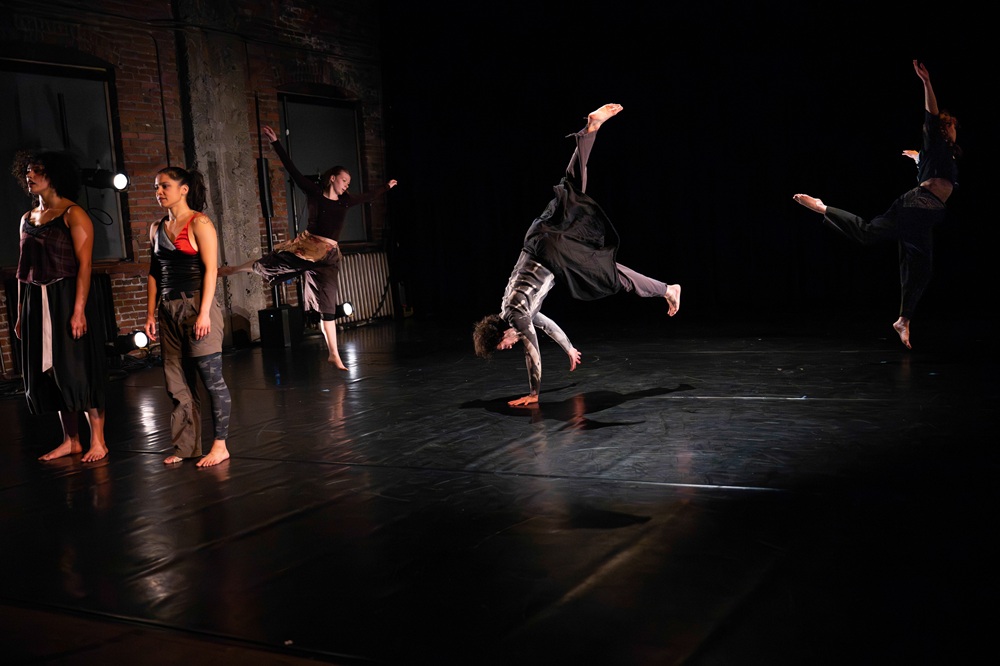
Throughout Laura the dancers alternate with ease between gravity and levity. Three dancers, playing crime scene officers, take pictures and notes over the dead body, while inserting commentary about dry shampooing (it’s a time-saver but bad for the environment). I notice how familiar it all seems, my imagination shaped by TV crime shows, particularly Law & Order. The Laura dancers evoke the show’s tropes. In a clever play with words and media images, the dancers hum Law & Order’s theme song and punctuate the ending with the name of the show’s creator, “Dick Wolf.” Later, Larissa Asebedo walks towards the audience and the lights brighten. She asks us, “Has anyone ever been scared to walk home, alone, at night?” She shares her experience, when a man followed her home with his hand in his pants. As we take in the gloom of this familiar story, Asebedo lightens the mood to talking about television. She tells us she is watching Charmed, a show about three witches whose magic becomes more powerful when they are together.
The dancers in Laura are strongest together. Early in the piece they lightly touch the blood splatters on each other’s clothes, they stand in a circle noticing each other, inspecting, inquiring. When they are together, they alternate partners, one draping her body over another’s back. Hands reach out to help another up. There is playful banter when two dumpster-dive for a couch. Madi McGain plays the role of the couch—her body folding in half to offer support, her knees knocking inwards, stiffened so the other dancers can lift and place her in spots throughout the stage. The solos in Laura did not effectively carry the story or emotional content forward, and the solo movement was harder for me to remember: arm swipes, turns, and rolls that filled in gaps between the stronger group and vocal work.
Nearing the end, the four dancers stand together under a glow of red light. In slow motion, their arms cover their faces, they punch into the darkness and they recoil from attacks. Watching them, I notice how often I think about violence towards women. One by one the dancers leave the space and we are left with the initial image: the body of a dead woman, face down on the ground.
Sharing the bill was Anne-Marie Mulgrew and Dancers Company, who presented Strange Dreams: 30 Years Later (2018). The company of seven dancers, with cameos by Mulgrew and Joseph Cicala, presented 13 sections, each representing a different dreamscape. Mulgrew invites the audience to “join us through unknown realms of the imagination where anything is possible.” I found myself entering a dream state in Cicala’s cameos when he walked across the stage in a suit, his face barely visible under a large umbrella. The randomness of the promenade and the creepiness of his presence felt most reminiscent of dreams.
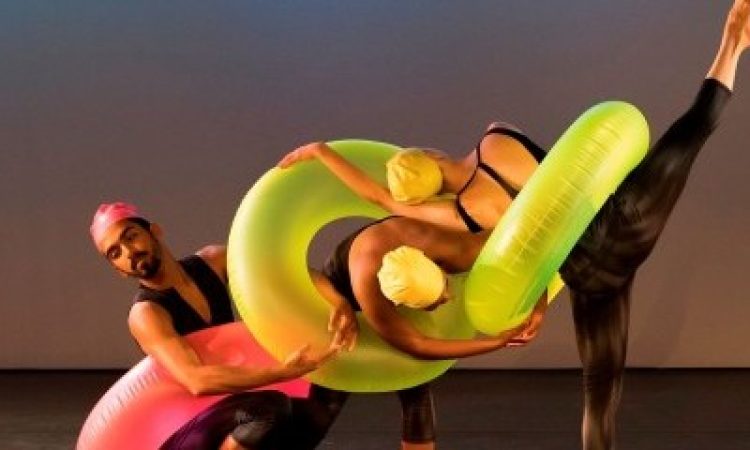
Other sections highlighted color and the dancers’ exuberance. The dancers in “Inflatable Dreams” wore fluorescent green, pink, and yellow colored bathing caps and carried large, similarly colored inner tubes. Throughout the section, the dancers alternated between lounging on the tubes and playing with them. The program notes encouraged the audience to join the dancers on the ride, and I enjoyed the colors, the dancers’ joyful expressions, and how they spun, threw, and twirled the tubes. Another section, “Sad Cat” featured a solo dancer moving to a sound-score titled “Sad Cat Diary.” The cat was deadpan humorous, calling his owners “authorities,” while the dancer pawed, twitched, and chased like a cat, but also maintained a human elegance. Her human-cat quality allowed for a dreamlike state where both the cat and the human intertwined.
Some of the sections relied on wild costuming to create a dream state. There were bright clown-like tutus and many yards of white gauze, but the relationships were the stuff of real life. Most of the sections were entertaining, like the two men who met in a Parisian café and court through a highly technical social dance, but I did not feel a dream state. The stage went black in between vignettes, so ideas, characters and images did not transform from one to another the way dreams transform and shift. Strange Dreams ended with a lullaby as the dancers’ hands released white fabric that fluttered through the air to the ground. It was a satisfying image that prompted a feeling of calm as the night ended.
Dance Alumni Showcase, featuring Megan Mizanty and Anne-Marie Mulgrew and Dancers Company, Conwell Dance Theater, Oct. 18-19.