When I left Mascher Space Cooperative after seeing “Two Short Dances,” I found myself wondering how short a dance must be to be called short. The two pieces—the first by Meghan Frederick and Kate Seethaler and the second by Mira Treatman*—didn’t feel like the kind of short, rough-draft work that I had expected. Instead, I saw two thoughtfully crafted, albeit very different, works-in-progress.
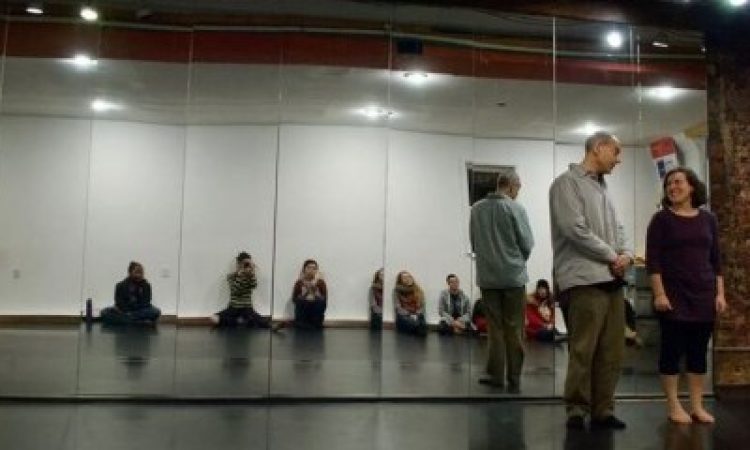
“Two Short Dances” was the inaugural show for Mascher’s new space, located not far from Mascher’s previous home of 14 years. The site felt fresh with soft lighting and white walls—although before the show started, I noticed two walls had bright orange tape on them—and a floor that didn’t feel like it was going to break if jumped on too hard, as in the old space. The space retained Mascher’s emphasis on experimental creation over high production. This was clear when I first walked in; groups of people stood around the space talking and sipping drinks from the concession stand. The artists alternated between stretching on the floor and greeting audience members as they arrived.
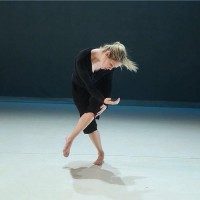
Meghan Frederick and Kate Seethaler’s Carnivore is the third of three research performances that form a year-long project, which the duo hopes to synthesize into an evening-length work. The confident spatial and temporal choices make this piece strong. Frederick begins the performance with a diagonal walk upstage where she freezes, facing a chair in the corner, her stance wide, arms outstretched above and to the side of her. Almost imperceptibly at first, she moves through a slow and smooth pattern of poses around and eventually onto the chair, where she gazes at the floor as Seethaler enters the space. In contrast to Frederick’s controlled movements, Seethaler spirals and sails around the stage, with movements that feel free. Towards the middle of the work, the pair trade roles; Frederick whirls in and out of the floor, while Seethaler slows and becomes calculated with her movements.
Throughout, the performers only come close to unison a few times, but other elements bind them together. Each has a costume change—putting on or taking off sweatshirts and pants that reveal more orange tape, this time on their chests and torsos. Both grotesquely chew and slurp at the air with their mouths. Their breath accompanies the mostly silent piece, although at one point, cinematic music breaks the silence and encompasses the two dancers. A striking moment came towards the end, when Frederick and Seethaler repeatedly cross the stage from side to side. They twist and turn, navigating the space around one another. As their energy builds, they are pulled through the space, until finally they break free from their repetition.
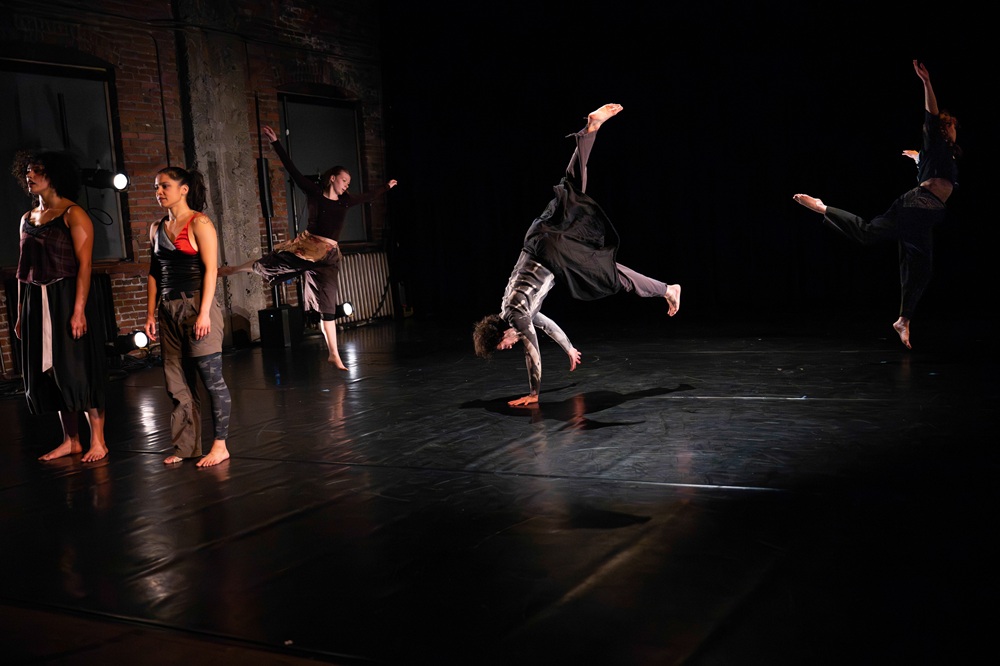
By contrast, Mira Treatman’s Supernatural Displays of Yearning begins with a rendition of The Alphabet song. With a choppy delivery by Treatman and Joel Chartkoff, this and other nursery rhymes—many with amusingly similar melodies—are threaded through the work. Moments happen in every corner of the stage; Chartkoff gazes out the window silently except for sudden outbursts of “QRSTUV.” Treatman and Vitche-Boul Ra jump and fall and cling to the vertical beam in the center of the room. In another moment, the two dance wildly around the space to what sounds like an ’80s synth pop track.
Later, Irina Varina enters from the audience and reads lines from a book for women who want to get married. The book gives such advice as: don’t wear earrings that are too sharp, or men won’t want to nibble on your earlobe. Meanwhile, Ra, slumped in the corner, plays with a children’s slinky toy and drools on the ground. Suddenly, I begin to recognize something a little darker is at play below the surface of this piece. I feel loneliness in moments, as when an audience member takes pictures of the performers as they clamor over one another in exaggerated Instagram-worthy poses. I sense sadness and isolation in others, as when Treatman sings “me, me, me” and Ra interrupts with “that’s right, it’s all about you, isn’t it Mira?”
As the piece progresses and my unease grows, I repeatedly wonder, was that supposed to happen? The cast is so skilled in their performances that I leave without a clear answer to my question. No moment better exemplifies this than when Ra spontaneously gives a vampire neck bite to an audience member sitting right next to me. The bite goes on forever. Treatman breaks away from the performance to make sure the audience member isn’t uncomfortable. Somewhat like a Punchdrunk production, Supernatural Displays of Yearning doesn’t worry about breaking the fourth wall because, from its opening, it smartly chooses not to set it up.
*Mira Treatman is a writer and editor for thINKingDANCE
Two Short Dances, Meghan Frederick, Kate Seethaler, Mira Treatman, Mascher Space Cooperative, January 18.