From the warmth of the packed theater, I emerge dazed. My heart torn open and my senses spent. The cold air is a welcome shock, an invitation back to the real world so wholeheartedly lamented by Soledad Barrio and Noche Flamenca in their two-and-a-half hour journey presented at Plays & Players. True to its mission to create performance that “exceeds the highest artistic expectations […], to evoke the vivid and expansive sea of passion and emotion that is flamenco,” the company left something of themselves in the space and with me.
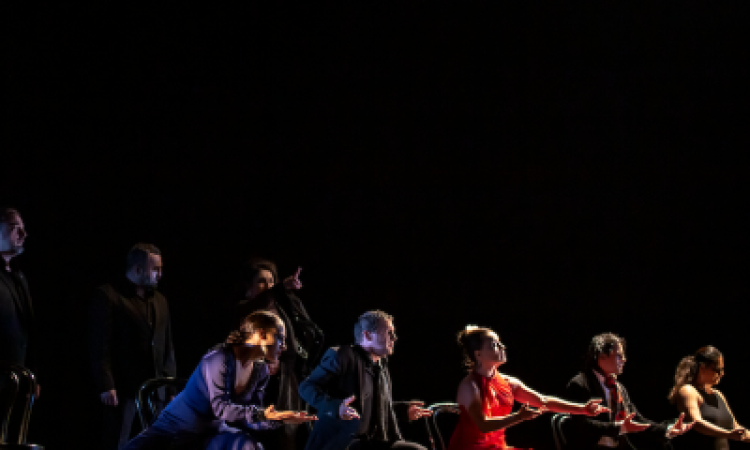
The program opens with Entre Tú y Yo (You and I), a series of duets and trios inspired by Arthur Schnitzler’s racy 1897 play, La Ronde. Seated in bistro chairs that cross the stage diagonally, six cast members turn their faces back over their shoulders, as if hiding from judging eyes. They extend their arms slowly, circle wrists and fingers suggestively, caress the languid guitar notes floating on the air. Forecasting the drama to come, their knees shoot wide and their feet stomp into goddess pose. A singer howls, “sin el amor, solo tengo soledad” (“without love, I have only loneliness”). “Siempre fuiste la razón” (“you were always the reason…”).
In a company named for its star, the Bessie Award-winning Soledad Barrio, every member shines. Certain vignettes stand out, however, like percussionist David “Chupete” Rodriguez’ show-stopping castanet solo. The contradiction of his fingers—cool, concentrated dexterity at hyped up speed—yields a layered, rolling, click-clack rhythm that spills over and races with itself. Similarly, Manuel Gagos’ cante (song) solo slows time. His dirge pokes at something nestled in the pit of my belly, freeing me to give myself over, to revel in sentiment.
Cantantes (singers) Carmina Cortes and Reyes Martín accompany dancer Antonio Granjero, their throaty cries, somber dress, and physical fortitude channeling female strength and sorrow through timeless longing—“¿y si no puedo verte?” (“And if I can’t see you?”). Granjero’s explosive footwork echoes their incantation; rising the length of his spine, it boils over into wild facial expressions. Falling to his knees and lifting a dress, he recasts a calf as forbidden fruit. Spinning to halt with torso skyward, he offers his body in supplication.
Dancer Marina Elana captivates in a sultry duet with her bata de cola. Emerging barebacked from beneath a pile of midnight blue ruffles, like a mermaid departing the sea, she oozes into the top of a shimmering floor-length gown. Cradling the trailing ruffles, she lays them down to rest like a child. Later she inflates them behind her head, invoking the virgin’s mandorla, then surrenders her body under the weight. In a closing duet with Barrio, the pair circle and face off, tussle like animals battling over prey. Modern attire—frame-hugging black leather pants and tanks—and the electric charge between the two women, signal flamenco’s female revolution and its opening to new narrative terrains.
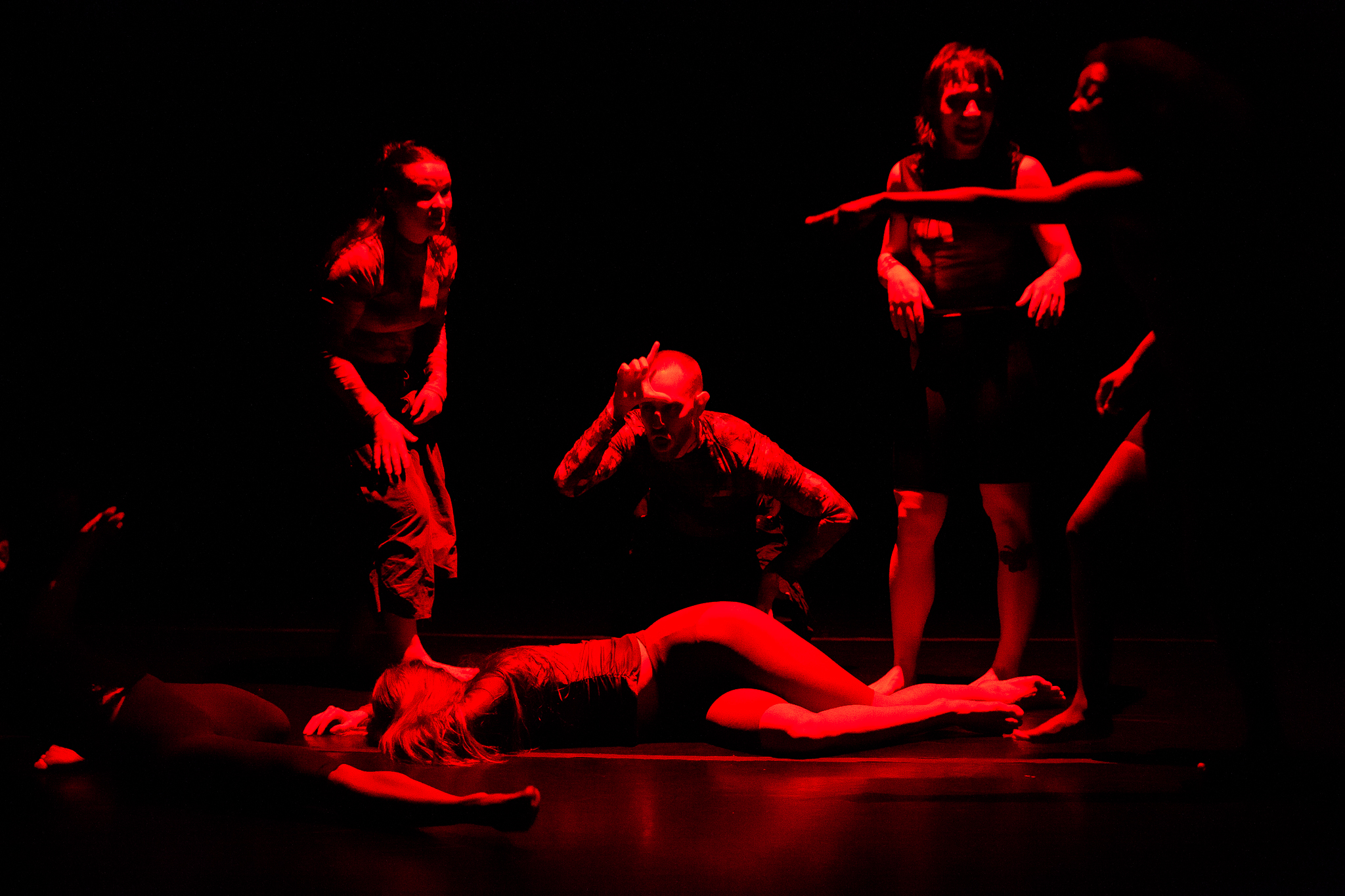
Three shorter works round out the show’s second half: Refugiados, an ensemble piece inspired by the literature and poetry of refugee children, followed by breathtaking solos by Granjero (Pa’Cai) and Barrio (Soleá). Like a child tamped down and bursting with emotion, Granjero delights in the playful Alegrias flamenco palo (form). In contrast, Barrio’s Soleá, named for the haunting, mournful palo, lifts a transcendent evening to new heights. Down and dirty, Barrio hikes her skirt high between her thighs, sways with abandon in a sunken, wide plié, her feet ablaze in zapateado (footwork). So far in the moment as to nearly disappear, her face beyond recognition, eyes aflutter and lips mouthing unintelligible sounds, she recalls possession rites as she carries flamenco’s roots in human suffering onto the stage. The dance transforms into a beautiful mourning, a collective celebration of our shared loss. She ends looking back over her shoulder beyond us, one arm extending toward other times and places.
From beginning to end, the show is a master class in integration—the communion of song, music, and movement utterly seamless. Artistic Director Martín Santangelo is also Barrio’s husband, and together the duo has gathered a stellar team. That a group is more than the sum of its parts seems especially so in flamenco, where interplay is key and underscored in live performance. The cast feed off of one another and they give voice to that process when they yell, “Olé!” and shout out names to hail virtuosic moments. This feedback loop extends to the audience, many of whom vocalize along with the cast, enveloping us in their soul-clutching dive into flamenco’s depths of feeling.
Trying to recapture the evening’s magic feels like grasping at the details of a dream by writing it down. I long to step off the page so that I might dig deep and dwell there, open my body to joy and sorrow, move toward renewal.
Entre Tú y Yo (You and I), Soledad Barrio and Noche Flamenca, Plays and Players, January 15- February 2.