In a kind-of prologue to her new structured improvisation solo, Clearly or Darkly, Leslie Bush* (sitting and crouching on the floor) gives sustained focus to small rectangular shapes of clear plastic that dangle from a string around her neck. Spectral, in a simple white chemise, she swings, balances, weighs, and inspects this motley yet connected array of objects, seeing in them visions, or thoughts, or sights that I cannot fathom. Are they fragments of a shattered self, a life reduced to pieces by forces yet unknown? The accompanying whistling and breath-like sounds from Carlos Johns-Davila’s quenacho soon meet the strange sounds of his theremin, adding to the eerie, out-of-body world we have entered.
As set out in her press statement, Bush’s intent is, “to explore ways in which we may reconcile with and create space to express trauma,” via movement and specially-programmed sensor technology. She asks, “How do we deal with who we are after trauma? How do we let our bodies free us?”
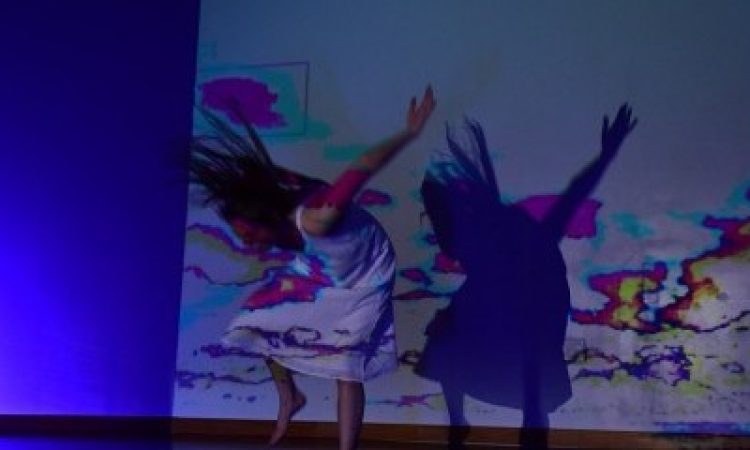
Darkness. The only words that we hear in this performance arrive as voice-over fragments: “here I am,” “am I?,” “I am here—but also there.” As she runs and slides across a wall, a precorded video projected behind Bush shows abstract water currents and leaf-like forms in calming blue hues. In marked contrast, with mouth agape and grimacing, fingers frozen in flexion, she begins a contorted dance with slow steps and abrupt gestures, uttering occasional gasps and guttural sounds. Alternating with Bush’s spasmodic movements, arms probing her kinesphere, are the video’s red-hued images of a woman’s hands and arms covering her face, then the full woman revealed in undulations, followed by a battered, bloodied body, bathed in a deep visceral red. A cleansing interlude of fleeting smudges of greens, purples and yellows disperse as if by breezes. The recurring images of water currents and leaf patterns remind us that healing and cohesion are also viable, present.
A transition. Bush dually reveals her body and her process, baring her breasts and a wrap-around body sensor that the few of us in the audience who might have read her press release know is creating a feedback loop duet between her body movements and the video. (Program notes might have aided the audience’s understanding of the sensor technology.) As Bush bends and rolls her torso and undulates her arms in the air, the shadow of her movements is layered onto the video images. She circles slowly in pale white while the woman in red re-appears and swiftly exits the video. Bush also exits, the clear plastic fragments still dangling around her neck. Water currents return, calming us, cleansing us. Then a grey, blue sky, with hints of birds flying.
Silence.
Afterlude. It was not apparent (at least not to me) what effects the body sensor technology had on the video images I was seeing, but I was comfortable with this. This unknowing or unseeing contributed to the mystery of the body/mind dissociation explored in this duet with oneself, physical and virtual. I did not have to fully understand all to admire Bush’s deft grasp of these physical and virtual phenomena, and the artistic sensibility and insight she shone on the human condition.
*Leslie Bush is a writer for thINKingDANCE.
Leslie Bush/Midden Heap Project, Clearly or Darkly, The Whole Shebang, Feb. 22.