Theatre Philadelphia and thINKingDANCE continue our partnership, begun in 2018, bringing coverage and new perspectives to Philadelphia’s vibrant theatre scene.
Award-winning playwright Jacqueline Goldfinger brings her newest work, Babel, to Theatre Exile with the promise of themes both eternal and timely (procreation and social engineering), the play having received the Smith Prize for Political Theatre (2017-2018). Set in a not-too-distant future beset by global warming and resource shortages, Babel explores government intervention in reproductive policy as a strategy for survival in an insecure world. Building on sci-fi and dystopian predecessors (Brave New World, Parable of the Sower, Gattaca, The Handmaid’s Tale, Never Let Me Go), Goldfinger interrogates the potential of advanced reproductive technologies through the story of two expecting couples and friends.
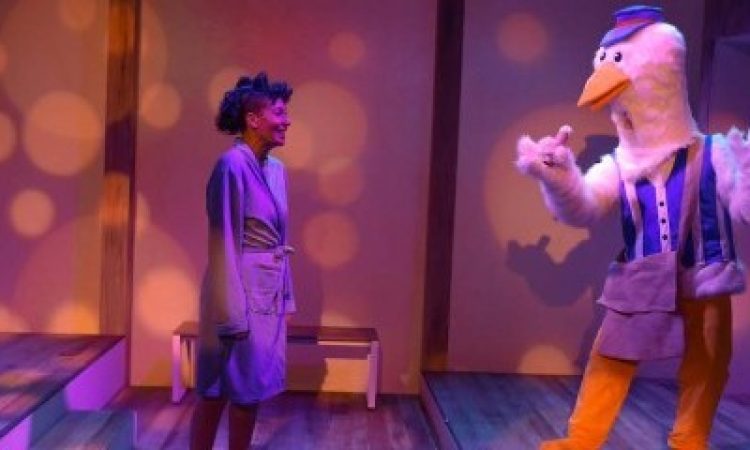
Lesbian moms-to-be Dani (Amanda Schoonover) and Renee (Anita Holland) have been toiling eight years to conceive when in-vitro genetic testing reveals an aberration that precludes their fetus’ “pre-certification.” Should the moms disregard the doctor’s advice to abort, their unborn child faces a lifetime in “The Villages,” an apartheid-style ghetto for the genetically pre-disposed (to cognitive, behavioral, or psychological abnormalities). Meanwhile, a secret threatens newly expecting straight couple Ann (Bi Jean Ngo) and Jamie (Frank Nardi Jr.), who anticipate their own fetal testing with different ideas of perfection. To this quartet of frayed nerves a talking stork arrives, replete with a raspy Brooklyn accent, loose hips, and a clunky but sinister sci-fi subplot.
From the opening scene, in which Holland, as Renee, exaggeratedly huffs and puffs and thrusts her pelvis, stopping to rub and admire her belly and to wipe her brow, the cast immerses us in the characters’ very real labor of reproduction. Dani commends her partner—“you’re already such a great mom”—highlighting the demands placed upon expectant moms. In a painfully funny scene that recalls Stuart Smalley, Ann trips over her self-worth affirmations as she prepares for the office, her mind also consumed by the life growing inside her. Ngo brings perfect pitch to Ann’s over-practiced poise, sculpted by societal- and self-surveillance of women wherever they work. As Dani, Schoonover brings charisma and swagger to an overachiever who barrels against friction with a perma-smile. When she dismisses Renee’s worries as hormonal, suggesting they try (yet) again for another baby, we get a tiny window into the trials of modern conception.
As a mom, an anthropologist who has taught courses on family and reproduction, and a participant-observer in a world that feels ever more surreal, I anticipated Babel to resonate on levels both personal and intellectual, and I expected to love it. Like Goldfinger—who has attributed the idea for the play to in-vitro genetic testing during her own recent pregnancy—I underwent such testing when I was pregnant in the 2010s. And like any glimpse into the abyss of “what if?”, the experience spun the wheels inside my head beyond overdrive. Having become a mother, I know all too well that all any parent wants is for their child to be healthy. Perfect, even. Despite the utter impossibility of perfection.
For all its provocative quandaries, Babel lands somewhat mired in exposition. Characters spell out dilemmas and high stakes, supplanting the trippy texture of real life with the formulaic feel of a debate. The title’s biblical reference gets full explanation in a bit of dialogue tailor-designed for a program note. Because I see far more dance than theater, I found myself wondering if all the dance I’ve consumed has somehow ruined straightforward narrative for me. But other moments in the play also strain plausibility. Despite resource shortages, the characters enjoy wine, coffee, and pizza delivery, and they care for domesticated animals and eat bacon. A surprise energizes the play with new questions, but the twist itself feels far-fetched, while the existence of a disenfranchised underclass doesn’t ring as especially dystopian.
If the explication lands heavy at times, spare scenic and design elements effectively conjure the SSRI pallor of a world KonMaried to the letter. Ariel Wang’s monochrome pastel costumes suggest pre-prison Martha Stewart. Colin McIlvaine’s set evokes new minimalism’s sanitized emptiness. Drew Billiau bathes the stage in pink and purple polka-dots that dance on Elizabeth Atkinson’s reality-show waiting-room soundtrack.
As part of the National New Play Network’s Rolling World Premieres, Babel will have four additional premieres in theaters across the country (for a total of six, counting the play’s Philadelphia run and its recent debut in Kansas City, MO). These additional stagings may benefit what, on paper, sounds like a worthy project—it features LGBTQ characters and a female-centric cast, and centers on themes including women’s bodies, reproductive autonomy, and the female-heavy labor of reproduction. Moreover, Babel exposes the fault lines in the best-laid plans, a timeless message that applies even to our most innate impulse as a species—to survive, to reproduce.
To join the conversation, follow thINKingDANCE and Theatre Philadelphia online and on social media to read, share, and comment.
Babel, Theatre Exile, February 13-March 8.