As Foreign Tongues began in the Kimmel Center’s lobby, I thought about the safety of all. Two days later, a month’s programming at the Center was suspended due to the coronavirus. None of us were practicing social distancing while the dancers wove in between audience members, all of us in close proximity to each other.
Foreign Tongues, by Liquid Loft is a US premiere, made possible through the Kimmel Center Cultural Campus’ membership in IN SITU, a network of European presenters specializing in art in public spaces.
How does the body reflect or reject the meaning of language? How does the body deconstruct language? Liquid Loft recorded conversations around Europe for an ever-expanding score. The dancers in Foreign Tongues had small iPods tucked into their clothing that controlled their sound-score and they lip synced to the text and songs. They each held a small cylindrical black speaker and did a remarkable job making it look like a natural extension of their hands. They committed to the text fully with their bodies and faces. Each line, each pause was perfectly timed. I felt they were the engine behind the words. They used sound to draw attention to themselves, bringing the crowd closer. When a higher pitched sound came from the large staircase in the lobby, I looked up and saw a dancer, in a bandeau top and tight black pants, slowly descending the steps. Before entering the Perelman Theater, the dancers stood at the curved arc of the exterior. As they gestured with quick hands, rising up and down, I saw details of the arc: the lines that create blocks and the smoky black color. In these moments, the space expanded, bringing this piece into conversation with the architecture and with other art happenings at the Kimmel Center.
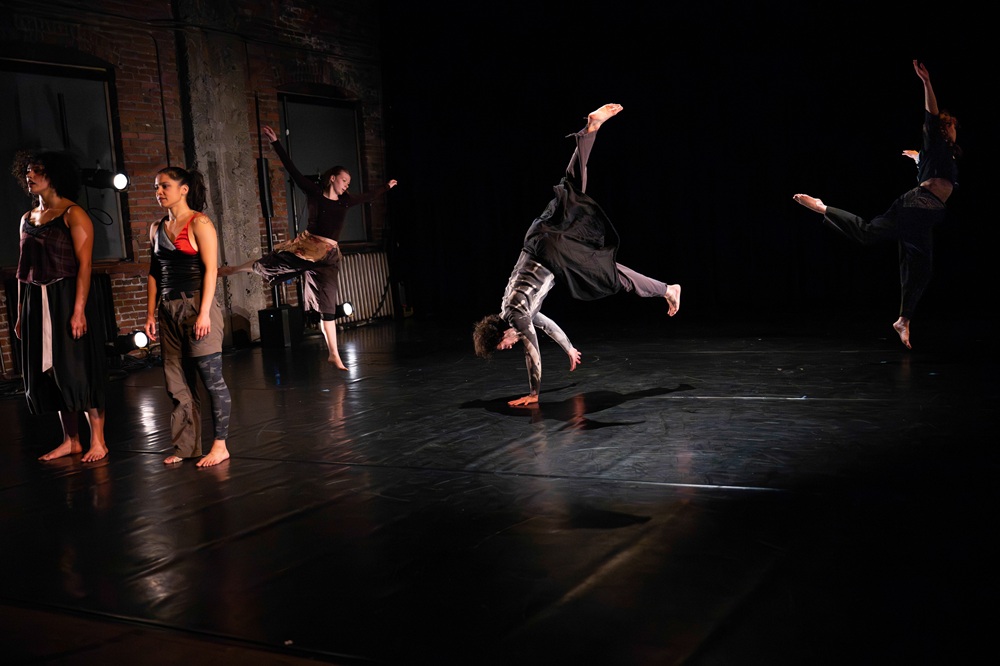
Once inside the theater—which was emptied of seats, stage and curtains—Foreign Tongues continued in a similar fashion. The music began to have stops and starts, like listening to a radio station that is slightly out of range. With each staccato beat of the music, the dancers’ bodies also appeared to be stopping and starting; or was this the effect of sound on my sight? I was mesmerized by the dancers’ commitment to their text and “catching” the text’s stops and starts with their bodies. When the dancers all came together, each touched a body part or costume of another, creating an asymmetrical moving sculpture. They moved in time with a creaking noise and reminded me of a machine, each doing their part, but needing synchronicity to operate.
Inside the theater, the text, movement, and singing sections repeated. I had fun following the dancers’ configurations, but after several repetitions, I wanted a change. As an English speaker, my lack of understanding of the text meant I relied on its resonance rather than on meaning. It was near the end of Foreign Tongues when the iPods played the voices of Philadelphians. On one recording a man complained when asked for food by a homeless man who had food requirements like not eating pork. Another person on tape repeated “fuck it,” while the dancer moved in a small circle. While I laughed at the repeating “fuck it,” given that it is a phrase I say often, I felt the Philadelphia section was an addendum rather than integral to the piece. It is hard to represent a city to itself. While the movements of Foreign Tongues highlighted architectural spaces, the text of Philadelphia repeated back to me stereotypes. What are the conversations that reflect a city? How does a city feel about its own text, sounds, and jargon? What makes us proud and what makes us cringe?
I enjoyed the dancers in Foreign Tongues; they were athletic, committed, capable of large, sweeping gestures and expressive, quick hand movements. I was captivated by one dancer in black underwear, with her bare legs reaching into wide lunges as her arms spread out and she arched backwards. This movement of vivid expressivity, contrasted to two dancers’ gestures as they played auctioneer, with a strange, computerized voiceover trying to increase bids. Of what, I have no idea. Distilling the meaning of a word from the sound of the word seems as challenging as separating the meaning of a gesture from the form of the gesture, but I appreciated the fun of trying.
Foreign Tongues, Liquid Loft, Kimmel Center, March 11-12.