When is a place another dancer? When is it a hazy backdrop? When is it trying to tell you something?
Place played a particular role in each of the three short dance films debuted by BalletX. Part of the company’s subscription-based online season, the films premiered as a live Zoom event featuring conversations with the choreographers. The locations of the films promised iconic Philly sites, while the choreographers suggested national star power.
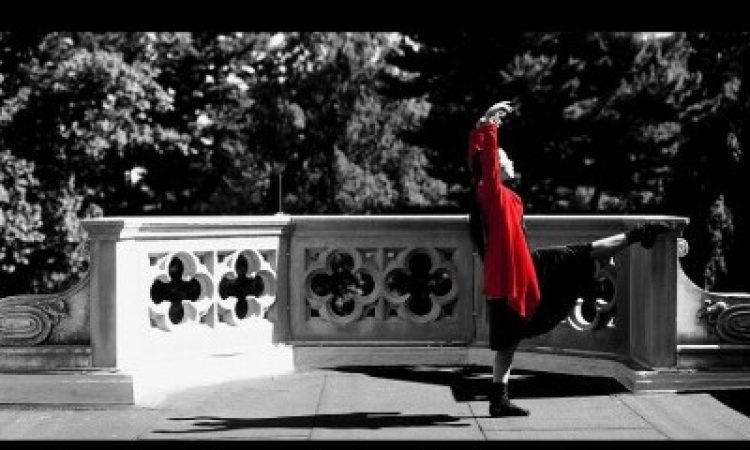
Saudade, a duet by Mariana Oliveira and performed by Zachary Kapeluck and Andrea Yorita, opened the evening. Set in the Stoneleigh mansion and surrounding grounds, the work brought me into a black and white world, except for the pop of Yorita’s red coat. An unspecified storyline followed the two dancers, reflecting loosely on memory and nostalgia (the closest translation of the Portugese word that titles the work). The bossanova score by Antônio Carlos Jobim lent a surreal quality to an already dream-like scene. The stylized film reflected the haze of memory, with some details out of reach while others remained stark. Captivated though I was by the dancers’ weightless lifts and impeccable lines, I longed for richer, more tangible details of the historic site. I grasped for more crispness of the architectural details, the exact nuance of each green in the trees – but so do we long for more substance and form to our memories than we can often find.
As dreamily wobbled as the setting was in Saudade, it was brightly detailed in Robbie Fairchild’s larger company piece, The Cycle, filmed at Longwood Gardens. Opening with soft, early autumnal light streaming through still-green leaves and the slow, bone-by-bone movement of hands in water, the dance explored the question of “what if nature was trying to communicate with us?” Rather than imitating particular elements of the natural world, the dancers embodied its qualities abstractly, staged brilliantly in the fields, fountains, and trees of Longwood. Detailed camerawork showed them blending their bodies with natural elements, like hyper-focused shots of hair mixing with long grass. Wider views decentralized them: a camera angle showed the company floating out of focus in the distance, plants in the foreground.
The cycle of the piece followed the dancers in an effortful rise from the ground; to suspended gesturing flows; then twitching, jerking motions; and descending back to earth. The choreographic sequence was continuous but not dense, which allowed the film a breathy quality as it shifted between dancers and settings.
Fairchild explained that, to imitate nature, we need to wear the most gorgeous garments we can, our most elegant best. I appreciated this departure from nude leotards, the more expected costuming choice for nature dances that strive toward our most primal human form. Rather, the gowns and suits from high-end fashion designer Marchesa reflected the ornate extravagance of form and sensory decadence that the planet provides us.
New Heights by Amy Hall Garner brought a high energy ending, set at three different murals in Philadelphia. Garner noted that she considered the murals another character in the work, and it showed; the murals’ rhythms were symbiotic with the dancing. At Isaac Tin Wei Lin’s Start From Here, dancer Francesca Forcella drew in viewers with a playful look before breaking into expansive, exuberant movement.
The driving soundtrack of Sebastian Bartmann, performed by Spark, set the pace for a vibrant experience, alongside the energetic camera work of Elliot deBruyn and Nathaniel Brown. The camera operators must have been moving almost as much as the dancers, which gave the shots of the dancing dynamism and activity, a pleasant unsettlement.
Cropping out the tops of the mural walls in the shot lent a funhouse feel before the camera panned up to the sky and returned down on the image of a new mural: Nate Harris’s Untitled at the Navy Yard. The golden hour light created dramatic shadows through the waterside railings and structures at the feet of the mural’s black and white geometry.
A brief, bold interlude unfolded in the grass in front of eL Seed’s Soul of the Black Bottom before the company was back in the brightness of Lin’s opening mural. Despite having staged the piece remotely through Zoom, Garner made clever use of details of each site, like using the parking guide lines as spacing markers for the dancers.
The quality and caliber of BalletX’s filmmaking ups the ante for dance films. I note that many of the filming sites chosen already receive a great deal of attention (and funding) in the region; for future place-based dance films, I’d love to see BalletX bring the spotlight to some of Philly’s lesser known gems. Still, in a time of virtual saturation, experiencing dancing bodies moving through real Philadelphia sites was a welcome shift, though still transmitting place through pixel.
BalletX Beyond: November Virtual Premiere, BalletX, online, November 18.