As a recipient of a Philadelphia Asian Performing Arts (PAPA) mini-residency, Joseph Ahmed presented his work-in-progress performance, Half Magic. The theatrical one-man show centered on Ahmed’s childhood memories, the loss of his mother, and his personal struggles to come to terms with his identity as a biracial child raised in white America where white history and traditions are the baselines, and non-white cultural traditions are often dismissed. With the Asian Arts Initiative and PAPA support, Ahmed conceived this work for a live audience. However, due to the realities of COVID-19, the show was adapted to a live stream format and presented on the Philadelphia Asian American Film Festival Facebook page.
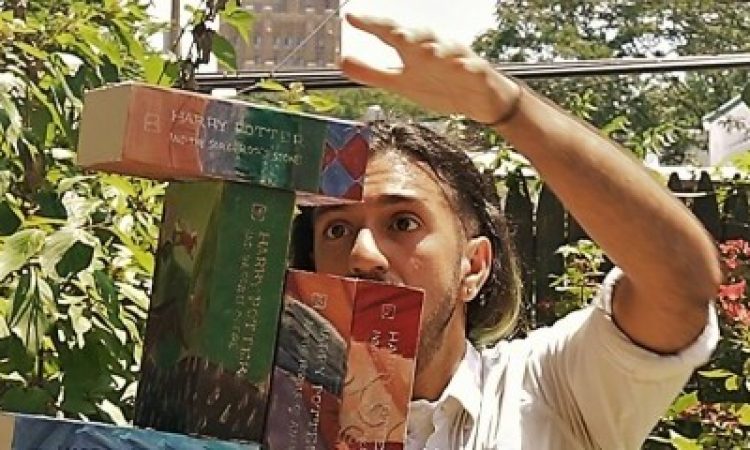
Half Magic is about stories told and untold. The performance is an autoethnographic work of Ahmed, a half Bangladeshi and half white theater artist, raised in the New Jersey suburbs. Using circus arts and physical theater as modes for storytelling, Ahmed opens the show by tossing Harry Potter books to establish the significance of children’s stories to one’s identity formation. “Why can’t I find a reflection of myself anywhere I look?”
Ahmed narrates his memories from his library. He quotes Roland Barthes’s famous 1967 essay, The Death of an Author, in which he recounts, “The text truly lives when it reaches the lives of the reader. In that moment of transmission, the author dies, and the reader is born.” Highlighting this statement at the beginning of his monologue foreshadows his mother’s death, who he later states authored his life.
In revisiting his childhood, Ahmed makes no mention of magical characters from the rich well of Bengali literature, myths, and folklore from his father’s heritage. Instead, books like Harry Potter took center stage. Ahmed narrates that his mother took him to plays, bought him books, and cooked and cared for him while his Bangladeshi father worked. This gives me the impression that Ahmed grew up in a heteronormative family structure where the husband worked while the wife cared for the children. And because whiteness and brownness are brought up significantly throughout the performance, I begin to contextualize whiteness as a privilege, brownness as America’s source of labor, and the act of juggling as Ahmed’s modality to present his struggles of balancing in between cultures.
Ahmed relocates to his living room, where U-Haul boxes fill the space. At this moment, Ahmed reminisces the aftermath of his mother’s death. While packing his mother’s belongings into boxes, he squeezes himself into a box, grabs a knife, struggles around the living room, and stabs the box he’s in. This is a manic episode, perhaps dramatized, but perhaps not. Minutes later, his dad calls and asks about his well-being. He responds, “I’m just working through stuff,” a clear understatement. This scene uncloaks the process of boxing and unveiling memories and searching for memories that were not made… such as growing up in Bangladesh. Pew Research statistics show increasing trends of white and Asian people intermarrying. Although this seems like a great sign of breaking color lines and a progression from white racial purity, Ahmed’s story claims that white dominance persists even within familial relationships. “Whiteness like a white blood cell consumes everything it touches, myself included,” Ahmed states.
As a foreign-born Filipino mother with a biracial child, this work touched me in unexpected ways. With all my efforts to consciously parent a well-rounded child, I have failed to share my own stories of magic. The force of whiteness is strongly evident in the popularity of Star Wars, Lord of the Rings, Game of Thrones, and The Nutcracker, to name a few. I struggle against the mythology of the founding fathers, the fantasy of Thomas Jefferson’s declaration of independence for all, the Easter Bunny, Santa Claus, and Thanksgiving. White faces and voices envelop us every day, suffocating my voice and erasing my paint drops out of the picture.
Ahmed’s writing is filled with symbolism and words that cut to the core. The piece is a poignant, critical work that ought to be viewed, documented, and revisited, especially by immigrant parents, children of immigrants, and those with a biracial identity. Ahmed’s story is vital to many mixed-race children searching for answers in books and movies that do not represent them.
Half Magic, Joseph Ahmed, Philadelphia Asian Performing Arts, November 12.