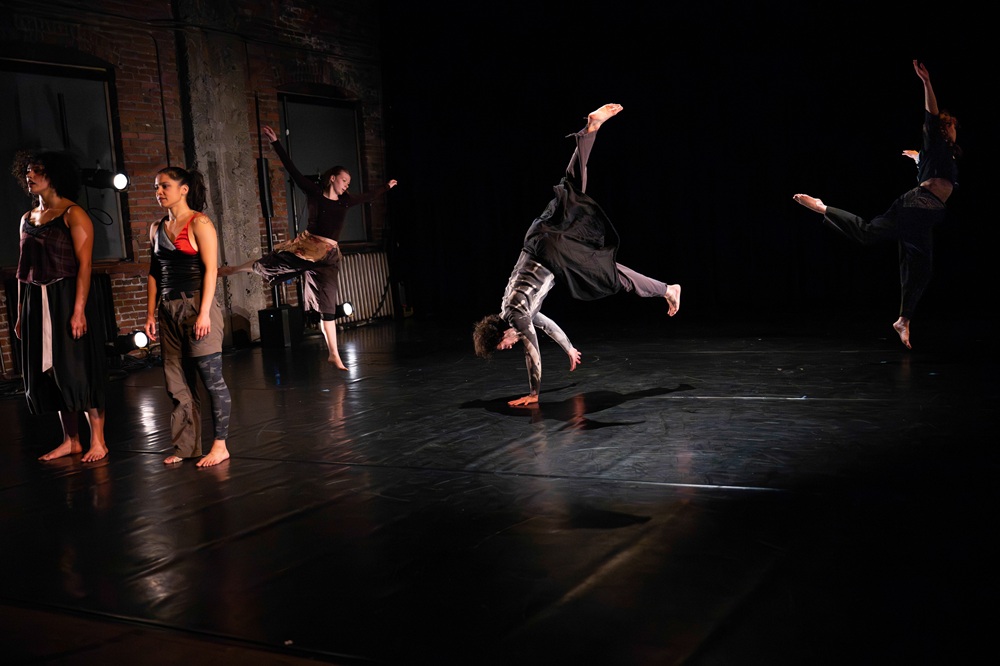
How important is legacy, and what do we do with the urgency to preserve it? Pamela Hetherington’s Philadelphia Jazz Tap Ensemble delves into this theme in her newest creation, Tyner and Timmons, honoring the artistry of Philadelphia jazz pianists McCoy Tyner and Bobby Timmons. Staged in an intimate space inside Christ Church Neighborhood House, dimly lit with exposed brick walls and the band six feet away from my ears, the vibe was warm, reminiscent of an underground jazz club in some alleyway in New York City. Immediately my thoughts trailed to feelings of lingering fondness of memories shaped by the musical soundtrack of my life; I was already transported.
It was only fitting that the opening piece was the Tyner and Timmons suite, with the first section entitled “What Brings You Here?” Pondering that loaded question, I wondered if this was something I examine enough myself. Hetherington was joined in an opening duet with vocalist, Bethlehem Roberson, who also tapped in the piece. Each performer displayed a different narrative, dancing together as soloists, yet unified in sound. Roberson performed spoken word like an echo or stream of consciousness, while Hetherington wove in and out of circular spatial patterns; perhaps this represented evolution or a return to the place where one’s journey began? Roberson’s poem transitioned into a powerful musical vocalization, serving as a layered soundscape to the distinct instrumentation of the band.
The second section, “What Did You Hear?/ The Soapbox” was a swinging piano solo by Tim Brey playing a bluesy Timmons tune while Hetherington and Roberson danced, this time without shoes. They took turns stepping on and off the wooden soapbox creating rhythms with feet, hands, and body parts similar to the style of the hambone. At the same time, they shared stories of significant past experiences, such as Hetherington mentioning how she birthed three children. Though the vocal projection and steadiness of rhythm was tough at times for Hetherington, I did not mind her raw imperfections because the two dancers shared a genuine connection and the music was a groove! Then unexpectedly, Roberson took us to church with a chilling acapella rendition of the hymn Wade in the Water that brought a spirit of cleansing through me and absorbed my soul. The blues groove re-entered as Hetherington returned wearing shoes. She playfully tapped down an invisible, long, winding road in the distance, exiting the stage. The moment captured the meaning behind rhythm in Jazz, the steady triplet of that blues tune indicating constance, lineage, and ongoing journey.
Leading into the third section, Hetherington shared that she did not know how she got to where she is in her life and that she is trying to put the puzzle pieces together. Following this vulnerable moment, she performed to a ballad by Tyner called Contemplation, her feet briskly moved from one direction to another yet never lost the pocket in the music, her upper body sustained and smooth. Roberson reunited with her in the following section to an upbeat Timmons tune Little One. Hetherington, front and center, acted as the lead of the rhythm section of the band, with the music playing in the background. Between the fourth and fifth sections a new dancer, Rosie Marinelli danced to Tyner’s Passion Dance. Though the title of the section was “Hope You Were Listening,” Marinelli had minimal interplay with the musicians even during a call and response moment between her and drummer Anwar Marshall. If there was any moment to focus on the music as a separate entity and force, this was the appropriate time for it to be highlighted. Instead, the dance overshadowed its natural brilliance.
The suite concluded with “Where Have I Danced With You Before?” which featured the entire band and all three dancers in a satisfying finale. Roberson created another colorful landscape with her poetic words, Hetherington aggressively pronounced every accent in the music through each toe, ball, heel, and Marinelli trickled in and out between the melodies. Everyone jamming together was exhilarating, but the most profound happening was the repeated text we heard throughout the ending, “When you appeared, my future came to me.” The future being linked to the past came full circle in those words as a reminder that no matter the start, the finish will find you. Pathways are destined to intersect.
The show could have ended on this rich note. However, there were two additional pieces on the lighter side that paid homage to Hetherington’s teachers and showcased more of her percussive proficiency. The strength of Tyner and Timmons left me reflecting that sound can serve as identity and become the signature of who a person is in life.
Tyner and Timmons, Philadelphia Jazz Tap Ensemble, Christ Church Neighborhood House, April 24-25.