On a Sunday in May, I attended a roving funeral in my hometown, Norfolk, VA.
At the corner of some ancient, sub-sea-level streets stands a colonial-era church that still sports a British naval cannonball wedged in its brick walls. Next to that stands a different temple, one to capitalism: Macarthur Center. Like that trapped metal ball, it feels stuck in the amber of recession, a concrete pit of bloat, an archaic hold-over from a time when we could gather unmasked to spend money we didn’t have on things we didn’t need, breathing recycled air, clinging to that driving force of Americana: [“to prove we’re alright,”] the American obsession with proving you’re alright by showing that you are still capable of purchasing things you don’t need even in the face of biological warfare. Amidst its dated, mid-nineties, shoulder-padded splendor, one can really feel a crumpling happening to Macarthur Center, the squeezing-out of its life-force;[“a mall is really just a hallway with some bathrooms…is there a cheesecake factory near me?…we need your money, please… please!”]
Inside this discreetly decaying cavern, masked people shuffle and sway down the gaping white and silver polished stone corridor whose mirror-paneled walls suggest suburban luxury as the muscle mass of swollen capitalism presses us on all sides. There’s a feeling of being tight in a fishbowl, polished by the reality that some of the folks working here earn way too little per hour to justify us being here, much less to allow them to shop here. Storefront after haunted storefront dons drawn black curtains, taut behind glass, a sort of reverse shiva: a mourning, not for a person, but for a machine of consumption, of functional greed and surplus, never running out of more, a meeting place that is now a morgue. We’re guided here by the work of Mallbodies.
Mallbodies: A Performative Elegy to the American Mall, whose most standout quotes are written throughout this review in brackets with italics, is an immersive theatrical experience set to a trippy, eerie, effortlessly nostalgic, relentlessly and cuttingly sarcastic yet poetic word-scape [“what’s my age again?”] that is arranged in audio tracks starting from the parking lot, circling through the mall and back to the start. The tracks echo in the mind, providing backdrop for the physical theater you’re performing as you wade through a spiraling decomposition of this capitalist town square.
As we trudge past “everything must go… store closing…80% off!” signs and kiosks whose purveyors claw desperately to make a sale, Mallbodies asks us [“to find ourselves”] in front of a trendy store, [“the one with white paneling for the future,”] or at a big-box department store or the food court while prompting us with tasks like [“let’s find a particular garment…something you’re drawn to but might never wear… check the tag… where was it made?”] Ralph Lauren watermelon red dad swim trunks/made by children in Cambodia. [“LuXUriOuS, right?”] This particular prompt from Mallbodies lands heavily, making me think of the people who made this garment and will never be able to afford it both in coins and time off, of the employees at the mall itself who will never be able to taste this American luxury, however sour and decayed it may be, how I couldn’t afford it either. With each track, the show crushes us with its overlay of critiques of income inequality and lopsided opportunities for those with and those without, alongside nostalgic throwbacks of music and text to a time not so long ago but seemingly alien. The succinct tongue-in-cheekness of Mallbodies unfolds into what is really an elaborate, liberatingly haunting farewell to a relic–liberating because we as a culture have come to a collective precipice where we can choose to let go of outdated modalities in order to mold the future, and haunting because we may not all be on the same page.
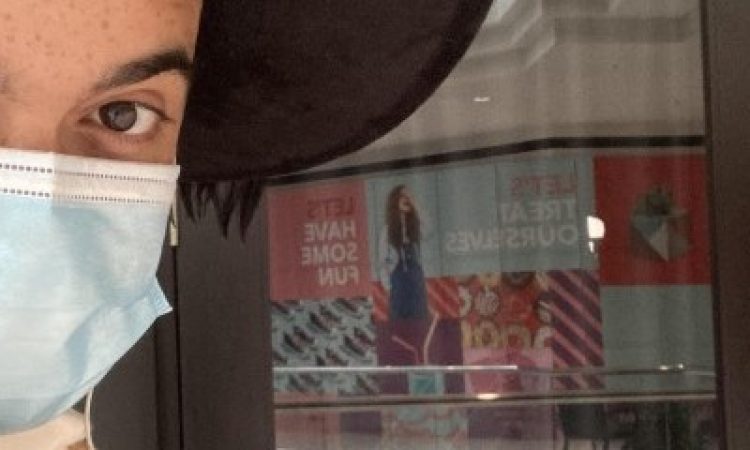
Meandering through this graveyard of my teenage memories, lost in this [“nostalgia for nostalgia,”] I’m instructed to take a selfie in front of a closed store. I wriggled with joy to the death tome of Abercrombie and Fitch, the store that caulked self-hatred into my teenage body. It sealed firmly into my deepest recesses the notion that I could never look like those bicep heavy, whiter-than-white, gee my jeans are almost falling down but are saved from that fate by my rock-hard gluteal muscles in the back that you can see from the front-guys. This bastion of binary showed me that there were only a few options for me in this life if I wanted to “make it” or be desirable. Much like the similarly amber-stuck ballet/Western concert dance idiom, this store told me I had to make a decision about how masculine I wanted the world to know I am–or am not, and to my peril if not. I had to prove how capable of purchasing these price-engorged items I was, much like how our world makes choices about choreography, access, aesthetics, and ethics around notions of dancers having the means afford dance or not, if they’re male or female, if they’re white or who cares else, if they’re fit or super-fit. So often, the scrappy, un-monied, contra-ideal bodies get tossed to the dead pointe shoe pile.
Now this place of punishment that I never thought would not exist now sits with a black curtain drawn behind its glass casing, as if the neighbors will be by soon with casseroles for the next 7 days. The reflection in the glass shows the store across from A&F also boarded up, but without such muted glamour. I took a selfie in front of the store, as asked by Mallbodies, and was surprised at my profound inner peace, peace in knowing that my Blackness, hairiness, shortness, petiteness, immigrant-ness are what keep me booked, audiences hooked, and heads resting on my chest after shunning other, more Abercrombie merchandise. I put to rest a decade of acid wash(board) obsessions, and presuppositions about my own “male” dancing body, put to sleep notions of lack in the face of the expectations that men must look and dance a certain way. Mallbodies succeeds in bringing us to a place of release from our own shackles of nostalgia, shaking us awake to the excesses we can no longer stomach, showing us how fragile and shriveled our cling to capitalism is, and how we can always rest assured that one day…[“it will all be sSSOOLLDDddd.”]
Mallbodies, Mike Durkin, Dylan Gygax, and Logan Gabrielle Schulman, online and at your local mall, March 18-May 18.