In Earthdance’s virtual three-day Future of CI Conference, artists across the globe grappled with the mixed legacy of Contact Improvisation (CI), a discipline that is meant to include all bodies in principle, yet contains inequities of race, gender, sexuality, and disability in practice.
In the first part of this series, I examined how CI practitioners are critiquing issues of equity and access in their field. These criticisms by no means negate the fact that many are still finding creative, restorative, and subversive potential in the practice. Of the many projects described throughout the conference, some of the most promising implementations of CI seem to be taking place in the Global South, where it can exist outside the default of whiteness that has become associated with most North American and European CI communities. It’s not that decentering white people eliminates racism in itself, as most cultures have their own forms of racial and ethnic hierarchies. But according to several international presenters, CI remains a bit too far outside their local mainstream to become steeped in hegemony. With fewer assumptions about the universal body, we see these CI leaders making culturally- and community-informed choices as to how CI can best serve their contexts.
In a presentation on her personal journey in CI spaces as a French woman of Haitian and Moroccan descent, Myriam Konoté recounted an overwhelmingly positive experience practicing CI in Rabat, Morocco. Studying with Lisa Dali, the French-Moroccan artist who pioneered Morocco’s CI community, she discovered new awareness of human connections and safety with other bodies, only to be later discouraged by exotification and racial harassment at a CI festival in Berlin. It’s not that Konoté wasn’t racialized in Rabat. Quite the contrary, she experienced frequent anti-Black harassment. However, as CI itself was considered niche and nonnormative in Morocco, there was more conscious effort made to build a safe, supportive, and consistent community around it–a process neglected in Berlin.
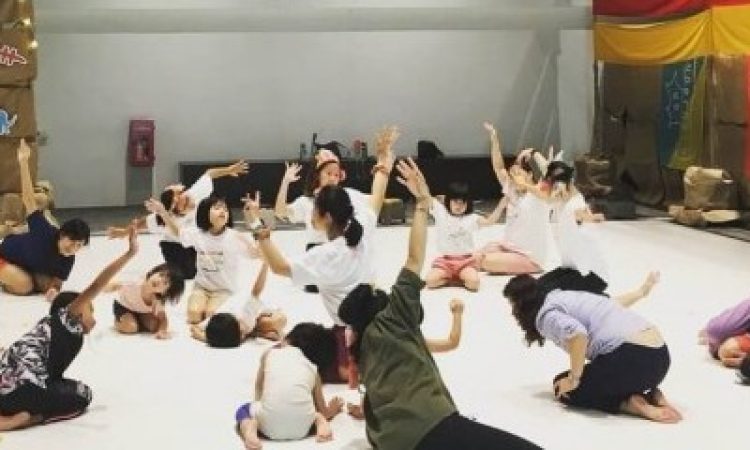
Faye Lim and Priyanka Barua, who introduced CI programs for families and children in Singapore and India respectively, also spoke about needing to thoughtfully integrate CI in communities less familiar with it, with sensitivity towards cultural expectations surrounding touch. They both found that their approach to CI could reinforce certain cultural values – the importance of family and intergenerational spaces – while also gently challenging established hierarchies. Barua, who incorporates explicit consent into her curriculum working with girls 5-14, noted that it can be liberating for girls to learn that they can say “no,” a choice that might remain underemphasized in other parts of their education. Lim described the playful inversion of family dynamics that can occur in an intergenerational contact jam as children might support the body weight of adults, and witness their elders acting “goofy” as they maneuver themselves through awkward and unusual positions.
According to Pedro Penuela, a CI practitioner and researcher in Brazil, the principles of CI also hold value as a model for political organizing. Most poignantly, he highlighted the notion of resistance, a term used equally to refer to opposing forces between physical bodies in contact and opposition to political power. Not unlike a contact jam, he noted, contemporary insurrections tend to be decentralized in their leadership and employ forms of resistance that are not necessarily direct or forceful. He also pointed to CI’s influences from Aikido, which strategizes how to defend against a larger or stronger opponent with strategic nonlinear motions. Hee postulates how this philosophy might serve grassroots organizers hoping to tackle insurmountably larger opponents like the US military, the CIA, or systemic sexism.
Without adopting illusions of utopia or universalism, I became re-convinced of the radical potential of CI. It’s one thing to hypothesize whether certain principles of movement are artistically “revolutionary,” and another to apply them in an actual political uprising. Perhaps in a time when physical contact remains precarious and systemic injustice persists, it might be less important to ask whether we can build a utopic CI space. Rather, we might ask how CI–in informing our understanding of community, hierarchy, and power–might be a tool for shaping a better world.