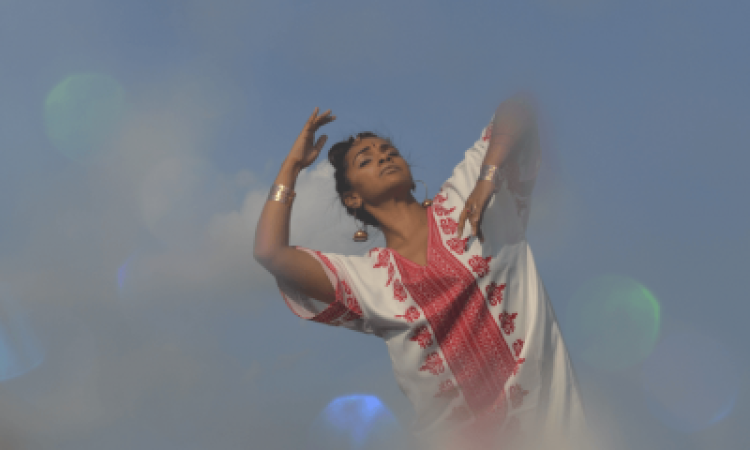
Asian and Asian American choreographers are abundantly celebrated for their visions in the 10,000 Dreams: Virtual Choreography Festival put on this May by Final Bow for Yellowface. The founders, Phil Chan and Georgina Pazcoguin, have tasked the ballet world with bringing itself into the 21st century by getting rid of orientalist stereotypes and centering real stories. Titled 10,000 because it is “the ‘biggest’ number in many Asian Languages,” the festival submissions are not restricted to ballet—instead they feature all movement styles. The festival’s content is powerful because it isn’t tangled up in trying to define Asianness for the white gaze. Rather, dance as a form is challenged to prove itself worthy of what each choreographer of Asian descent has to say through their exploration of the human condition. Each day during AAPI month, a different choreographer’s dream is released. Here is just a sampling of three out of the thirty-one dreams presented.
My spirits were immediately lifted watching Brinda Guha’s Can’t Take My Eyes Off of You, a short, bright relief of brown-skinned joy performed by Soraya Lundy, Amanda Castro, Rebecca Robinson, and Brinda Guha. Viewers are invited into a floor-to-ceiling white room by the striking, lipsticked smiles of each woman. The camera cuts to the group vibing together in the one and only rhythmic time of Lauryn Hill. These four energetic women give their all in ripped jeans and colorful flowing button-downs. The dancers begin in unison and each woman is propelled to the front of a rotating diamond formation. I’m drawn in by crisp footwork, free flowing arms, and expressive eyes. The group is tight, but each woman stands out as an individual telling a slightly different version of the story, giving us glimpses into their different dance backgrounds. Guha has dubbed her style “Contemporary Indian,” although she says “it’s still under review,” and the piece was a fortifying combination of hip hop and classical Indian shapes, facial expressions, and footwork. The piece is over before I even knew what happened (much like a dream) and in the end each woman dances an outro solo while the credits roll. I was left wanting more, but the brevity felt like an invitation for the audience to complete the dance—to be brighter, happier, and more unapologetically flirtatious.
In Robyn Mineko Williams’ Snow Angel v2, I am reminded of how long it’s been since I’ve set foot inside a theater. Not only that, but I am reminded of the warm intimacy that grows between dancer and performance space. Williams runs down the street in a golden pleated skirt with her ponytail flying behind her. She vanishes into a building as the camera follows her up a poorly-lit brick stairwell, passing a stained-glass window on the way. We find her again in an empty theater, staring at the stage from where the audience would sit. She stands poised under warm light, and begins to melt. At the center of this work is a collaboration with space. Her body sometimes reacts to and sometimes creates resonant guitar sounds with an initiation from the shoulder, carving and opening the space with her hips and arms, flinging her arm around in circles as if strumming a guitar. She and the theater are partnering. She and the videographer, Mike Gibisser, circle each other. In other moments, Williams throws herself about under unfiltered stage lights. She makes her way to a chair, where she carves commanding shapes, undulates fluidly, and eventually slinks to the floor. When she’s done, she takes the elevator down and leaves into the snow with a coat she didn’t have on when she entered. My theater dreams are usually nightmares, this one, surreal, complicated, and warm felt like the real deal.
The first moments of Caili Quan’s Love Letter, a long-distance duet between BalletX dancers Francesca Forcella and Richardo Villaverde, are some of the best, as the camera gently focuses from the background settings to the faces of the dancers against two separate skylines. On a rooftop in Center City, Philadelphia, Villaverde earnestly turns his head from right to left, sweaty and a little dirty from the roof tar, his chest calmly rising and falling as his head tilts down, reminding me that there’s nothing like the presence of a dancer. He is filled up with some memory and begins to move as if he’s testing what his hands and arms can do in this dream world. Against a stormy sunset, Forcella dances on a darkening beach embodying a raw, oceanic calm. The two of them are jerked back and forth by some invisible force, reacting urgently and tenderly to one another in their separate worlds. The piece ends with them together on the rooftop, dancing in mirrored unison but never touching. Love Letter really felt like a contemporary ballet interpretation of a dream sequence—an over the top yearning love—that can’t be consummated.
The ballet world is far too small to encapsulate the voice of choreographers of Asian descent. AAPI choreographers and dancers have the power to redefine not just ballet, but dance altogether. When you give artists complete freedom, and a prompt to dream, no form can hold that—it’s too big.
10,000 dreams: Virtual Choreography Festival culminates on May 31st with an archival screening of choreographer Choo San Goh’s “Fives,” presented by the Washington Ballet.
10,000 dreams: Virtual Choreography Festival, Final Bow for Yellowface, May 1-31st.