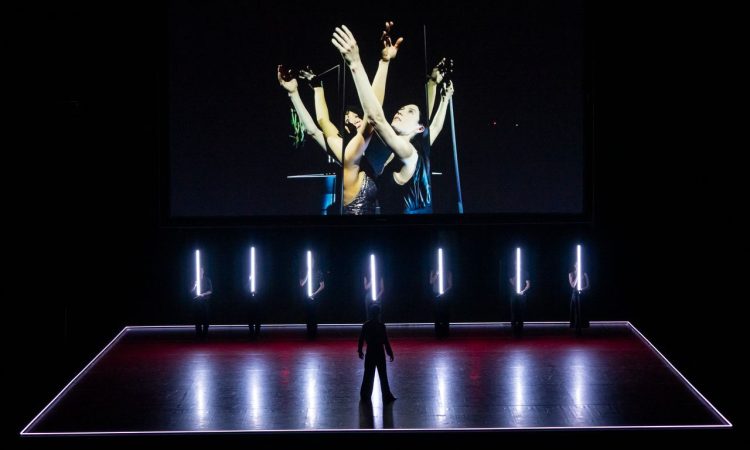
The malleable Wade Thompson Drill Hall at the Park Avenue Armory is set up like a spacious movie theater for Benjamin Millepied’s Romeo & Juliet Suite. Metal stadium seating faces a black platform stage with sides that slant down to the wooden floor. A red velvet couch sits at the center–its back to the audience–facing a large blank screen. Long, bright lightbulbs stand guard throughout the space. The site-specific dance theater work, performed by L.A. Dance Project and running through March 21, is inspired by the classic ballet, which itself is inspired by William Shakespeare’s tragic play.
Sergei Prokofiev’s orchestral masterpiece from 1935 booms on. Two people dressed in black street clothes and jazz shoes rush up a ramp onto the stage. One sits on the couch and watches the screen where a projection shows the other dancer walking off the stage, out of the hall, and into the lobby. L.A. Dance Project Associate Artistic Director Sébastien Marcovici supplies the live feed, following the dancer down the hall with a handheld camera. On screen, performers stand in the lobby next to a rack of costumes, chatting. The music swallows their words. The projection brings the audience “backstage,” breaking the fourth wall before it has even been built.
And then the screen goes blank. Attention returns to the hall as about 10 more dancers run onto the stage. They wear black pants and tops in a mix of leather, lace, mesh, and sequins. Some have pops of blue and red, differentiating the Montagues from the Capulets. (Camille Assaf’s design is stylish and effective–a clear visual reminder of who is who.) The cast spins and jetés while the screen at their backs shows a bird’s-eye view of the performance. The dual live/screen image is a fun game for the eyes; the formations–swirling, staggered–quickly become more compelling than the movements themselves.
Romeo (David Adrian Freeland Jr. for this performance) makes his appearance. Then Juliet (played by male dancer Morgan Lugo) arrives. Then they meet each other. Juliet dances a stretchy, yearning solo, clearly thinking of Romeo, while Romeo appears on screen in another room, lying on a couch and clearly thinking of Juliet. The camera turns, flipping the image on its head; Romeo now appears upside down, hanging from the couch, above Juliet. On-Stage-Juliet and On-Screen-Romeo unknowingly reach toward each other. It’s a bit too dramatic, but cool.
Many of the work’s strongest moments happen on screen. The party scene, set to the score’s most intense and recognizable section (“Dance of the Knights”), shows performers wearing black masquerade masks and dancing in a narrow, sparkly room. They lunge their faces at the camera and laugh. It’s claustrophobic and exciting. Later, Romeo and Juliet dance a duet in The Veterans Room, one of the Armory’s most beautiful spaces featuring ornate woodwork, Tiffany windows, and a teal glass-tiled fireplace. Here, the creative vision is most successful: Millepied’s choreography is simple and affectionate, the setting stunning, Simola’s videography intimate.
Another thrill awaits beneath the seats where Tybalt and Romeo fight. They run through the beams, dodging each other, and I can hear it, almost feel it, happening below and behind me, but can only see the pursuit unfold on the screen.
—
Romeo & Juliet Suite turned out to be both more and less than I expected. While I was entertained by the visual experience of watching the story onstage and onscreen simultaneously, I expected more from Millepied’s choreography. Given his credits as a former principal dancer with the New York City Ballet, former director of the world-renowned Paris Opera Ballet, and choreographer for the edgy Academy Award-winning films Black Swan (2010) and Dune (2021), Millepied’s movement vocabulary here was surprisingly uninspired. Overall, the piece was lukewarm contemporary ballet veering dangerously toward lyrical, with too much reaching and leaning. The dancers are clearly talented (Addison Ector, as Tybalt, was especially spectacular) and did what they could with the material.
Other elements excelled, though. François-Pierre Couture’s incredible, stark, cinematic lighting and scenic design gave the set a transmutative power. For instance, the thin standing bulbs, which at first stood guard around the stage, took on various roles with the performers’ help: casting shadows, creating boundaries, even signifying a vigil. And Simola’s videography (and Marcovici’s execution of it) was the pulsing heart of the work, guiding the audience throughout the space and the age-old narrative in a new way.
While many of the dance sequences fell flat, the directorial choices on blocking, tone, and scene structure were invigorating. Millepied succeeded more as a director than a choreographer with this work. Most notably, the choice to mix the genders of the lead roles (the cast rotates between female-female, male-male, and female-male pairings) was one of the show’s most interesting and memorable aspects. It was an inclusive statement on the universality of desire. Despite my disappointments, I would return again to watch the other couples fall in love.
Romeo & Juliet Suite, Benjamin Millepied and L.A. Dance Project, Park Avenue Armory, New York, March 2- 21, 2026