Hearing the words “dancer” and “choreographer” in the same sentence as “House” and “Senate” gives me whiplash as I try to understand the Protect the Right to Organize Act, or the PROAct. I find it difficult to wrap my head around government processes, and I’ve never even considered what the performing arts field would have to do with federal bills. Because the work is undervalued, underpaid, and underrepresented, these subliminal messages make dance labor feel as if it’s not “real,” and therefore, for better or worse, it has no overlap with what’s sliding across the President’s desk. DANC is emerging into the consciousness of many dance artists, teaching us that this does not have to be the way.
Dance Artists’ National Collective (DANC) is a group of freelance dancers organizing the field for better labor practices, dancers’ rights, and standards that respect their first guiding principle: “Dancers are Workers.” So often in the dance world, dancers’ talents are exploited under the guise of “opportunity” for the artist, a lifestyle only possible for those that can work for free—those who have the privileges of inherited wealth, no dependents, and/or the ability to work a full time job (on top of a dance practice too? where’s your rest?!).
DANC consists of an ever-morphing group of dancers advocating for all-around better practices in the field, with a guiding intention to create justice-based equity for dancers most impacted by systems of oppression. Megan Wright, a volunteer, speaks to DANC’s community-based structure in an interview with thINKingDANCE from last May. Since then, DANC has published a series of DANConversations, campaigned for Immigrant Dancer Awareness, drafted a contract toolkit for freelance dancers, and created audition guidelines for employers.
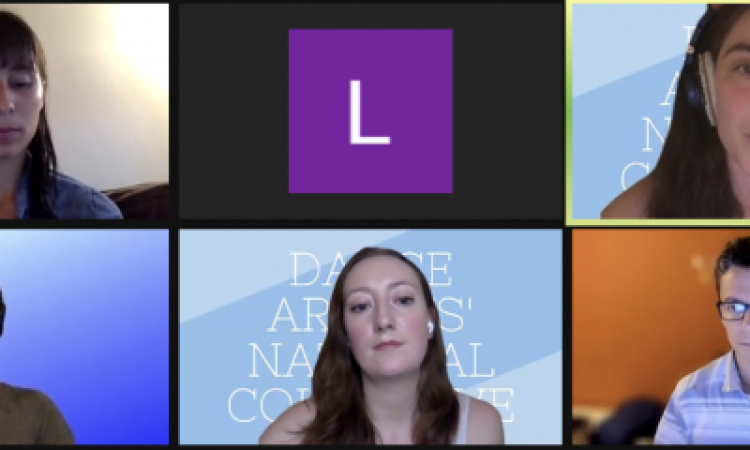
On Tuesday, June 22 I joined a Zoom meeting about DANC’s support of the PROAct facilitated by Rebecca Margolick and Garnet Henderson with speakers Griff Braun, the Director of Organizing and Outreach at AGMA, and Phillip Golub, a member of the Music Workers’ Alliance. Together, they explained unionizing, the PROAct, and how it would benefit freelance dancers.
The PROAct would be the first pro-worker amendment to the National Labor Relations Act since the late 1940s. Passed in the House in March, only 3 votes away in the Senate, and with monumental support from President Biden, the PROAct would protect group bargaining for conditions of employment. So, as a hired dancer, instead of accepting inaccessible studios, late-night hours, and severe underpayment, you would be able to garner collective pressure to demand that your needs are met. Dancers would be protected in forming unions that not only advocate for living wages, but also for workplace safety like pro-Black practices, access needs met, and queer and trans competency.
My one hesitation going into the meeting was about choreographers, dancers’ direct employers, who are similarly underfunded and without much power themselves. After all, many small choreographers float between the roles of dancer, performer, and director from project to project, grasping for just enough funding to get their piece off the ground. Today, it is only legal for employees to strike against their direct employers, creating a dead end in this scenario. But, under the PROAct, workers would be protected in secondary boycott, making it possible for dancers and choreographers to collectivize and go directly to the presenting theater, or foundation, or nonprofit—wherever the money starts—to meet their demands. Wherever the exploitation begins is where the union could legally target.
DANC emphasized how these shifts would benefit the freelance dancer, but also how important it is for arts workers to stand in solidarity with the most marginalized laborers in this country. I learned the PROAct would support immigrant workers, regardless of documentation status, in gaining legal protection to organize against a harmful employer and report unlawful firings. This would be a remarkable change for immigrant safety in the United States. I learned the PROAct is supported by workers from Uber, Lyft, and DoorDash who would, as independent contractors, be protected to unionize and advocate to their corporate employers. As undervalued laborers, it is essential that dancers partner with workers across fields to co-create new labor standards.
To support the PROAct, DANC recommends writing a letter to your senators, especially those living in Arizona, Virginia, or Alaska. You can also talk to your artist friends about the PROAct and get your communities ready for more equitable workplaces in the future!
To watch the full meeting with captions, visit DANC’s YouTube. It’s easy and free to join DANC as a member and further dance worker advocacy. Submit this Google Form and visit their website for more info. To get the most up-to-date announcements, follow DANC’s Instagram.
DANC PRO Act Information Session for Dancers, Dance Artists’ National Collective, Zoom, June 22.