OhOk’s contemporary dance film offers portraits of illusion and collapse from dance artists based in Berlin. These works follow themes of dreaming and drifting through a discomforting un/reality.
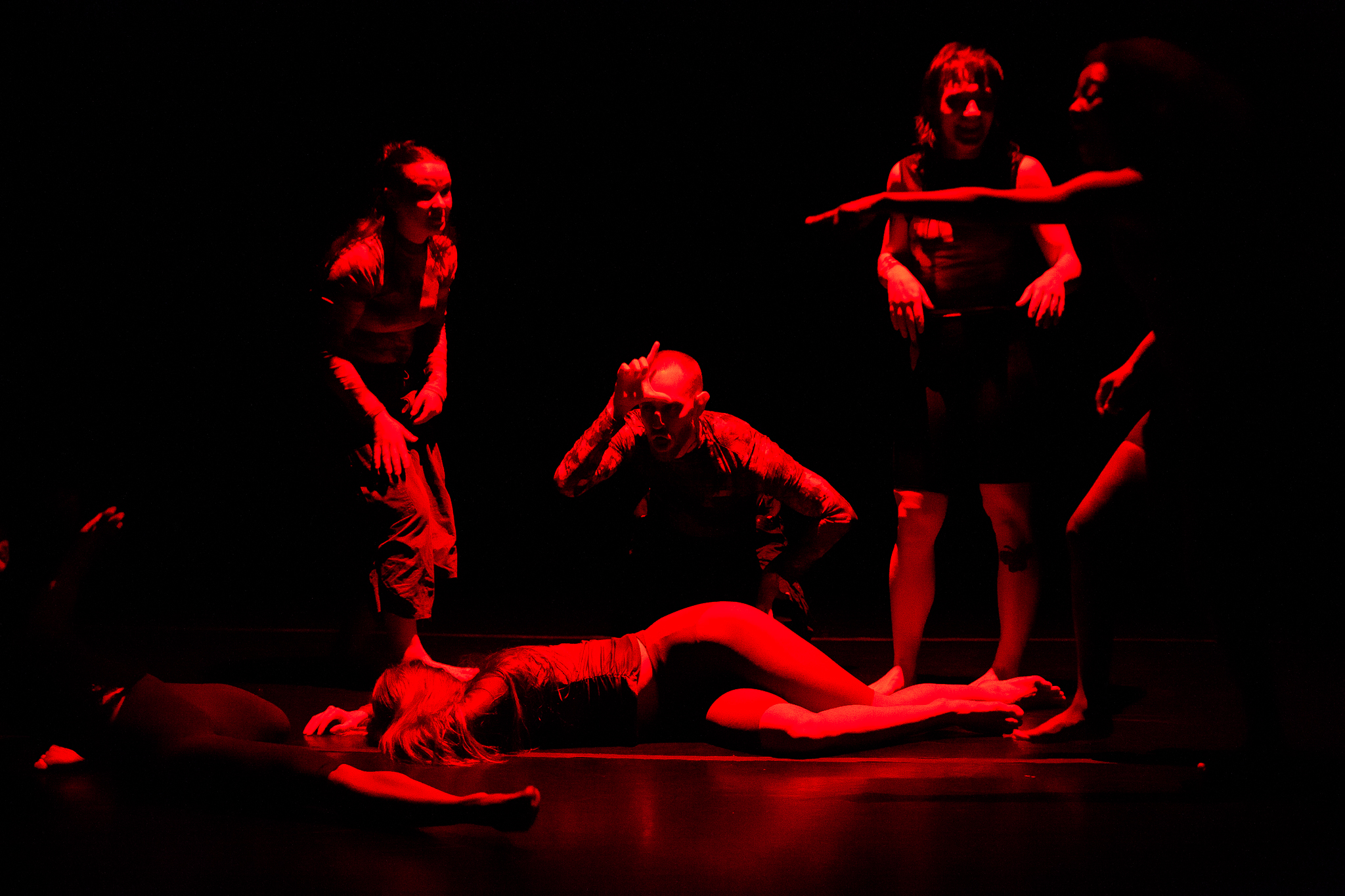
Britt Davis is a pair of legs that flirt, lunge, tiptoe, and twirl to a bossa nova standard. “Act Natural” features a long gray ball gown suspended from the ceiling, obscuring all but her lower half. As the music quiets, a hand reaches up, impossibly high, up through the collar of the dress. Something slides beneath the hem. And the body falls out, panic red, to the ground.
In “June,” Anna Rose leans face-first into the black curtained wall, an arm extended up while the other hangs loosely against a pink satin robe. There’s a long silence. Is she breathing? Then she crumples, deflated, down the wall. Arms and legs give out beneath the strain of a “woman’s” role.
Sofi Seta dances “Transition” as she careens off a chair and into nightmare. Her hands manipulate invisible machinery, diving, cutting, whipping air. A voice recounts a “monstrous shape,” a slight twitch of the head causes shivers. She jerks forward toward unseen terrors.
In “Now and Not Yet,” Whitney Casal loops gently from air to floor and up again, torso twisting around and around, as if pacing. She shifts her weight with thoughtful curiosity, following ideas to their full extent until she loses momentum, stares into space. She lies down and lifts herself, slowly, on one arm. Waiting.
Each section of OhOk’s dance film begins with a brief introduction from the artist, interspersed with rehearsal footage. They offer a glimpse into the creators’ process and intentions, each affected by the pandemic.
In her preview, Davis shared what she misses from live performance. “We don’t get to have the laugh, the absolute pure silence…,” she says. “I hope the audience has a little giggle …or finds themselves breathless.”
shared spaces | distant voices, OhOk Performance Group, Philadelphia Fringe (virtual), Sep. 6 – Oct. 4.